
New ventilation system installation
IAQ & Ventilation Solutions
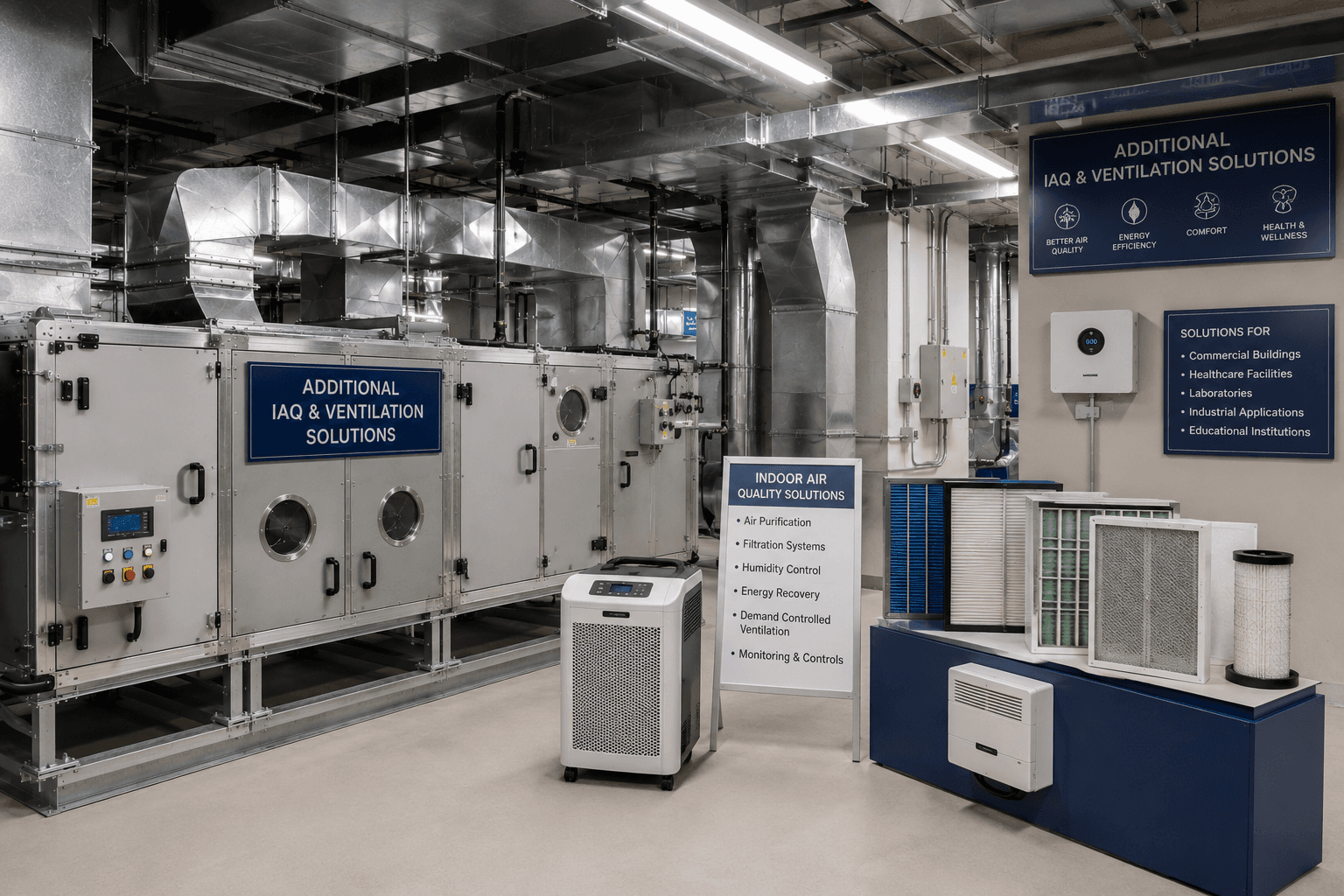
Additional IAQ & Ventilation Solutions
Zenvent Engineering provides comprehensive Additional IAQ & Ventilation Solutions for commercial buildings, industrial facilities, hospitals, laboratories, hotels, offices, residential properties, warehouses, basements, kitchens, car parks and other occupied or enclosed environments.
Our solutions are designed to improve indoor air quality, control airborne contaminants, introduce adequate fresh air and remove stale, polluted or process-generated air. Each system is developed according to the building layout, occupancy, contaminant levels, airflow requirements and operational conditions.
Our indoor air quality and ventilation services include:
Indoor air quality monitoring
IAQ monitoring systems
Air quality sensors
CO2 monitoring systems
PM2.5 and PM10 monitoring
VOC monitoring systems
Humidity and temperature monitoring
Fresh-air ventilation
Exhaust ventilation
Supply ventilation
Balanced ventilation systems
Demand-controlled ventilation
Energy-recovery ventilators
Heat-recovery ventilators
Mechanical ventilation with heat recovery
Air purification systems
HEPA filtration
Activated-carbon filtration
UVGI air purification
Germicidal UV systems
Negative-pressure ventilation
Kitchen and toilet exhaust systems
Basement and car park ventilation
Staircase and lift-well pressurization
Smoke-extraction systems
Industrial exhaust ventilation
Smart controls and BMS integration
Zenvent Engineering works as an indoor air quality and ventilation solutions contractor, providing assessment, system design, equipment selection, installation, testing, air balancing, commissioning, retrofit and maintenance services.
Introduction to IAQ and Ventilation Services
Indoor air quality depends on the cleanliness, temperature, humidity and freshness of the air inside a building. Poor air circulation can allow carbon dioxide, dust, smoke, odours, moisture, volatile organic compounds and other contaminants to accumulate.
A suitable ventilation system continuously replaces or dilutes contaminated indoor air. Depending on the application, the system may introduce filtered outdoor air, extract stale air or maintain a controlled balance between supply and exhaust airflow.
Zenvent Engineering develops customised ventilation solutions for both comfort and process applications. Our systems can be integrated with HVAC heating systems, air-conditioning equipment, air purification systems and building management systems.
Our services cover:
Existing ventilation system improvement
Indoor air quality assessment
Fresh-air and exhaust-air balancing
Air purification integration
Real-time IAQ monitoring
Energy-recovery ventilation
Ventilation maintenance services
System testing and commissioning
What Is Indoor Air Quality?
Indoor air quality describes the condition of the air within an occupied or enclosed space.
It is affected by several factors, including:
Outdoor-air quality
Fresh-air quantity
Building occupancy
Carbon dioxide levels
Dust and particulate matter
Volatile organic compounds
Smoke
Odours
Temperature
Relative humidity
Microbial contaminants
Cleaning chemicals
Building materials
Process emissions
Ventilation performance
An effective indoor air quality system monitors these conditions and maintains suitable ventilation according to actual requirements.
Zenvent Engineering provides commercial IAQ system installation services for offices, hospitals, laboratories, hotels, educational buildings, industrial facilities and other occupied environments.
Why Indoor Air Quality Matters
Poor indoor air quality can affect occupant comfort, concentration, productivity, equipment cleanliness and building performance.
Insufficient ventilation may contribute to:
Stale indoor air
High carbon dioxide levels
Persistent odours
Excess humidity
Condensation
Fine-particle accumulation
Smoke circulation
Uneven temperatures
Poor air movement
Increased dust deposits
Reduced occupant comfort
Industrial and process environments may also generate fumes, heat, dust and vapours that require specialised industrial ventilation solutions.
Zenvent Engineering develops energy-efficient indoor air quality solutions that balance ventilation performance, air cleanliness and energy consumption.
Common Indoor Air Pollutants
Different indoor spaces produce different contaminants. The ventilation and air-purification system must therefore be designed according to the actual pollution source.
01
Carbon Dioxide
Carbon dioxide increases when occupied rooms do not receive sufficient fresh air. A CO2 monitoring system can help determine whether ventilation is adequate for current occupancy.
02
PM2.5 and PM10 Particles
PM2.5 and PM10 include fine airborne dust, smoke and other small particles. These contaminants may enter from outdoors or be generated indoors.
03
Volatile Organic Compounds
VOCs may be released from paints, furnishings, cleaning products, adhesives, manufacturing processes and chemicals.
04
Smoke and Combustion Contaminants
Smoke may originate from cooking, industrial activities, vehicles, generators or other combustion sources.
05
Excess Humidity
High humidity can contribute to condensation, odours and microbial growth. Humidity monitoring helps identify conditions requiring ventilation or dehumidification.
06
Odours
Odours may be generated by kitchens, toilets, basements, waste areas, chemicals and industrial processes.
07
Process Dust and Fumes
Industrial facilities may require local extraction and mechanical ventilation to control dust, heat, smoke and fumes near the source.
How Ventilation Improves Indoor Air Quality
Ventilation improves indoor air quality by introducing fresh outdoor air and removing stale or contaminated indoor air.
A properly designed air ventilation solution can:
Dilute carbon dioxide
Remove odours
Control humidity
Reduce airborne contaminant levels
Replace exhausted air
Support indoor temperature control
Maintain room pressure
Improve air circulation
Reduce stagnant zones
Support air purification systems
The appropriate system may use supply ventilation, exhaust ventilation, balanced ventilation or demand-controlled ventilation.
Zenvent Engineering selects the system according to occupancy, room use, contamination level, exhaust requirements and available HVAC infrastructure.
Indoor Air Quality Assessment
An indoor air quality assessment helps identify the causes of poor ventilation and indoor air complaints.
Zenvent Engineering provides indoor air quality testing and assessment services that may include:
Carbon dioxide measurement
PM2.5 monitoring
PM10 monitoring
VOC monitoring
Temperature measurement
Humidity measurement
Airflow measurement
Fresh-air quantity checks
Exhaust-air measurement
Room-pressure checks
Ventilation equipment inspection
Filter-condition inspection
The collected information is used to determine whether the existing ventilation system requires adjustment, cleaning, balancing, filtration upgrades or equipment replacement.
Real-Time IAQ Monitoring Systems
A real-time IAQ monitoring system continuously measures indoor environmental conditions.
The system may monitor:
Carbon dioxide
PM2.5
PM10
VOC levels
Temperature
Relative humidity
Air pressure
Occupancy
Ventilation status
Real-time IAQ monitoring for commercial buildings helps facility teams identify poor air conditions before they become persistent.
An IAQ monitoring system may provide:
Live readings
Historical trends
Warning notifications
High-CO2 alerts
Humidity alerts
Particulate alerts
Equipment status
BMS communication
Data reporting
Zenvent Engineering provides indoor air quality monitoring system installation for offices, educational buildings, hotels, hospitals and commercial facilities.
Air Quality Sensors
Air quality sensors are installed at suitable locations to measure indoor environmental conditions.
Sensor selection depends on:
Room function
Occupancy
Contaminant type
Monitoring range
Control requirements
BMS compatibility
Required accuracy
Sensors may be wall-mounted, duct-mounted or installed inside ventilation equipment.
Zenvent Engineering integrates air quality sensors with ventilation controls, alarms, dashboards and building management systems.
CO2 Monitoring Systems
A CO2 monitoring system measures carbon dioxide levels inside occupied spaces.
High CO2 readings may indicate:
Insufficient fresh air
High occupancy
Poor air circulation
Closed dampers
Fan problems
Blocked filters
Inadequate ventilation design
A CO2 and VOC monitoring system for offices can help regulate fresh-air supply according to actual occupancy and air-quality conditions.
CO2 sensors can also be connected to a demand-controlled ventilation system to increase or reduce outdoor-air supply automatically.
PM2.5 and PM10 Monitoring
PM2.5 monitoring measures very fine airborne particles, while PM10 monitoring measures larger inhalable particles.
Particulate monitoring is suitable for:
Commercial buildings
Hospitals
Schools
Laboratories
Hotels
Industrial facilities
Buildings near roads
High-pollution locations
A PM2.5 indoor air quality monitoring system can be connected to air purifiers, filtration units or fresh-air systems.
Zenvent Engineering evaluates particulate readings together with ventilation performance and filtration efficiency.
VOC Monitoring Systems
A VOC monitoring system measures airborne volatile organic compounds.
VOC monitoring may be required in:
Offices
Laboratories
Manufacturing areas
Printing facilities
Chemical storage areas
Renovated buildings
Healthcare environments
Workshops
When VOC levels increase, the ventilation system may increase fresh-air supply or activate dedicated extraction equipment.
Activated-carbon filtration can also be installed for odour and VOC control.
Humidity and Temperature Monitoring
Humidity and temperature monitoring are important for both comfort and building protection.
Excessive humidity can contribute to:
Condensation
Dampness
Odours
Material deterioration
Reduced comfort
Microbial growth
Low humidity can also cause discomfort and affect certain materials or processes.
Zenvent Engineering provides temperature and humidity sensors that can be integrated with ventilation, heating and cooling HVAC systems.
Fresh-Air Ventilation Systems
A fresh-air ventilation system introduces outdoor air into an occupied or enclosed space.
The system may include:
Outdoor-air intake
Intake louvre
Fresh-air fan
Air filters
Motorised damper
Fresh-air ductwork
Supply grilles
Airflow controls
IAQ sensors
BMS integration
Zenvent Engineering provides fresh air ventilation system installation for commercial, industrial and residential applications.
Fresh-air ventilation can be combined with air purification, cooling, heating, dehumidification or heat recovery.
Supply Ventilation Systems
A supply ventilation system uses a fan to introduce filtered outdoor air into the building.
This creates a controlled supply of fresh air and may produce slight positive pressure inside the space.
Supply ventilation is suitable for:
Offices
Apartments
Basements
Commercial buildings
Clean areas
Warehouses
Utility rooms
A fresh-air fan and duct ventilation system must be correctly sized to prevent excessive noise, drafts or pressure.
Exhaust Ventilation Systems
An exhaust ventilation system removes contaminated, humid or stale air from a building.
Typical applications include:
Toilets
Bathrooms
Kitchens
Basements
Car parks
Laboratories
Workshops
Industrial process areas
Waste rooms
The removed air must be replaced by controlled fresh air to prevent excessive negative pressure.
Zenvent Engineering provides industrial exhaust ventilation system installation and general exhaust solutions for commercial buildings.
Balanced Ventilation Systems
A balanced ventilation system uses both supply and exhaust fans.
The fresh-air supply and exhaust-air quantities are adjusted to maintain suitable building pressure and airflow.
Balanced ventilation can provide:
Controlled fresh-air delivery
Controlled exhaust removal
Improved pressure stability
Better airflow distribution
Heat-recovery compatibility
Improved IAQ control
Zenvent Engineering provides fresh-air and exhaust-air balancing services to ensure that both airflow systems operate together correctly.
Demand-Controlled Ventilation
Demand-controlled ventilation adjusts fresh-air supply according to actual indoor conditions.
A DCV system may use:
CO2 sensors
VOC sensors
Occupancy sensors
Humidity sensors
Temperature sensors
Variable-speed fans
Motorised dampers
Smart controllers
A CO2-based demand-controlled ventilation system increases fresh air when occupancy or CO2 levels rise and reduces airflow when demand is low.
Benefits may include:
Improved indoor air quality
Reduced unnecessary ventilation
Lower heating and cooling loads
Improved energy efficiency
Automatic response to occupancy
Better control of indoor conditions
Zenvent Engineering provides demand-controlled ventilation system installation for offices, meeting rooms, schools, commercial facilities and other variable-occupancy spaces.
Energy-Recovery Ventilation Systems
An energy-recovery ventilator transfers energy between outgoing exhaust air and incoming outdoor air.
An ERV system can reduce the heating, cooling and dehumidification load created by fresh-air ventilation.
An ERV system for commercial buildings may include:
Supply fan
Exhaust fan
Energy-recovery wheel or core
Air filters
Bypass dampers
Temperature sensors
Humidity sensors
Automatic controls
Zenvent Engineering works as an energy-recovery ventilation system contractor, providing design, installation, air balancing and commissioning.
Energy recovery must be carefully selected for applications where cross-contamination between supply and exhaust air must be limited.
Heat-Recovery Ventilation Systems
A heat-recovery ventilator transfers sensible heat between exhaust air and fresh air.
An HRV system can reduce heating or cooling demand while maintaining continuous ventilation.
Heat-recovery ventilation system installation is suitable for:
Offices
Apartments
Homes
Hotels
Educational buildings
Commercial facilities
Healthcare buildings
HRV home solutions and HRV solutions for commercial properties can improve fresh-air ventilation without allowing all conditioned-air energy to be discharged outdoors.
Mechanical Ventilation with Heat Recovery
Mechanical ventilation with heat recovery uses controlled supply and exhaust fans together with a heat exchanger.
An MVHR system generally includes:
Supply-air fan
Exhaust-air fan
Heat exchanger
Air filters
Supply ducts
Extract ducts
Air valves
Controls
Bypass function
An MVHR ventilation system is commonly used in well-sealed residential and commercial buildings.
Zenvent Engineering provides mechanical ventilation with heat recovery systems designed according to occupancy, room layout and airflow requirements.
Air Purification Systems
An air purification system improves indoor air quality by removing or controlling airborne contaminants.
Air purification technologies may include:
HEPA filtration
Activated-carbon filtration
UVGI air purification
Germicidal UV systems
Electrostatic filtration
Air scrubbers
Fine-particle filtration
An air purification system HVAC arrangement can be installed inside ductwork, air handling equipment or as a separate recirculation system.
Zenvent Engineering provides HEPA air purification systems for commercial spaces, healthcare environments, offices and industrial applications.
HEPA Filtration
HEPA filtration is used where high-efficiency airborne particle removal is required.
HEPA filters can help control:
Fine dust
Smoke particles
Pollen
Airborne microorganisms
Process particles
Other fine contaminants
HEPA filtration may be installed in:
Air handling units
Fresh-air systems
Air scrubbers
Negative-air machines
Terminal filter housings
Dedicated purification units
The available fan capacity and pressure drop must be evaluated before adding HEPA filters to an existing HVAC system.
Activated-Carbon and Odour Control
Activated-carbon filtration is used to reduce odours and certain gaseous contaminants.
Applications include:
Kitchens
Toilets
Waste rooms
Laboratories
Offices
Industrial facilities
Smoking areas
Basement spaces
Process exhaust systems
Activated-carbon filtration for odour and VOC control is normally installed after suitable particle filtration.
Zenvent Engineering selects the carbon media according to contaminant type, airflow volume and required contact time.
UVGI and Germicidal Air Treatment
UVGI air purification uses germicidal ultraviolet energy to support microbial control inside HVAC and ventilation systems.
A germicidal UV system may be installed:
Inside air handling units
Near cooling coils
In supply-air ducts
In return-air ducts
Inside air purification equipment
A UVGI air-cleaning system for HVAC must be selected according to airflow velocity, exposure time, lamp output and installation location.
UVGI supports microbial control but does not replace particle filtration or outdoor-air ventilation.
Air Scrubber Systems
An air scrubber removes airborne contaminants from indoor or process air.
Depending on the application, it may include:
Pre-filters
Fine filters
HEPA filters
Activated-carbon filters
Chemical filtration media
Fans
Air-quality sensors
Air scrubbers are suitable for:
Renovation areas
Industrial facilities
Laboratories
Healthcare environments
Dust-control zones
Odour-control applications
Zenvent Engineering provides fixed and project-specific air scrubber solutions according to the contamination source and required airflow.
Negative-Air Machines
A negative-air machine removes air from a controlled area while filtering the extracted air.
It is commonly used for:
Isolation areas
Containment zones
Renovation projects
Dust-control spaces
Healthcare applications
Temporary negative-pressure rooms
A negative-air machine may contain pre-filters, HEPA filters, a fan and airflow controls.
Zenvent Engineering can integrate negative-air equipment with temporary or permanent exhaust ductwork.
Negative-Pressure Ventilation
A negative-pressure ventilation system removes more air from a room than it supplies.
This creates inward airflow and helps prevent contaminants from spreading into adjacent areas.
Applications include:
Laboratories
Isolation rooms
Toilets
Waste areas
Chemical rooms
Industrial process spaces
Contaminated zones
Zenvent Engineering provides negative-pressure ventilation system installation with supply-air control, exhaust fans, pressure monitoring and airflow balancing.
Kitchen Ventilation Systems
A kitchen ventilation system removes heat, smoke, grease particles, steam and cooking odours.
Commercial kitchen ventilation may include:
Exhaust hood
Grease filters
Exhaust fan
Fresh-air fan
Make-up air
Ductwork
Activated-carbon filtration
Smoke filtration
Odour-control equipment
Zenvent Engineering provides kitchen ventilation solutions for restaurants, hotels, food courts, commercial kitchens and institutional facilities.
The system is designed according to hood dimensions, cooking load, exhaust volume and available replacement air.
Residential Kitchen Ventilation Solutions
Residential kitchen ventilation solutions may include extractor fans, cooker-hood ducts, wall fans and fresh-air replacement.
Common extractor fan problems and solutions include:
Blocked filters
Grease accumulation
Undersized ductwork
Excessive duct bends
Weak fan performance
Missing replacement air
Damaged backdraft dampers
Incorrect discharge locations
Zenvent Engineering evaluates the complete airflow path rather than replacing the fan without identifying the cause of poor extraction.
Toilet Exhaust Systems
A toilet exhaust system removes odours and humid air while maintaining negative pressure relative to adjacent occupied spaces.
A complete system may include:
Exhaust grilles
Branch ducts
Main exhaust duct
Exhaust fan
Backdraft damper
Volume-control dampers
Fresh-air transfer
Automatic controls
Zenvent Engineering provides kitchen and toilet exhaust ventilation contractor services for offices, hotels, hospitals, residential buildings and commercial properties.
Bathroom Ventilation Solutions
Bathroom ventilation solutions help remove steam, humidity and odours.
A system may use:
Ceiling exhaust fans
Wall-mounted exhaust fans
Inline exhaust fans
Ducted extraction
Humidity sensors
Timer controls
Fresh-air transfer grilles
For properties with no exhaust fan in the bathroom, the solution may involve installing a wall, ceiling or inline fan connected to an external discharge point.
Ventilation solutions for windowless rooms require a mechanical airflow path because natural ventilation may be unavailable.
Exhaust Fan Cleaning Solutions
Dust, grease and debris can reduce exhaust-fan airflow and increase noise.
A professional exhaust fan cleaning solution may include:
Fan-blade cleaning
Motor inspection
Grille cleaning
Filter cleaning
Duct inspection
Backdraft-damper cleaning
Airflow testing
Cleaning alone may not correct poor ventilation if the fan is undersized or the duct system is restrictive.
Zenvent Engineering provides inspection, maintenance and performance testing for exhaust systems.
Basement Ventilation
Basements often have limited natural airflow and may experience dampness, odours and stale air.
A basement ventilation system may include:
Fresh-air intake
Supply fan
Exhaust fan
Humidity sensors
Dehumidification
Air filters
Duct ventilation
Automatic controls
A basement and confined-space ventilation system must be designed to avoid uncontrolled moisture entry and excessive negative pressure.
Zenvent Engineering provides basement ventilation for residential, commercial and utility spaces.
Apartment Ventilation Solutions
Apartment ventilation solutions must manage fresh air, bathroom exhaust, kitchen extraction and pressure between rooms.
A suitable apartment system may include:
Individual exhaust fans
Central exhaust ventilation
Balanced ventilation
MVHR systems
HRV systems
Fresh-air wall units
Transfer-air grilles
Air-quality sensors
Zenvent Engineering evaluates the available duct routes, façade openings, building restrictions and existing HVAC systems before recommending a solution.
Attic Ventilation Solutions
Attic ventilation solutions help control heat and moisture accumulation in roof spaces.
Possible systems include:
Natural intake vents
Roof exhaust vents
Powered exhaust fans
Ridge ventilation
Soffit ventilation
Temperature-controlled fans
Humidity-controlled fans
Natural ventilation solutions may be sufficient where suitable intake and exhaust openings are available.
Mechanical attic ventilation may be required where natural airflow is inadequate.
Home Ventilation Solutions
Home vent solutions can improve air circulation in tightly sealed properties.
Residential systems may include:
Fresh-air fans
Extractor fans
HRV systems
ERV systems
MVHR systems
Balanced ventilation
Bathroom extraction
Kitchen ventilation
Basement ventilation
Air purification
Zenvent Engineering develops residential air vent solutions according to the property layout, occupancy and existing heating and cooling HVAC systems.
Dryer Vent Solutions
Dryer vent solutions are designed to discharge warm, moisture-laden air safely outdoors.
Common dryer-vent issues include:
Lint accumulation
Long duct routes
Excessive bends
Damaged ducts
Restricted discharge grilles
Poorly sealed joints
Condensation
Regular inspection and cleaning help maintain airflow and reduce drying time.
The duct material, route and external termination must be suitable for the appliance and installation conditions.
Heat Vent Under Bed Solutions
Furniture can restrict warm-air circulation when a floor or wall heating vent is positioned beneath a bed.
A heat vent under bed solution may include:
Vent extenders
Low-profile duct extensions
Air deflectors
Furniture repositioning
Additional return-air paths
Grille relocation
The solution must maintain adequate airflow and avoid excessive resistance to the HVAC heating system.
Windowless-Room Ventilation
Ventilation solutions for windowless rooms normally require mechanical supply or exhaust airflow.
Possible arrangements include:
Inline exhaust fan
Ducted supply fan
Transfer-air grille
Balanced ventilation
Fresh-air wall unit
Air purifier
CO2-controlled ventilation
An air purifier alone does not introduce fresh air. A suitable ventilation path is still required to control carbon dioxide and replace stale air.
Natural Ventilation Solutions
Natural ventilation uses wind pressure and temperature differences to move air without mechanical fans.
Natural ventilation solutions may include:
Openable windows
Wall vents
Roof vents
Louvres
Stack ventilation
Cross ventilation
Natural ventilation depends on outdoor conditions and building layout. It may not provide consistent airflow in enclosed, high-occupancy or polluted environments.
Zenvent Engineering evaluates whether natural ventilation is suitable or whether mechanical ventilation is required.
Car Park Ventilation
Car park ventilation removes vehicle emissions, heat and smoke from enclosed parking areas.
A system may include:
Supply fans
Exhaust fans
Jet fans
Carbon monoxide sensors
Nitrogen dioxide sensors
Smoke-extraction fans
Control panels
Variable-speed drives
Zenvent Engineering provides car park ventilation and smoke-extraction systems for basements, podium parking and enclosed parking structures.
The system may operate according to pollutant sensors during normal conditions and emergency controls during a fire event.
Smoke Extraction and Emergency Ventilation
A smoke-extraction system removes smoke from a building during an emergency.
The system may include:
Smoke-extraction fans
Fire-rated ductwork
Smoke-control dampers
Make-up air openings
Control panels
Fire-alarm integration
Emergency power arrangements
Smoke extraction must be coordinated with staircase pressurization, lift-well pressurization and building fire-safety systems.
Zenvent Engineering provides system installation, airflow testing and commissioning according to approved project requirements.
Staircase Pressurization
A staircase pressurization system supplies air into an escape staircase to reduce smoke entry during a fire.
The system may include:
Pressurization fan
Fresh-air intake
Fire-rated ductwork
Pressure-relief damper
Differential-pressure sensors
Automatic controls
Fire-alarm integration
Correct airflow and pressure are essential to reduce smoke entry while allowing doors to remain operable.
Zenvent Engineering provides staircase and lift-well pressurization system installation, testing and air balancing.
Lift-Well Pressurization
Lift-well pressurization supplies air into a lift shaft or lobby according to the project’s smoke-control design.
The system may include:
Pressurization fans
Motorised dampers
Pressure sensors
Relief openings
Fire-alarm controls
Emergency power interfaces
Lift-well systems must be coordinated with smoke extraction and building pressure conditions.
Industrial Ventilation Solutions
Industrial ventilation controls heat, dust, fumes, smoke, odours and process contaminants.
An industrial system may include:
Industrial exhaust fans
Fresh-air fans
Local extraction
General exhaust
Make-up air
Air scrubbers
Filtration equipment
Duct ventilation systems
Process hoods
Automatic controls
Zenvent Engineering works as an industrial ventilation system contractor in India, providing system design, equipment selection, installation and commissioning.
Warehouse Ventilation Systems
Warehouses can accumulate heat, dust and stagnant air, especially in large enclosed areas.
A warehouse ventilation system may include:
Roof exhaust fans
Wall exhaust fans
Fresh-air louvres
Supply fans
HVLS fans
Natural ventilation openings
Temperature sensors
Air-quality sensors
Zenvent Engineering provides warehouse ventilation system installation according to building size, storage conditions, occupancy and heat load.
Industrial Exhaust Fans
An industrial exhaust fan removes heat, fumes, dust or contaminated air from industrial spaces.
Fan selection depends on:
Airflow volume
Static pressure
Contaminant type
Air temperature
Duct resistance
Operating hours
Installation location
Noise requirements
Zenvent Engineering selects axial, centrifugal, roof-mounted or wall-mounted fans according to the application.
Smart Controls and BMS Integration
A smart BMS-integrated ventilation system allows central monitoring and automatic control.
The BMS may monitor:
CO2 levels
VOC levels
PM2.5 levels
Temperature
Humidity
Fan status
Filter pressure drop
Damper position
Airflow
System alarms
BMS-integrated ventilation can automatically adjust fan speed and damper position according to occupancy and air-quality conditions.
Zenvent Engineering integrates ventilation equipment, air quality sensors and automatic controls into a coordinated system.
HVAC and Ventilation Integration
Ventilation must be coordinated with the HVAC heating system and cooling equipment.
Introducing outdoor air affects:
Cooling load
Heating load
Humidity
Room pressure
Air distribution
Energy consumption
Zenvent Engineering integrates ventilation with HVAC cooling solutions, aircon HVAC solutions and combined HVAC and heating systems.
An air purification system HVAC arrangement can also be added to improve filtration without disrupting the required airflow.
System Design and Airflow Calculation
A reliable ventilation system begins with accurate airflow calculation.
Zenvent Engineering considers:
Room volume
Occupancy
Fresh-air requirements
Exhaust-air requirements
Heat load
Moisture load
Contaminant generation
Duct pressure loss
Required room pressure
Noise limits
Equipment locations
Operating schedule
The final system may use fixed airflow, variable airflow or demand-controlled ventilation.
Ventilation System Installation
Zenvent Engineering works as a turnkey IAQ and ventilation system contractor.
Our installation services may include:
Fresh-air fan installation
Exhaust-fan installation
Ductwork installation
Air grille installation
Damper installation
IAQ sensor installation
Air purifier installation
Filter installation
Heat-recovery unit installation
Control-panel installation
BMS integration
Electrical coordination
Every installation is planned to provide suitable maintenance access and reliable airflow.
Testing, Commissioning and Air Balancing
Ventilation system testing and commissioning confirm that the installed equipment operates according to the design requirements.
Testing may include:
Fan-operation checks
Airflow measurement
Fresh-air measurement
Exhaust-air measurement
Duct-pressure checks
Room-pressure checks
Sensor calibration
Control-sequence testing
Alarm testing
Filter pressure-drop checks
Noise assessment
BMS communication checks
Zenvent Engineering also provides HVAC airflow testing and balancing services for new and existing systems.
Ventilation Maintenance Services
Regular maintenance helps preserve airflow, indoor air quality and equipment performance.
Maintenance may include:
Filter replacement
Fan cleaning
Fan-belt inspection
Motor checks
Grille cleaning
Duct inspection
Damper inspection
Sensor calibration
Heat-exchanger cleaning
Drain inspection
Airflow measurement
Control-system checks
Zenvent Engineering provides planned ventilation maintenance services for commercial, residential and industrial systems.
Existing Ventilation System Retrofit and Upgrade
Existing systems may provide insufficient airflow or consume more energy than necessary.
Zenvent Engineering provides existing ventilation system retrofit and upgrade services, including:
Fan replacement
Variable-speed controls
Demand-controlled ventilation
Heat-recovery integration
Energy-recovery installation
Additional filtration
HEPA filtration
Activated-carbon filtration
UVGI integration
IAQ monitoring
BMS integration
Ductwork modifications
Air balancing
Commercial building ventilation improvement services can enhance air quality without requiring complete replacement of the existing HVAC system.
Specialised Ventilator System Assessment
Zenvent Engineering can assess existing branded or packaged ventilation equipment as part of a wider system evaluation.
Systems associated with Maxxair ventilation solutions, HRV home solutions or a Master Climate Solutions ventilator may require assessment of:
Equipment condition
Filter availability
Airflow performance
Duct connections
Control compatibility
Installation quality
Maintenance access
The complete ventilation path must be evaluated rather than reviewing the equipment alone.
Applications and Industries Served
Zenvent Engineering provides Additional IAQ & Ventilation Solutions across a wide range of applications.
01
Commercial Buildings
Offices
Hotels
Shopping centres
Retail facilities
Educational buildings
Conference centres
02
Healthcare Facilities
Hospitals
Clinics
Laboratories
Treatment rooms
Diagnostic centres
Isolation areas
03
Industrial Facilities
Factories
Warehouses
Workshops
Manufacturing plants
Process areas
Machine rooms
04
Residential Properties
Independent houses
Villas
Apartments
Basements
Attics
Windowless rooms
05
Hospitality and Food Facilities
Restaurants
Hotels
Commercial kitchens
Food courts
Institutional kitchens
06
Enclosed and Utility Areas
Car parks
Staircases
Lift wells
Toilets
Waste rooms
Boiler rooms
Why Choose Zenvent Engineering?
01
Complete IAQ Solutions
Zenvent Engineering combines monitoring, ventilation, filtration, air purification and controls into one coordinated solution.
02
Application-Based System Design
Every system is selected according to the building, occupancy, contaminant source and required airflow.
03
Commercial and Industrial Capability
Our ventilation solutions are suitable for offices, hospitals, hotels, warehouses, factories, laboratories and residential buildings.
04
Smart IAQ Monitoring
We integrate CO2, VOC, PM2.5, PM10, temperature and humidity sensors with ventilation controls.
05
Energy-Efficient Ventilation
Demand control, heat recovery and energy recovery can be used to reduce unnecessary ventilation loads.
06
Complete Installation Services
Our scope includes equipment installation, ductwork, controls, BMS integration, air balancing and commissioning.
07
Retrofit and Maintenance Support
Zenvent Engineering provides ventilation upgrades, filter replacement, system cleaning, performance testing and preventive maintenance.
08
Turnkey Project Coordination
We coordinate ventilation equipment with HVAC systems, electrical services, fire-alarm controls and building management systems.
Frequently Asked Questions
Additional IAQ & Ventilation Solutions include fresh-air systems, exhaust systems, IAQ monitoring, air purification, heat recovery, demand-controlled ventilation, smoke extraction and ventilation upgrades that improve indoor air quality and airflow.