
Rust
HVAC Pipeline Cleaning Solutions
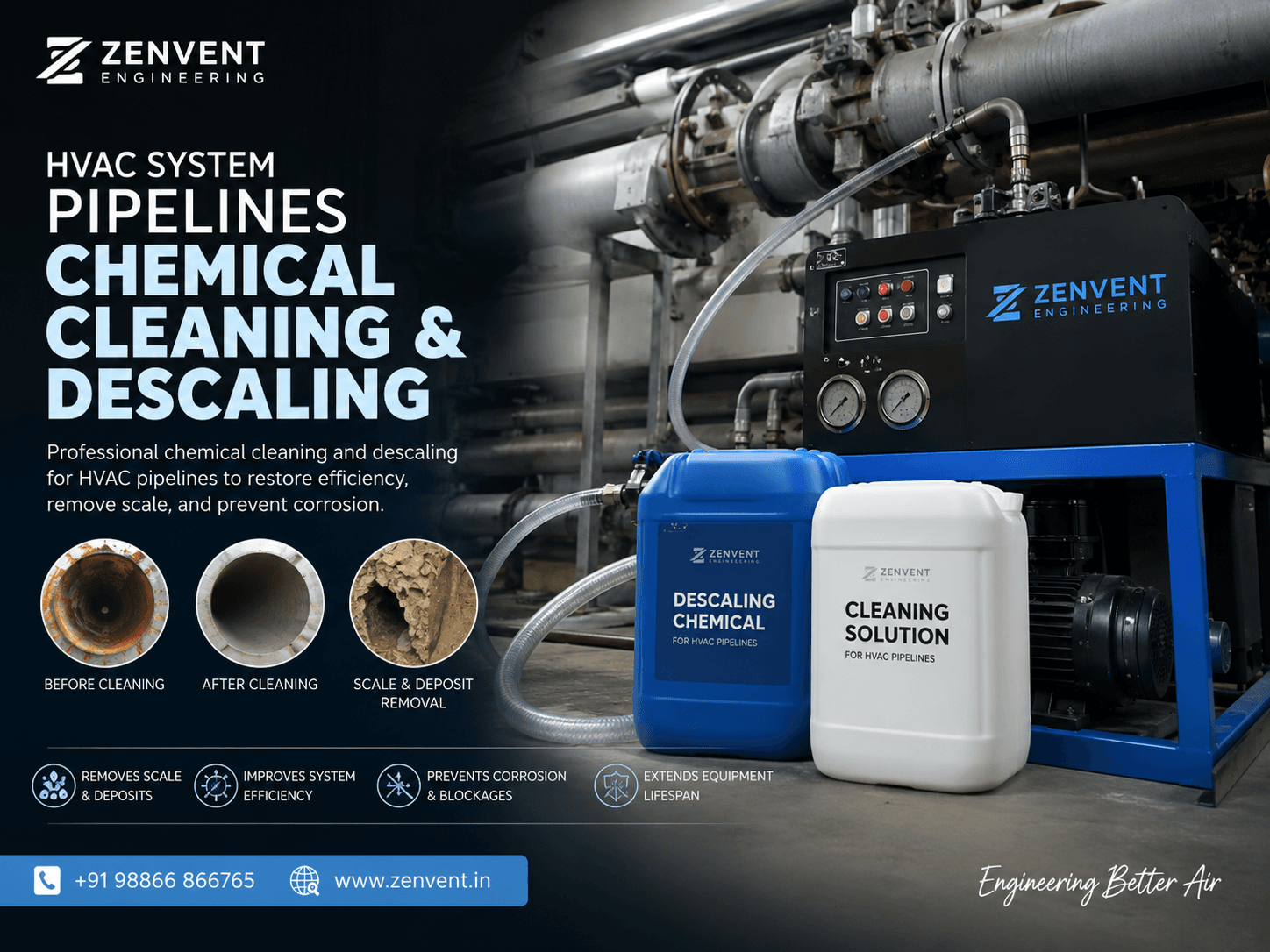
HVAC System Pipelines Chemical Cleaning & Descaling
Zenvent Engineering provides professional HVAC System Pipelines Chemical Cleaning & Descaling services for chilled-water pipelines, condenser-water circuits, closed-loop HVAC systems and industrial chiller plants. Our specialised cleaning process removes rust, scale, sludge, construction debris, oil residue and biological contamination that can restrict water flow and reduce cooling performance.
Contaminated HVAC pipelines can increase pump pressure, reduce heat transfer, block control valves and prevent chillers, air handling units and process equipment from receiving the required water flow. Regular HVAC pipeline chemical cleaning helps restore circulation, improve system reliability and protect valuable cooling equipment.
As an experienced provider of HVAC pipeline chemical cleaning services in India, Zenvent Engineering delivers complete support covering pipeline inspection, water-quality analysis, chemical selection, circulation cleaning, high-velocity flushing, neutralisation, passivation, final rinsing and system-performance verification.
Whether the requirement is pre-commissioning chemical cleaning of HVAC pipelines or restoration of an existing contaminated water circuit, Zenvent Engineering provides a planned, controlled and technically appropriate cleaning solution.
Introduction to HVAC Pipeline Chemical Cleaning and Descaling
HVAC pipeline chemical cleaning is a controlled process used to remove contamination from water-circulation pipelines, heat exchangers, coils, pumps, strainers and connected cooling equipment.
During fabrication, installation and operation, HVAC pipelines can collect:
Mill scale
Welding residue
Oil and grease
Sand and dirt
Construction debris
Mineral scale
Corrosion products
Sludge
Biological matter
Treatment-chemical residue
Water flushing alone may remove loose debris but cannot always eliminate hardened scale, corrosion deposits or oil films. HVAC pipeline descaling uses selected chemicals to dissolve, loosen or suspend contamination so it can be removed through circulation and flushing.
The complete process can include:
System inspection
Water sampling
Deposit identification
Temporary cleaning connections
Chemical circulation
HVAC pipe flushing
High-velocity water flushing
Neutralisation
Pipeline flushing and passivation
Final water treatment
Performance testing
Zenvent Engineering selects the cleaning method according to pipeline material, contamination type, system volume and operating requirements.
01
HVAC Pipeline Chemical Cleaning
HVAC pipeline chemical cleaning circulates a compatible cleaning solution through the piping network to break down rust, scale, sludge and other deposits.
The chemical solution is selected according to:
Carbon-steel piping
Copper components
Stainless-steel sections
Heat-exchanger construction
Valve and seal materials
Existing contamination
System operating temperature
Required cleaning duration
During circulation, chemical strength, pH, temperature, pressure and visual condition are monitored to maintain effective and controlled cleaning.
02
HVAC Pipeline Descaling
HVAC pipeline descaling focuses on hardened mineral deposits and corrosion scale that reduce the internal pipe diameter and restrict water flow.
Descaling may be required in:
Chilled-water pipelines
Condenser-water pipelines
Chiller evaporators
Chiller condensers
Plate heat exchangers
Cooling coils
Process heat exchangers
Cooling tower circuits
Professional chemical descaling services help restore clear water passages and improve heat-transfer performance.
03
HVAC Pipe Flushing
HVAC pipe flushing uses water circulation to remove loosened deposits, construction debris and suspended solids.
The flushing process may use:
Existing system pumps
Temporary high-flow pumps
Temporary tanks
Flexible hoses
Bag filters
Basket strainers
Flow meters
Pressure gauges
Each branch is flushed until the discharge water meets the required cleanliness condition.
04
HVAC Chemical Flushing
HVAC chemical flushing combines cleaning chemicals with controlled circulation and final water flushing.
This process is particularly useful when normal water flushing cannot remove:
Oil films
Hardened scale
Heavy rust
Corrosion residue
Biological deposits
Old treatment chemicals
Chemical flushing of HVAC chilled water pipelines should be followed by complete rinsing, neutralisation and corrosion-protection treatment.
Why HVAC Pipelines Require Periodic Chemical Cleaning
HVAC water systems depend on unrestricted circulation and clean heat-transfer surfaces. Internal contamination can gradually reduce system performance even when the main chiller and pumps appear to be operating normally.
Periodic HVAC system cleaning helps maintain:
Correct chilled-water flow
Correct condenser-water flow
Efficient heat transfer
Stable chiller operation
Lower system resistance
Reliable valve performance
Accurate flow measurement
Effective water treatment
01
Restricted Pipeline Flow
Rust, sludge and scale can reduce the available internal area of the pipeline.
Restricted flow can cause:
Insufficient cooling
Uneven room temperatures
Low flow through air handling units
Reduced process cooling
High pump pressure
Increased pump energy
Chiller flow alarms
Poor temperature difference
HVAC pipe rust, sludge and scale removal helps reopen restricted flow paths.
02
Reduced Heat-Transfer Performance
Deposits can form an insulating layer on the internal surfaces of coils and heat exchangers.
This reduces heat transfer through:
Chiller evaporators
Chiller condensers
Air handling unit coils
Fan coil unit circuits
Plate heat exchangers
Process cooling equipment
Chemical descaling of chiller and condenser pipelines helps remove deposits that affect thermal performance.
03
Increased Pumping Energy
Dirty pipelines, blocked strainers and restricted valves increase system pressure loss.
The pumps may consume more electrical energy while delivering less water to the cooling equipment. Cleaning helps reduce unnecessary system resistance and supports more efficient circulation.
04
Unstable Chiller Operation
Insufficient chilled-water or condenser-water flow can affect refrigeration-system performance.
Possible problems include:
High condensing pressure
Low evaporator flow
Reduced cooling capacity
Compressor cycling
Freeze-protection alarms
High energy consumption
Extended equipment run time
05
Valve and Instrument Blockage
Contamination can block or damage:
Balancing valves
Control valves
Flow meters
Pressure sensors
Temperature sensors
Strainers
Pump seals
Automatic air vents
Industrial pipeline cleaning helps protect these components and maintain accurate water-side control.
06
Poor Water-Treatment Performance
HVAC water-system treatment cannot perform effectively when the circulating water contains heavy sludge and corrosion products.
Chemical cleaning removes existing contamination before corrosion inhibitors, biocides and other treatment chemicals are introduced.
Common Deposits: Scale, Rust, Sludge and Biofouling
Different contaminants require different cleaning chemicals and flushing methods. Zenvent Engineering assesses the deposit before finalising the cleaning procedure.
01
Mineral Scale
Scale develops when dissolved minerals settle on internal metal surfaces.
Scale formation may result from:
Hard filling water
Frequent fresh-water addition
Poor water treatment
High system temperature
Cooling tower concentration
Contaminated make-up water
Incorrect chemical dosing
Scale reduces heat transfer and can restrict pipelines, condenser tubes and heat exchangers.
02
Rust and Corrosion Products
Rust forms when metal, oxygen and water react inside the pipeline.
Common causes include:
Air entering a closed-loop system
Low corrosion-inhibitor levels
Frequent drainage and refilling
Poor passivation
Untreated water
Mixed pipeline materials
Extended shutdown periods
HVAC corrosion removal helps prevent rust particles from circulating through pumps, valves and cooling coils.
03
Sludge Accumulation
Sludge consists of suspended solids, rust particles, dirt, biological material and treatment residue.
It commonly collects in:
Low pipeline sections
Dead legs
Buffer tanks
Chiller evaporators
Coil connections
Drain points
Horizontal headers
Equipment strainers
Closed-loop system cleaning removes settled and circulating sludge before it causes serious blockage.
04
Biofouling
Biofouling develops when microorganisms multiply inside water systems.
It can lead to:
Slime formation
Unpleasant odours
Blocked strainers
Reduced heat transfer
Microbiologically influenced corrosion
Poor water clarity
A suitable biocide and cleaning programme may be required after water analysis.
05
Oil and Grease
Newly manufactured or installed pipelines can contain oil, grease, jointing compounds and fabrication residue.
These deposits can coat heat-transfer surfaces and interfere with water-treatment chemicals. Pre-commissioning chemical cleaning of HVAC pipelines removes these contaminants before normal operation begins.
06
Construction Debris
New pipelines may contain:
Welding slag
Metal particles
Pipe-cutting residue
Sand
Dust
Sealant
Packaging material
Installation debris
High-velocity flushing of HVAC piping systems helps remove these loose contaminants before they damage pumps and valves.
Pipeline Inspection and Water-Quality Analysis
Zenvent Engineering begins each cleaning project with an assessment of the HVAC pipeline network and current water condition.
The inspection helps determine:
Cleaning sections
Required flow rate
Temporary pump capacity
Chemical selection
Equipment isolation
Cleaning duration
Safety requirements
Final treatment needs
01
System Layout Review
Available piping drawings and system information are reviewed to identify:
Main headers
Chilled-water branches
Condenser-water branches
Chillers
Pumps
Cooling towers
Heat exchangers
Air handling units
Isolation valves
Drain points
Air vents
Buffer tanks
Expansion tanks
The system is then divided into manageable cleaning circuits.
02
Pipeline Material Identification
The cleaning chemical must be compatible with all materials in the circuit.
Materials may include:
Carbon steel
Copper
Stainless steel
Galvanised steel
Aluminium
Brass
Rubber seals
Plastic components
Material compatibility is checked before chemical circulation begins.
03
Visual Inspection
Technicians inspect accessible equipment for signs of:
Rust
Scale
Sludge
Leakage
Dirty strainers
Blocked valves
Corroded fittings
Poor water clarity
Biological contamination
04
Water Sampling
Water samples may be collected from representative points.
Testing can include:
pH
Conductivity
Water hardness
Iron concentration
Suspended solids
Turbidity
Chloride levels
Corrosion-inhibitor concentration
Microbiological condition
Visual clarity
05
Deposit Assessment
Where possible, samples of internal deposits are assessed to determine whether they mainly contain:
Mineral scale
Iron oxide
Oil
Construction debris
Biological deposits
Mixed sludge
This helps select the most effective cleaning and descaling chemicals.
06
Flow and Pressure Assessment
The system’s current flow and pressure may be measured to identify restricted sections.
The assessment can include:
Pump discharge pressure
Differential pressure
Branch flow
Equipment pressure drop
Temperature difference
Strainer condition
07
Cleaning Plan Preparation
Based on the inspection, Zenvent Engineering prepares a cleaning plan covering:
Circuit isolation
Temporary connections
Chemical concentration
Circulation period
Flushing direction
Filter arrangement
Neutralisation
Passivation
Waste handling
Final verification
Selection of Suitable Cleaning and Descaling Chemicals
Chemical selection is one of the most important parts of HVAC system pipeline descaling.
An unsuitable chemical can damage pipes, seals, valves or heat exchangers. An ineffective chemical may fail to remove the contamination.
01
Alkaline Cleaning Chemicals
Alkaline cleaners may be used to remove:
Oil
Grease
Organic residue
Construction compounds
Light biological contamination
They are commonly considered during pre-commissioning cleaning of newly installed pipelines.
02
Acid-Based Descaling Chemicals
Controlled acid-based solutions may be used to dissolve mineral scale, rust and corrosion deposits.
The cleaning formulation may include inhibitors to reduce attack on the base metal.
Acid strength, temperature and circulation duration must be carefully monitored.
03
Chelating and Complexing Agents
Chelating agents help bind dissolved metal ions and keep them suspended in the cleaning solution.
They may be considered where controlled rust and oxide removal is required.
04
Dispersants
Dispersants help keep loosened sludge and solids suspended so they can be removed during flushing.
They reduce the chance of deposits settling again in low-flow sections.
05
Biocides
Biocides may be used where biological contamination has been identified.
The product must be compatible with:
Pipeline materials
Existing water treatment
System temperature
Environmental requirements
Disposal procedures
06
Corrosion Inhibitors
Corrosion inhibitors may be included during cleaning or introduced after the final rinse.
They help protect metal surfaces from rapid corrosion after deposits have been removed.
07
Chemical Compatibility Verification
Before circulation, Zenvent Engineering considers:
Pipeline material
Heat-exchanger material
Seal and gasket compatibility
Existing coating
Chemical concentration
System temperature
Contact duration
Disposal method
Chemical Circulation and High-Velocity Flushing Process
The cleaning process is planned to establish chemical contact and sufficient flow through every pipeline section.
01
System Isolation
The selected circuit is isolated from the remaining HVAC system.
Sensitive equipment may be protected or bypassed, including:
Chillers
Heat exchangers
Control valves
Flow meters
Cooling coils
Process equipment
Water-treatment equipment
02
Temporary Cleaning Arrangement
A temporary cleaning circuit may include:
Chemical circulation pump
Cleaning tank
Temporary hoses
Bag filters
Basket strainers
Flow meter
Pressure gauges
Temperature gauges
Chemical sampling points
Drain connections
The equipment is sized according to system volume, pipe diameter and required flow.
03
Initial Water Flushing
The pipeline is initially flushed with water to remove loose debris.
This reduces the amount of contamination that must be handled by the chemical solution.
04
Chemical Solution Preparation
The selected chemical is mixed according to:
System volume
Deposit severity
Pipeline materials
Required concentration
Recommended operating temperature
The solution is introduced gradually while circulation is maintained.
05
Chemical Circulation
The cleaning solution is circulated through the pipeline for the required period.
During circulation, technicians may monitor:
pH
Chemical concentration
Temperature
Flow
Pressure
Iron content
Turbidity
Visual condition
Reaction activity
06
Reversing the Flow Direction
Where practical, the circulation direction may be reversed.
Reverse circulation helps reach deposits trapped behind restrictions and improves cleaning of complex pipeline sections.
07
High-Velocity Flushing
After the chemical has loosened or dissolved the deposits, high-velocity water flushing removes suspended contamination.
The process creates turbulent flow to transport debris toward temporary filters and drain points.
08
Branch-by-Branch Flushing
Large systems are flushed in sections.
The procedure may include:
Isolating all branches except the selected circuit.
Establishing the required flushing flow.
Collecting contamination in temporary filters.
Inspecting and cleaning the filters.
Repeating the process until the water becomes clear.
Moving to the next branch.
Completing a final full-system flush.
09
Filter Monitoring
Temporary filters are checked throughout the cleaning process.
The amount and type of debris collected provide an indication of cleaning progress.
10
Industrial Chiller Pipeline Chemical Cleaning
Industrial chiller pipeline chemical cleaning may require special planning because process cooling systems often operate continuously.
The work may be completed:
During a planned shutdown
In isolated sections
Through temporary bypass circuits
On one production line at a time
With standby cooling equipment operating
Neutralisation, Passivation and Corrosion Protection
Chemical circulation must be followed by controlled neutralisation, rinsing and surface protection.
01
Draining the Cleaning Solution
The used chemical solution is transferred to a controlled collection point.
Disposal requirements depend on:
Chemical composition
Deposit content
Site rules
Environmental requirements
Local waste-handling procedures
02
Chemical Neutralisation
A neutralising solution may be circulated after acidic or alkaline cleaning.
Neutralisation helps:
Stop the chemical reaction
Restore acceptable pH
Remove chemical residue
Protect metal surfaces
Prepare the system for rinsing
03
Final Water Rinsing
Clean water is circulated until the required water-quality condition is achieved.
Rinsing can continue until acceptable values are achieved for:
pH
Conductivity
Turbidity
Visual clarity
Suspended solids
Chemical residue
04
Pipeline Flushing and Passivation
HVAC pipeline flushing and passivation services create a controlled protective condition on cleaned metal surfaces.
Passivation helps reduce:
Flash rusting
Rapid corrosion
Metal loss
Recontamination
Corrosion-product circulation
05
HVAC Pipeline Corrosion Treatment
HVAC pipeline corrosion treatment services may include:
Passivation
Corrosion-inhibitor dosing
pH adjustment
Oxygen control
Air removal
Water-quality monitoring
Side-stream filtration
06
Corrosion-Inhibitor Dosing
A suitable inhibitor may be added after the system has been cleaned and refilled.
The treatment programme depends on:
System material
Water volume
Operating temperature
Water quality
Existing chemical programme
Facility requirements
07
Air Removal
Air trapped inside the pipeline can accelerate corrosion and reduce pump performance.
After refilling, the system is vented through:
Automatic air vents
Manual air vents
Air separators
High-point connections
08
HVAC Water-System Treatment
Long-term HVAC water-system treatment can include:
Corrosion inhibitors
Biocide treatment
pH control
Side-stream filtration
Chemical dosing
Periodic water testing
Make-up water monitoring
Final Rinsing, Water Testing and Performance Verification
Zenvent Engineering verifies the cleaning results before the system returns to normal service.
01
Water Clarity Check
Final water samples are checked for reductions in:
Rust particles
Sludge
Suspended solids
Oil
Scale fragments
Chemical residue
Construction debris
02
Water-Quality Testing
Final testing may include:
pH
Conductivity
Iron content
Turbidity
Water hardness
Inhibitor concentration
Microbiological condition
The exact testing scope depends on the system and project requirements.
03
Strainer Inspection
Pump, chiller and equipment strainers are inspected after flushing.
Collected debris helps confirm how much contamination has been removed.
04
Flow Verification
Water flow may be checked through:
Chiller evaporators
Chiller condensers
Cooling coils
Heat exchangers
Main headers
Branch pipelines
Process equipment
Flow verification can identify any remaining restrictions.
05
Pressure Testing
Pump pressure and system differential pressure are reviewed after cleaning.
A reduction in system resistance may indicate improved pipeline flow.
06
Temperature Performance
The operating system may be checked for:
Chilled-water supply temperature
Chilled-water return temperature
Condenser-water temperature
Temperature difference
Coil performance
Process temperature stability
07
Equipment Performance Verification
The final performance review may include:
Stable chiller operation
Correct pump operation
Reduced flow alarms
Improved cooling performance
Correct control-valve response
Stable heat-exchanger temperatures
08
Cleaning Documentation
The cleaning report can record:
System sections cleaned
Chemicals used
Cleaning concentration
Circulation duration
Flushing process
Water-test results
Filter observations
Final treatment
Performance findings
Applications, Safety Standards and Recommended Cleaning Frequency
Zenvent Engineering provides industrial and commercial HVAC cleaning services for new and existing pipeline networks.
01
Commercial Building HVAC Pipeline Cleaning
Commercial building HVAC pipeline cleaning is suitable for:
Office towers
Shopping malls
Hotels
Educational buildings
Airports
Convention centres
Retail developments
Mixed-use properties
Cleaning helps maintain water distribution across air handling units and fan coil units.
02
Hospital and Healthcare HVAC Systems
Hospital HVAC systems require stable cooling and carefully planned cleaning work.
Pipeline cleaning may support:
Patient areas
Operating theatres
Laboratories
Medical equipment rooms
Pharmacy areas
Central cooling plants
Work can be divided into sections to reduce operational disruption.
03
Industrial HVAC Pipeline Cleaning and Descaling
Industrial HVAC pipeline cleaning and descaling is suitable for:
Manufacturing plants
Pharmaceutical facilities
Chemical plants
Food and beverage production
Plastic industries
Electronics facilities
Printing plants
Process cooling systems
04
Chilled Water Pipeline Cleaning
Chilled water pipeline cleaning may cover:
Main chilled-water headers
Primary circuits
Secondary circuits
Air handling unit branches
Fan coil branches
Process heat exchangers
Buffer tanks
Chiller evaporators
05
Condenser Water Pipeline Cleaning
Condenser water pipeline cleaning removes scale, corrosion and biological contamination from:
Chiller condensers
Condenser-water pipes
Cooling tower connections
Condenser-water pumps
Strainers
Balancing valves
Open condenser-water circuits generally require more frequent inspection because they are exposed to air, make-up water and environmental contamination.
06
Closed-Loop HVAC System Chemical Flushing
Closed-loop HVAC system chemical flushing is suitable for chilled-water and heating-water circuits affected by rust, sludge or old treatment chemicals.
The system should be cleaned before fresh inhibitor treatment is introduced.
07
Pre-Commissioning Pipeline Cleaning
Pre-commissioning chemical cleaning of HVAC pipelines removes fabrication and installation contamination before the system begins operation.
It is recommended for:
Newly installed buildings
Chiller plant extensions
Pipeline replacements
New process cooling systems
Major HVAC renovations
08
Data Centres
Data-centre cooling systems require reliable chilled-water circulation and uninterrupted operation.
Pipeline cleaning can help protect:
Precision cooling units
Chillers
Pumps
Heat exchangers
Control valves
Redundant cooling circuits
09
Safety Measures
HVAC chemical cleaning should be performed under a documented safety plan.
Important safety measures include:
Chemical risk assessment
Personal protective equipment
System isolation
Lockout and tagout
Ventilation
Controlled chemical mixing
Spill containment
Emergency washing facilities
Pressure monitoring
Safe drainage
Material compatibility checks
Emergency-response preparation
10
Recommended Cleaning Frequency
There is no fixed cleaning interval suitable for every HVAC system.
Cleaning frequency depends on:
Water quality
System age
Corrosion rate
Operating hours
Treatment history
Make-up water quantity
Pipeline condition
Filter condition
Maintenance history
System modifications
Cleaning may be required when the system shows:
Dirty strainers
Low water flow
High pump pressure
Poor cooling performance
Visible rust or sludge
Frequent chiller alarms
Reduced heat-transfer efficiency
Contaminated water samples
Poor temperature difference
Why Choose Zenvent Engineering for HVAC Pipeline Cleaning?
Zenvent Engineering provides complete technical support for HVAC pipeline inspection, chemical cleaning, flushing, descaling and water treatment.
01
Complete Pipeline Assessment
We evaluate the full water-circulation network before selecting a cleaning method.
Our assessment considers:
System size
Pipeline material
Contamination type
Equipment configuration
Water quality
Available isolation valves
Drain points
System operating schedule
Facility restrictions
Safety requirements
02
Mechanical and Chemical Cleaning Capability
Our services include:
HVAC pipeline chemical cleaning
HVAC pipeline descaling
HVAC pipe flushing
HVAC chemical flushing
HVAC system cleaning
Industrial pipeline cleaning
Closed-loop system cleaning
Chilled water pipeline cleaning
Condenser water pipeline cleaning
HVAC scale removal
HVAC corrosion removal
High-velocity flushing
Pipeline flushing and passivation
Industrial HVAC cleaning services
03
Controlled Chemical Selection
Zenvent Engineering selects the cleaning chemicals according to contamination and system materials.
The process is designed to protect:
Carbon-steel pipelines
Copper tubes
Stainless-steel components
Pumps
Valves
Heat exchangers
Seals and gaskets
Equipment coatings
04
Pre-Commissioning and Operational Cleaning
We support both:
New-system pre-commissioning cleaning
Existing-system restoration
Pipeline modification cleaning
Chiller replacement projects
Plant expansion cleaning
Periodic maintenance cleaning
05
High-Velocity Flushing Capability
High-velocity flushing helps remove loosened scale, sludge and debris after chemical circulation.
Our team plans the flushing sequence according to pipe diameter, circuit layout and available pressure limits.
06
Neutralisation and Passivation
Cleaning is followed by controlled neutralisation, rinsing and passivation.
This helps prepare the system for long-term corrosion protection and effective water treatment.
07
Water Testing and Performance Verification
Our process can include:
Water sampling
pH testing
Conductivity testing
Turbidity assessment
Filter inspection
Flow verification
Pressure review
Temperature-performance testing
08
Commercial and Industrial Project Capability
Zenvent Engineering supports HVAC pipeline cleaning for:
Commercial buildings
Hospitals
Hotels
Shopping malls
Data centres
Manufacturing plants
Pharmaceutical facilities
Process industries
Central chilled-water plants
Industrial chiller systems
09
HVAC Chemical Cleaning and Water-Treatment Services
In addition to cleaning, Zenvent Engineering can support:
Corrosion-inhibitor treatment
Chemical dosing
Biocide treatment
Side-stream filtration
Water-quality monitoring
Chilled-water balancing
Condenser-water treatment
Preventive maintenance
10
Factors Affecting HVAC Pipeline Cleaning Cost
The cleaning cost depends on:
Total pipeline length
Pipe diameter
Number of circuits
System water volume
Contamination level
Cleaning chemicals
Temporary pump requirements
Filter requirements
Equipment isolation
Working hours
Water disposal
Testing scope
Passivation requirements
Zenvent Engineering prepares a project-specific cleaning plan based on the actual system condition and service scope.
Contact Zenvent Engineering for professional HVAC pipeline chemical cleaning, descaling, high-velocity flushing and passivation services for commercial and industrial cooling systems.
Frequently Asked Questions
HVAC pipeline chemical cleaning is the controlled circulation of cleaning chemicals through chilled-water, condenser-water or heating-water pipelines to remove rust, scale, sludge, oil and other internal deposits.