
Construction debris
Chilled Water System Cleaning Solutions
Chilled Water System Cleaning, Descaling & Flushing
Zenvent Engineering provides professional Chilled Water System Cleaning, Descaling & Flushing services for commercial HVAC systems, industrial water chiller plants and central chilled-water networks. Our services help remove sludge, rust, scale, construction debris and biological contamination that can restrict water flow and reduce cooling efficiency.
A contaminated chilled water system can increase pump pressure, reduce heat-transfer performance and prevent air handling units, fan coil units and process equipment from receiving the required water flow. Without proper cleaning, even a correctly selected water cooling chiller may consume more energy while producing insufficient cooling.
Zenvent Engineering provides complete chilled water system cleaning services in India, including system inspection, water-quality assessment, dynamic flushing, chemical cleaning, pipeline descaling, neutralisation, passivation, filtration and final performance testing.
Whether your requirement involves pre-commissioning chilled water system flushing, operational system cleaning or restoration of a contaminated chiller water plant, Zenvent Engineering delivers a planned and technically controlled solution.
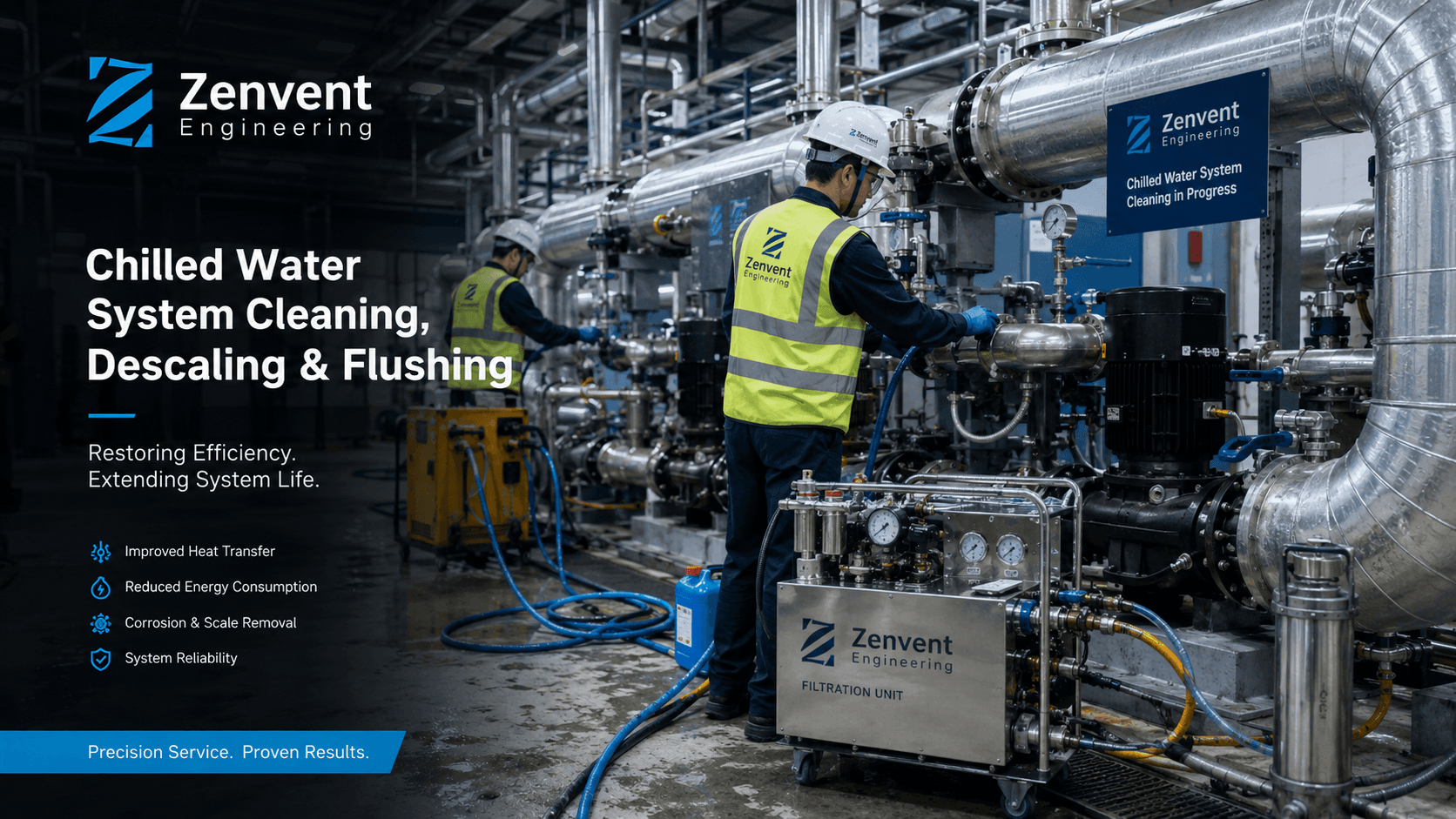
Introduction to Chilled Water System Cleaning, Descaling and Flushing
Chilled water system cleaning is the process of removing unwanted contaminants from chilled-water pipes, heat exchangers, coils, tanks, strainers and connected equipment.
These contaminants may include:
Welding residue
Metal particles
Pipe scale
Corrosion products
Rust
Oil
Grease
Sand
Sludge
Biological matter
Chemical residue
A chilled water plant continuously circulates water between the chiller and the cooling equipment. When contamination accumulates inside the closed loop, it can reduce flow, block strainers and form deposits on heat-transfer surfaces.
Professional descaling & flushing restores water circulation and prepares the system for efficient operation. Depending on the condition of the system, the process may involve mechanical flushing, high-velocity flushing, dynamic flushing, chemical descaling or a combination of cleaning methods.
01
Chilled Water System Flushing
Chilled water system flushing uses controlled water movement to remove loose contamination from the piping network.
The flushing process can remove:
Loose rust
Pipe-cutting debris
Welding particles
Dirt
Sand
Sediment
Installation residue
Suspended solids
A correctly planned flushing operation divides the chilled-water network into manageable sections and establishes sufficient water velocity through each branch.
02
Chilled Water System Descaling
Chilled water system descaling uses suitable cleaning chemicals to dissolve or loosen hardened scale and mineral deposits.
Descaling may be required when deposits have formed inside:
Chiller evaporator tubes
Heat exchangers
Chilled-water pipes
Cooling coils
Control valves
Water-cooled condensers
Process equipment
The chemical selection, concentration, temperature and circulation period must be controlled according to the system material and deposit type.
03
Chilled Water Pipe Cleaning
Chilled water pipe cleaning removes contamination from the complete pipeline network, including main headers, risers, branches and equipment connections.
The process can include:
Section isolation
Temporary flushing connections
Strainer installation
High-velocity water circulation
Chemical circulation
Drainage
Refilling
Venting
Water-quality verification
04
Closed-Loop System Cleaning
A chilled-water network normally operates as a closed-loop system. However, contamination can still enter during installation, repairs, system modifications or repeated water replacement.
Closed-loop chilled water system chemical cleaning helps remove existing contamination and prepares the system for corrosion-inhibitor treatment.
Why Chilled Water Systems Require Regular Cleaning
A chilled-water system depends on uninterrupted water circulation and clean heat-transfer surfaces. Even a thin layer of scale, sludge or corrosion product can reduce system performance.
Regular cleaning helps protect:
Chillers
Chilled-water pumps
Cooling coils
Heat exchangers
Control valves
Flow meters
Balancing valves
Strainers
Sensors
Process equipment
01
Maintaining Chilled-Water Flow
Contaminants can accumulate inside pipes and control valves, restricting water flow.
Low water flow may cause:
Reduced cooling capacity
Uneven building temperatures
Low chilled-water temperature difference
Increased pump pressure
Frequent chiller alarms
Insufficient process cooling
Air handling unit performance problems
Chilled water pipeline flushing services help restore clear flow paths and reduce unnecessary system resistance.
02
Improving Heat-Transfer Performance
Scale and sludge can form an insulating layer on heat-transfer surfaces. This prevents efficient heat movement between the water and the refrigeration system.
Cleaning can improve the performance of:
Chiller evaporators
Cooling coils
Plate heat exchangers
Shell-and-tube heat exchangers
Process heat exchangers
Water-cooled condensers
03
Reducing Pump Energy
Restricted pipes, dirty strainers and partially blocked valves force pumps to work harder to circulate water.
A clean chilled-water network can reduce unnecessary pressure loss and support efficient pump operation.
04
Protecting Chiller Equipment
Low flow and poor heat transfer can affect the operation of a chilled water chiller.
Potential consequences include:
Evaporator freezing risk
Low-temperature alarms
Compressor cycling
Reduced chiller capacity
Longer operating hours
Increased energy consumption
Premature equipment wear
05
Supporting Chilled-Water Balancing
Chilled water balancing ensures that each branch, air handling unit and process circuit receives the required flow.
Balancing cannot be completed accurately when pipes, strainers or control valves are blocked with contamination.
The system should therefore be cleaned before final chilled water balancing meter readings and valve adjustments are completed.
06
Improving Water Quality
Chilled water filtration and chemical treatment work more effectively when existing sludge and corrosion products have been removed.
Cleaning provides a stable foundation for long-term chilled water treatment and corrosion protection.
Common Problems: Scale, Sludge, Rust and Biofouling
Different contaminants require different cleaning methods. Zenvent Engineering assesses the type and severity of contamination before selecting the cleaning process.
01
Scale Formation
Scale forms when dissolved minerals settle on internal surfaces.
Although closed chilled-water systems generally experience less scale than open condenser-water systems, deposits can still form because of:
Untreated filling water
Repeated water replacement
Incorrect chemical treatment
High water hardness
Cross-contamination
Improper system maintenance
Scale can reduce internal pipe diameter and limit heat transfer.
02
Sludge Accumulation
Sludge is a mixture of corrosion products, dirt, suspended solids and biological material.
It commonly settles in:
Low points
Dead legs
Buffer tanks
Chiller evaporators
Coil connections
Drain points
Horizontal pipe sections
Chilled water system sludge removal services use controlled flushing and filtration to remove settled material.
03
Rust and Corrosion Products
Rust develops when oxygen, water and metal surfaces react inside the piping system.
Common causes include:
Incomplete passivation
Frequent fresh-water addition
Air entering the closed loop
Incorrect chemical treatment
Low inhibitor concentration
Mixed system materials
Extended system shutdown
Chilled water pipe rust and scale removal helps reduce blockage and prevents corrosion products from circulating through pumps and coils.
04
Biofouling
Biological contamination can develop where water conditions support microbial growth.
Biofouling may create:
Slime
Unpleasant odour
Blocked strainers
Reduced heat transfer
Microbiologically influenced corrosion
Poor water clarity
A suitable cleaning and biocide treatment programme may be required depending on test results.
05
Oil and Construction Residue
Newly installed chilled-water systems may contain oil, grease, jointing compounds, welding residue and fabrication debris.
These contaminants should be removed before the system is connected to the chiller and cooling equipment.
Pre-commissioning chilled water system flushing helps protect newly installed equipment from contamination.
06
Debris Inside Equipment
Debris can collect inside:
Chiller evaporators
Plate heat exchangers
Pumps
Balancing valves
Control valves
Flow meters
Cooling coils
Cleaning should cover both the main chilled-water piping and the connected equipment.
Initial System Inspection and Water-Quality Assessment
Zenvent Engineering begins the cleaning process with a detailed inspection of the chilled-water network.
The assessment helps determine the required cleaning method, temporary connections, chemical selection and flushing sequence.
01
System Layout Review
Our team reviews available system information such as:
Chilled-water piping layout
Chiller plant configuration
Pump arrangement
Equipment schedules
Pipe sizes
Branch connections
Isolation valves
Drain points
Air vents
Buffer tanks
Expansion tanks
Heat exchangers
This review helps divide the network into suitable flushing sections.
02
Visual Equipment Inspection
The inspection may cover:
Chiller evaporators
Chilled-water pumps
Pipe headers
Strainers
Cooling coils
Control valves
Balancing valves
Expansion tanks
Air separators
Chemical dosing equipment
Signs of corrosion, leakage, contamination and restricted flow are documented.
03
Water Sampling
Water samples can be collected from representative points within the system.
The assessment may consider:
pH
Conductivity
Water hardness
Iron content
Suspended solids
Turbidity
Corrosion-inhibitor concentration
Microbiological condition
Visual clarity
The results help determine whether mechanical flushing, chemical cleaning or complete descaling is required.
04
Deposit Identification
Where possible, deposits are examined to determine whether they consist mainly of:
Mineral scale
Iron oxide
Construction debris
Oil
Organic contamination
Mixed sludge
The cleaning method should match the deposit type and system materials.
05
Flow and Pressure Assessment
Existing pump pressure, branch flow and temperature performance may be reviewed before cleaning.
A chilled water meter or balancing instrument can help identify low-flow sections and restricted branches.
06
Cleaning Method Selection
Based on the inspection, Zenvent Engineering prepares a cleaning plan that may include:
Water flushing
High-velocity flushing
Dynamic flushing
Chemical cleaning
Chemical descaling
Biocide treatment
Filtration
Neutralisation
Passivation
Final water treatment
High-Velocity and Dynamic Flushing Process
High-velocity flushing removes loose contamination by creating sufficient water movement and turbulence inside the chilled-water pipelines.
01
System Isolation
The chilled-water network is divided into manageable flushing sections.
Sensitive equipment may be isolated or protected where required, including:
Chillers
Plate heat exchangers
Control valves
Cooling coils
Flow meters
Process equipment
Temporary bypasses may be installed to achieve the required flow path.
02
Temporary Flushing Connections
Temporary pumps, hoses, tanks, filters and drain connections may be installed according to the system size.
The temporary arrangement can include:
High-flow flushing pump
Temporary water tank
Bag filters
Basket strainers
Flexible hoses
Flow measurement instruments
Pressure gauges
Sampling points
Drainage connections
03
High-Velocity Flushing
High-velocity flushing of chilled water systems generates turbulent flow to lift and transport loose contamination.
The cleaning velocity should be sufficient to remove deposits without exceeding the pressure limitations of the piping and equipment.
Flushing continues until the discharged water meets the specified cleanliness criteria.
04
Dynamic Flushing of the Chilled Water System
Dynamic flushing uses controlled flow through individual branches while other sections are isolated.
The sequence may involve:
Opening one branch at a time.
Establishing the required water velocity.
Flushing debris toward the collection point.
Cleaning or replacing temporary filters.
Repeating the process until water clarity improves.
Moving to the next branch.
Completing a final system-wide circulation.
This method helps clean branches that may receive insufficient flow during normal system operation.
05
Reverse Flushing
Where practical, selected sections may be flushed in the reverse direction.
Reverse flushing can help dislodge contamination trapped behind restrictions or inside low-flow branches.
06
Filter Monitoring
Temporary filters collect suspended debris during flushing.
Filters are inspected and cleaned regularly to evaluate progress and prevent excessive pressure loss.
07
Flushing Water Management
Flushing water is drained and handled according to site requirements and the nature of the contamination.
Chemical discharge is controlled separately from normal water flushing.
Chemical Cleaning and Descaling Procedure
Mechanical flushing removes loose contamination, but hardened scale and corrosion deposits may require chemical cleaning.
Zenvent Engineering provides chemical descaling of chilled water pipelines using a controlled process selected for the system materials and deposit condition.
01
Chemical Selection
The cleaning chemical is selected according to:
Deposit composition
Pipe material
Chiller heat-exchanger material
Valve material
Seal compatibility
System temperature
Cleaning duration
Environmental and disposal requirements
The chemical must remove contamination without damaging the system.
02
Pre-Cleaning Preparation
Before chemical circulation, the system may be:
Isolated
Drained
Flushed with clean water
Connected to a temporary cleaning pump
Fitted with temporary filters
Checked for leaks
Prepared with sampling points
Sensitive components may be bypassed where required.
03
Chemical Circulation
The cleaning solution is circulated through the selected system section.
During circulation, technicians may monitor:
pH
Temperature
Pressure
Flow
Chemical concentration
Iron content
Visual condition
Reaction activity
The circulation period depends on the deposit level and chemical performance.
04
Chiller Chemical Cleaning
Chiller chemical cleaning can be carried out on evaporators, condensers and associated water circuits.
The cleaning process may help remove deposits from:
Evaporator tubes
Condenser tubes
Plate heat exchangers
Chilled-water headers
Equipment connections
Chiller condenser and evaporator descaling services should be completed using chemicals compatible with the tube material and heat-exchanger construction.
05
Chiller Tube Descaling
Chiller tube descaling targets hardened deposits that reduce heat transfer and water flow.
The process can include:
Chemical circulation
Mechanical brushing
Tube inspection
Water rinsing
Neutralisation
Final leak testing
The exact method depends on the chiller and deposit condition.
06
HVAC Chilled Water Pipeline Flushing Services
Chemical cleaning can be combined with HVAC chilled water pipeline flushing services to remove both dissolved deposits and loose contamination.
Following chemical circulation, the system is thoroughly flushed until the remaining cleaning solution and suspended solids are removed.
07
Chemical Strength Control
Excessive chemical concentration can damage system materials, while insufficient concentration may not remove the deposits.
Zenvent Engineering controls the cleaning process according to system conditions rather than applying an uncontrolled chemical dose.
Neutralisation, Passivation and Corrosion Protection
Chemical cleaning must be followed by proper neutralisation and protection of the cleaned metal surfaces.
01
Chemical Neutralisation
After descaling, the cleaning solution is drained and the system is flushed.
A neutralising solution may then be circulated to restore the water-side surfaces to an acceptable pH condition.
Neutralisation helps:
Stop the chemical reaction
Remove acidic residue
Protect metal surfaces
Prepare the system for passivation
Support safe final water treatment
02
System Rinsing
The system is rinsed until water-quality measurements confirm that cleaning residue has been removed.
Rinsing may continue until acceptable values are achieved for:
pH
Conductivity
Turbidity
Visual clarity
Suspended solids
03
Passivation of HVAC Pipelines
Chemical flushing and passivation of HVAC pipelines creates a protective condition on cleaned metal surfaces.
Passivation helps reduce flash rusting and prepares the system for controlled long-term operation.
04
Corrosion-Inhibitor Treatment
After passivation, a suitable corrosion inhibitor may be introduced into the closed-loop chilled-water system.
The treatment programme depends on:
System material
Water quality
Operating temperature
System volume
Existing treatment strategy
Facility requirements
05
Biocide Treatment
Where microbiological contamination is identified, a suitable biocide treatment may be included.
The treatment must be compatible with the corrosion-inhibitor programme and system materials.
06
Air Removal
Air trapped inside a closed chilled-water system can increase corrosion risk and reduce pump performance.
Following refilling, the system should be properly vented through:
Automatic air vents
Manual air vents
Air separators
High-point vents
07
Final Water Treatment
The final chilled water treatment programme helps maintain system cleanliness after commissioning.
It may include:
Corrosion inhibitor
pH control
Biocide treatment
Side-stream filtration
Periodic water testing
Chemical dosing
Make-up water monitoring
Cleaning Verification and System Performance Testing
Cleaning is not complete until the results are checked and system performance is verified.
01
Water Clarity Inspection
Water samples are inspected after flushing and chemical treatment.
The final water should show a significant reduction in:
Suspended solids
Rust particles
Sludge
Oil
Construction debris
Chemical residue
02
Laboratory or Site Water Testing
Final testing may include:
pH
Conductivity
Iron content
Turbidity
Inhibitor concentration
Microbiological condition
Water hardness
The test scope depends on project and facility requirements.
03
Strainer Inspection
Chiller, pump and equipment strainers are opened and inspected after flushing.
The collected debris provides a useful indication of the contamination removed from the system.
04
Flow Verification
Flow is checked through major branches and equipment connections.
Improved flow may be confirmed using:
Chilled water balancing meter
Ultrasonic flow meter
Differential pressure measurement
Pump readings
Balancing valve measurements
05
Chilled-Water Balancing
After cleaning, chilled water balancing can be completed to distribute the required flow throughout the network.
Balancing can cover:
Chiller evaporators
Air handling units
Fan coil branches
Process heat exchangers
Main risers
Secondary circuits
06
Temperature Performance Testing
The system is operated to confirm chilled-water supply and return temperatures.
Performance checks may include:
Chilled-water supply temperature
Return-water temperature
Temperature differential
Chiller loading
Pump pressure
Coil performance
Process temperature stability
07
Pump Performance Verification
Pump operating pressure and flow are checked after cleaning.
Reduced system resistance may improve pump performance and allow operating adjustments.
08
Chiller Performance Review
The chiller is monitored for:
Stable evaporator flow
Correct chilled-water temperature
Reduced alarm frequency
Improved cooling capacity
Stable compressor operation
Acceptable operating pressure
Applications, Safety Measures and Recommended Cleaning Frequency
Zenvent Engineering provides cleaning, descaling and flushing for new and existing chilled-water systems across commercial, residential and industrial applications.
01
Commercial Chilled-Water Systems
Chilled water system cleaning for commercial buildings is suitable for:
Office towers
Shopping malls
Hotels
Educational facilities
Airports
Convention centres
Retail developments
Mixed-use properties
A commercial water chiller system may serve many air handling units and fan coil units, making pipeline cleanliness essential for proper cooling distribution.
02
Hospitals and Healthcare Facilities
Chiller pipeline cleaning for hospitals and industries requires careful planning to reduce disruption and protect sensitive equipment.
Hospital applications may include:
Patient areas
Operating rooms
Laboratories
Pharmacy areas
Medical equipment rooms
Central chilled-water plants
Cleaning work may be planned in sections to maintain cooling availability.
03
Industrial Chilled-Water Systems
Industrial chiller cleaning services are suitable for:
Manufacturing plants
Pharmaceutical production
Food and beverage facilities
Plastic processing
Chemical plants
Printing facilities
Electronics production
Process machinery
A water chiller for industrial use may operate continuously, making clean water circuits essential for process stability.
04
Central Chilled-Water Plants
A central chilled water plant can include multiple chillers, primary pumps, secondary pumps and large distribution networks.
Cleaning may cover:
Main headers
Chiller evaporators
Pump connections
Risers
Secondary loops
Air handling unit branches
Heat exchangers
Buffer tanks
05
Process Cooling Systems
A water cooled process chiller or process water chiller may serve equipment that requires accurate fluid temperature.
Cleaning helps maintain flow through:
Production machines
Mould cooling circuits
Heat exchangers
Process tanks
Laser systems
Laboratory equipment
06
Brine and Glycol Systems
A brine chiller plant or brine water chiller operates with a specialised heat-transfer fluid.
Cleaning chemicals and procedures must be selected according to:
Existing brine or glycol
Operating temperature
System materials
Contamination type
Fluid disposal requirements
07
Residential and Central Air-Conditioning Systems
Residential chilled water air conditioning and chilled water central air conditioning plant systems may also require cleaning when water circulation or cooling performance declines.
Applications can include:
Residential towers
Large villas
Housing developments
Mixed residential-commercial properties
Central water chiller installations
08
Water-Cooled Chiller Plants
Zenvent Engineering can clean water-cooled chiller plant systems associated with different chiller technologies, including:
Scroll chillers
Screw chillers
Reciprocating chillers
Centrifugal chillers
Water-to-water chillers
Industrial water-cooled chillers
09
Safety Measures
Cleaning and descaling work should be completed under a controlled safety plan.
Important measures include:
Chemical risk assessment
Correct personal protective equipment
System isolation
Lockout and tagout
Controlled chemical handling
Ventilation
Spill-control arrangements
Safe drainage
Pressure monitoring
Equipment material verification
Emergency-response preparation
10
Recommended Cleaning Frequency
There is no single cleaning interval suitable for every chilled-water system.
Cleaning frequency depends on:
Water quality
Corrosion rate
System age
Previous treatment
Operating hours
Make-up water quantity
Maintenance history
Filter condition
System modifications
Performance readings
A system may require cleaning when inspections identify:
Dirty or blocked strainers
Low water flow
High pump pressure
Poor chilled-water temperature difference
Visible rust or sludge
Repeated chiller flow alarms
Reduced coil performance
Contaminated water samples
Why Choose Zenvent Engineering for Chilled Water System Cleaning?
Zenvent Engineering provides complete technical support for chilled-water cleaning, flushing, chemical treatment and performance restoration.
01
Complete Cleaning Assessment
We evaluate the complete chilled-water network before selecting a cleaning method.
Our assessment considers:
System size
Pipe condition
Contamination type
Water quality
Chiller configuration
Equipment materials
Available drain points
Required system availability
Operational restrictions
02
Mechanical and Chemical Cleaning Capability
Our services include:
Chilled water system cleaning
Chilled water system flushing
Chilled water system descaling
Chilled water pipeline flushing
Chiller chemical cleaning
Chilled water pipe cleaning
HVAC system flushing
Chemical flushing of chilled water systems
Chiller descaling
Chilled water line cleaning
Closed-loop system cleaning
Chiller tube descaling
High-velocity flushing
Dynamic flushing
Sludge removal
Rust and scale removal
03
Pre-Commissioning Flushing
New chilled-water systems can contain significant construction contamination.
Zenvent Engineering provides pre-commissioning chilled water system flushing to remove debris before the chillers, pumps, valves and cooling coils begin normal operation.
04
Cleaning for Existing Systems
Operational systems may require cleaning because of:
Poor water treatment
Repeated water replacement
Corrosion
Scale
System modifications
Pump or chiller replacement
Long shutdown periods
Reduced system performance
Our cleaning process can be planned in sections to minimise disruption.
05
Controlled Chemical Descaling
We select and monitor cleaning chemicals according to the system materials and deposit condition.
The controlled process helps protect:
Carbon-steel pipes
Copper tubes
Stainless-steel components
Rubber seals
Pumps
Valves
Heat exchangers
06
Cleaning Verification
Our work can include water sampling, filter inspection, flow verification, final flushing and performance testing.
This provides a clear indication that the system has been cleaned and prepared for normal operation.
07
Support for Different Chiller Plants
Zenvent Engineering supports cleaning requirements for:
Industrial water chiller plants
Commercial water chiller systems
Central AC chiller plants
Water-cooled chiller plants
Chilled water HVAC systems
Process cooling plants
Brine chiller systems
Residential chilled-water systems
08
Complete Chiller Plant Support
In addition to cleaning, Zenvent Engineering can support:
Chilled-water balancing
Water-treatment coordination
Chemical dosing
Filtration improvement
Chiller inspection
Pump inspection
Heat-exchanger cleaning
Control and instrumentation checks
Performance testing
Preventive maintenance
09
Cost Factors for Chilled-Water System Cleaning
The cost of chilled-water system cleaning depends on:
Total pipe length
Pipe diameter
Number of branches
System water volume
Contamination severity
Cleaning method
Chemical quantity
Temporary pumping requirements
Filter requirements
Equipment isolation
Working hours
Water disposal requirements
Testing scope
Cleaning cost should be evaluated separately from the water chiller cost, industrial water chiller price or complete chiller plant cost.
A planned cleaning programme may help protect the existing chiller plant and reduce the need for premature equipment replacement.
Contact Zenvent Engineering for chilled water system cleaning, descaling and flushing services engineered around your system condition, operating requirements and facility schedule.
Frequently Asked Questions
Chilled water system cleaning is the process of removing sludge, rust, scale, oil, debris and other contamination from chilled-water pipes, heat exchangers, coils, tanks and connected equipment.