
Air-cooled centrifugal chiller selection
Air-Cooled Chiller Solutions
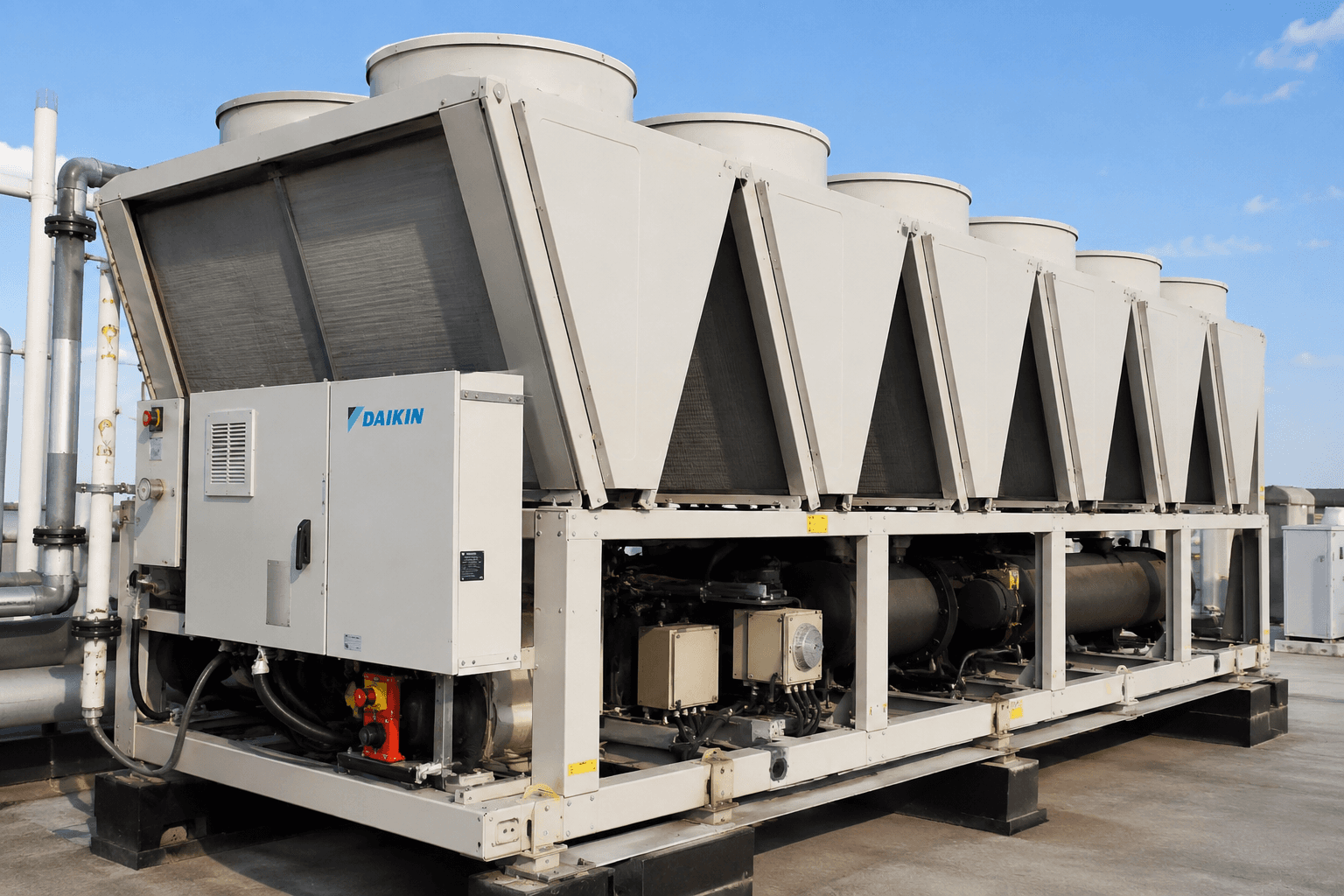
Air-Cooled Centrifugal Chillers
Zenvent Engineering provides complete Air-Cooled Centrifugal Chillers and central chilled-water system solutions for commercial buildings, industrial facilities, hospitals, hotels, shopping malls, offices, data centres and manufacturing plants.
Our systems combine high-capacity cooling with an air-cooled condenser arrangement, eliminating the need for a separate cooling tower and condenser-water circuit. This makes an air-cooled centrifugal chiller suitable for projects that require efficient central cooling with reduced water consumption and simplified external heat rejection.
As an air-cooled centrifugal chiller installation contractor, Zenvent Engineering manages equipment selection, cooling-load calculation, system design, piping, pumps, electrical coordination, controls, testing, balancing and preventive maintenance.
Zenvent Engineering provides complete services for:
Oil-free centrifugal chiller systems
Magnetic-bearing chillers
Variable-speed centrifugal compressors
Air-cooled magnetic-bearing chillers
Modular air-cooled chillers
Packaged air-cooled chillers
Central chilled-water plants
Process cooling systems
Comfort cooling systems
Chilled-water piping
Chilled-water pumps
Buffer and expansion tanks
Chiller control panels
BMS-integrated chillers
Chiller sequencing
Testing and commissioning
Chiller maintenance
Chiller retrofit and replacement
Chiller plant optimization
Introduction to Centrifugal Chiller Solutions
A central chilled-water system removes heat from a building or industrial process and transfers it to the outdoor environment.
In an air-cooled centrifugal chiller system, chilled water circulates between the chiller evaporator and the connected air-conditioning or process equipment. The heat absorbed from the water is transferred to the refrigerant and then rejected outdoors through an air-cooled condenser.
The system can support:
Large commercial cooling loads
Industrial process cooling
Data-centre cooling
Hospital air conditioning
Hotel chilled-water systems
Shopping-mall cooling
Office-building HVAC
Manufacturing temperature control
Central plant replacement projects
Energy-efficiency improvement projects
Zenvent Engineering develops customised central cooling systems according to the required capacity, operating hours, ambient conditions, available installation space and expected part-load operation.
What Is an Air-Cooled Centrifugal Chiller?
An air-cooled centrifugal chiller is a chilled-water cooling machine that uses a centrifugal compressor to circulate refrigerant and air-cooled condenser coils to reject heat.
The main refrigeration cycle includes:
Evaporator
Centrifugal compressor
Air-cooled condenser
Electronic expansion valve
Refrigerant controls
Chilled-water circuit
Condenser fans
Chiller control panel
The centrifugal chiller compressor increases the pressure and temperature of the refrigerant vapour. The refrigerant then enters the air-cooled condenser, where condenser fans move outdoor air across the coil and release heat into the atmosphere.
The cooled refrigerant passes through the expansion device before returning to the evaporator, where it absorbs heat from the chilled-water system.
How an Air-Cooled Centrifugal Chiller Works
The centrifugal chiller working process begins inside the evaporator.
Warm return water from the building or process enters the evaporator heat exchanger. The refrigerant absorbs heat from the water, reducing the chilled-water temperature before it returns to the connected air-conditioning equipment or process.
The refrigerant vapour then enters the centrifugal refrigeration compressor. A high-speed impeller increases the refrigerant velocity and pressure.
After compression, the refrigerant flows to the air-cooled condenser unit. Outdoor air passes across the condenser coil and removes heat from the refrigerant.
The refrigerant then passes through an electronic expansion valve, where its pressure and temperature decrease before it returns to the evaporator.
This continuous centrifugal refrigeration cycle provides chilled water for comfort or process cooling.
Main Components of an Air-Cooled Centrifugal Chiller
A complete air-cooled centrifugal chiller system contains several coordinated mechanical, electrical and control components.
01
Centrifugal Compressor
The centrifugal compressor is the main refrigerant-moving component.
Modern systems may use:
Oil-free centrifugal compressors
Magnetic-bearing compressors
Variable-speed compressors
Inverter centrifugal compressors
Multiple compressor arrangements
The compressor is selected according to cooling capacity, refrigerant type, operating conditions and expected part-load requirements.
02
Evaporator Heat Exchanger
The evaporator transfers heat from the chilled water to the refrigerant.
The evaporator must be selected according to:
Chilled-water flow rate
Entering-water temperature
Leaving-water temperature
Cooling capacity
Water pressure drop
Fouling allowance
Process-fluid requirements
03
Air-Cooled Condenser
The air-cooled condenser rejects heat directly to outdoor air.
It normally includes:
Condenser coils
Condenser fans
EC condenser fans
Fan-speed controls
Refrigerant headers
Microchannel condenser sections
Protective grilles
04
Electronic Expansion Valve
The electronic expansion valve regulates refrigerant flow into the evaporator.
It responds to cooling demand and operating conditions to help maintain efficient refrigerant control.
05
Chiller Control Panel
The control panel monitors and manages:
Compressor speed
Chilled-water temperature
Refrigerant pressure
Condenser fan operation
Pump interlocks
Flow switches
Safety alarms
Operating schedules
BMS communication
Air-Cooled vs Water-Cooled Centrifugal Chillers
Air-cooled and water-cooled centrifugal chillers use different methods of rejecting heat.
01
Air-Cooled Centrifugal Chiller
An air-cooled centrifugal chiller rejects heat through condenser coils and outdoor fans.
Its main characteristics include:
No cooling tower
No condenser-water pump
Reduced water consumption
Simplified external piping
Outdoor installation capability
Easier plant-room coordination
Lower water-treatment requirements
02
Water-Cooled Centrifugal Chiller
A water-cooled centrifugal chiller uses condenser water, cooling towers and condenser-water pumps.
It may be selected for very large, continuously operating cooling plants where suitable water infrastructure and plant space are available.
Zenvent Engineering evaluates energy use, water availability, ambient conditions, maintenance requirements and project space before recommending an air-cooled or water-cooled centrifugal chiller.
Centrifugal Chillers vs Screw Chillers
Both centrifugal and screw chillers are used in commercial and industrial cooling applications.
01
Centrifugal Chillers
Centrifugal chillers are commonly considered for medium-to-large cooling capacities and projects requiring efficient variable-load operation.
Possible benefits include:
High-capacity cooling
Variable-speed operation
Oil-free compressor options
Magnetic-bearing technology
Reduced mechanical friction
Strong part-load performance
Central plant integration
02
Air-Cooled Screw Chillers
An air-cooled screw chiller uses a rotary screw compressor.
A screw compressor chiller can be suitable for applications requiring reliable operation across a broad load range.
03
Air-Cooled Scroll Chillers
An air-cooled scroll chiller uses one or more scroll compressors.
A scroll chiller is commonly used for smaller and modular cooling capacities.
Zenvent Engineering selects the compressor technology according to cooling load, operating profile, redundancy, noise requirements, efficiency targets and maintenance strategy.
Oil-Free Centrifugal Chillers
An oil-free centrifugal chiller operates without a conventional compressor oil-lubrication circuit.
Oil-free technology can reduce:
Oil-management requirements
Oil-related heat-transfer losses
Mechanical friction
Routine oil maintenance
Refrigerant contamination risk
An air-cooled oil-free chiller may use magnetic bearings to support the rotating compressor shaft.
Zenvent Engineering provides oil-free air-cooled centrifugal chiller solutions for commercial and industrial projects requiring high efficiency, reduced maintenance and stable part-load operation.
Magnetic-Bearing Compressor Technology
A magnetic-bearing chiller uses electromagnetic forces to support the compressor shaft without conventional mechanical bearings.
An oil-free magnetic-bearing compressor can provide:
Reduced mechanical contact
Lower compressor friction
Oil-free refrigerant circuits
Quiet operation
Variable-speed control
Improved part-load efficiency
Reduced routine compressor maintenance
An air-cooled magnetic-bearing chiller is suitable for data centres, hospitals, hotels, offices and industrial applications requiring efficient and reliable central cooling.
Zenvent Engineering provides magnetic-bearing centrifugal chiller installation, controls integration, testing and maintenance support.
Variable-Speed Centrifugal Compressor Operation
A variable-speed centrifugal compressor adjusts compressor speed according to actual cooling demand.
Most buildings and industrial systems do not operate at full cooling capacity throughout the year. Variable-speed operation allows the chiller to reduce compressor output when cooling demand decreases.
Benefits can include:
Improved part-load efficiency
Reduced electrical demand
Stable chilled-water temperature
Lower compressor stress
Better response to changing loads
Improved seasonal energy performance
A variable-speed centrifugal chiller system may also coordinate compressor speed with condenser fan speed, chilled-water pumps and plant-level controls.
Inverter Centrifugal Chillers
An inverter centrifugal chiller uses an electronic drive to control compressor motor speed.
The inverter responds to:
Cooling demand
Chilled-water temperature
Condenser conditions
Compressor operating limits
System pressure
Control-panel commands
Inverter control helps the chiller maintain efficient operation across changing building or process loads.
Zenvent Engineering integrates inverter chillers with pumps, control panels, sensors and BMS systems for coordinated central cooling.
Air-Cooled Condenser Systems
The air-cooled condenser removes heat from the refrigerant without requiring condenser water.
An air-cooled condenser system may use:
Copper-tube aluminium-fin coils
Microchannel condenser coils
Axial condenser fans
EC condenser fans
Variable fan-speed controls
Multiple condenser sections
Protective coil coatings
The condenser is selected according to:
Outdoor design temperature
Refrigerant type
Cooling capacity
Available installation area
Required sound level
Airflow restrictions
Coil protection requirements
Zenvent Engineering considers condenser-air circulation carefully to prevent hot-air recirculation and reduced chiller performance.
Microchannel Condenser Technology
A microchannel condenser uses compact aluminium passages to transfer heat from the refrigerant to outdoor air.
Possible advantages include:
Compact coil construction
Reduced refrigerant charge
Lower equipment weight
Efficient heat transfer
Smaller installation footprint
The suitability of microchannel condenser technology depends on the environment, maintenance access and corrosion conditions.
Protective treatments may be considered for coastal, industrial or chemically aggressive locations.
Condenser Fans and Airflow Management
Condenser fans move outdoor air across the heat-rejection coils.
The system may use:
Standard axial fans
Variable-speed fans
EC condenser fans
Multiple fan stages
Low-noise fan assemblies
Efficient fan control helps maintain condensing pressure while reducing unnecessary electrical consumption.
The chiller location must provide sufficient clearance for air intake and discharge. Poor equipment positioning can cause hot condenser air to return to the coil, reducing capacity and increasing energy use.
Evaporator and Chilled-Water Circuit
The evaporator cools the water supplied to the building or process.
A complete chilled-water circuit may include:
Chiller evaporator
Primary chiller pump
Secondary chilled-water pump
Buffer tank
Expansion tank
Air separator
Chemical dosing equipment
Strainers
Isolation valves
Balancing valves
Control valves
Pressure gauges
Temperature sensors
Flow switches
Zenvent Engineering designs chilled-water systems according to the required cooling load, flow rate, operating temperature and pressure loss.
Chilled-Water Pumps
Chilled-water pumps circulate water between the chiller and the connected cooling equipment.
01
Primary Chiller Pump
A primary chiller pump maintains the required flow through the evaporator.
02
Secondary Chilled-Water Pump
A secondary chilled-water pump distributes chilled water through the building or process network.
03
Variable-Flow Pumping
Variable-speed pumps can adjust water flow according to cooling demand.
This may reduce pumping energy and improve plant efficiency when the system is correctly designed and controlled.
Zenvent Engineering provides air-cooled chiller piping and pump installation for primary-only, primary-secondary and variable-primary-flow systems.
Buffer Tanks and Expansion Tanks
A buffer tank adds water volume to the chilled-water circuit and can reduce rapid chiller cycling during low-load conditions.
A buffer tank may be required for:
Small system water volume
Rapid process-load changes
Modular chiller systems
Low-load applications
Temperature-sensitive processes
An expansion tank accommodates changes in water volume caused by temperature variation.
Zenvent Engineering sizes buffer and expansion tanks according to total system volume, operating temperature and pressure conditions.
Refrigerant and Expansion Controls
The refrigerant influences operating pressure, cooling performance, safety requirements and environmental impact.
A centrifugal chiller refrigerant must be compatible with:
Compressor technology
Chiller capacity
Evaporator design
Condenser design
Required operating temperature
Applicable environmental requirements
A low-GWP refrigerant chiller can support projects seeking reduced environmental impact.
Electronic expansion valves regulate refrigerant flow according to evaporator demand and system conditions.
Chiller Control Panels
A chiller control panel manages equipment operation and safety.
The panel can monitor:
Entering chilled-water temperature
Leaving chilled-water temperature
Refrigerant suction pressure
Refrigerant discharge pressure
Compressor speed
Condenser fan status
Chilled-water flow
Pump status
Electrical current
Alarm history
Operating hours
Energy consumption
Zenvent Engineering provides air-cooled chiller control-panel upgrades for existing systems requiring improved controls, monitoring or BMS communication.
BMS Integration and Remote Monitoring
A BMS-integrated chiller allows central monitoring and control from a building management system.
The BMS may display:
Chiller operating status
Supply-water temperature
Return-water temperature
Cooling load
Compressor operation
Condenser fan operation
Pump status
Energy consumption
Fault alarms
Maintenance notifications
A high-efficiency chiller with BMS integration can coordinate with pumps, valves and air-conditioning equipment for improved overall plant operation.
Remote monitoring can also help maintenance teams identify performance changes before they develop into major failures.
Chiller Sequencing
Chiller sequencing determines how multiple chillers start, stop and share cooling demand.
A sequencing system may consider:
Current cooling load
Chiller efficiency
Operating hours
Chilled-water temperature
Equipment availability
Chiller capacity
Planned maintenance
Redundancy requirements
Proper sequencing helps avoid inefficient operation and unnecessary equipment cycling.
Zenvent Engineering provides chiller plant automation and sequencing for modular air-cooled chillers and multi-chiller central plants.
Chiller Plant Automation
Chiller plant automation coordinates:
Chillers
Primary pumps
Secondary pumps
Control valves
Buffer tanks
Differential-pressure sensors
Temperature sensors
Air-handling units
Process equipment
The controls can adjust the number of operating chillers and pump speeds according to actual system demand.
This approach helps support chiller plant optimization and stable chilled-water delivery.
Cooling-Load and Capacity Calculation
Correct capacity calculation is essential for efficient and reliable chiller operation.
Zenvent Engineering considers:
Building heat gain
Occupancy
Lighting load
Equipment load
Fresh-air load
Process heat
Operating schedule
Outdoor design temperature
Required chilled-water temperature
Diversity factor
Future expansion
Redundancy requirements
An oversized chiller may cycle frequently or operate inefficiently at very low load. An undersized chiller may fail to maintain the required water temperature.
Equipment should therefore be selected from calculated project requirements rather than only from nominal tonnage.
Chiller Capacity Options
Air-cooled chiller systems are available across a wide range of capacities.
Project requirements may include:
1-ton air-cooled chiller
2-ton air-cooled chiller
3-ton air-cooled chiller
5-ton air-cooled chiller
7-ton chiller
10-ton air-cooled chiller
15-ton air-cooled chiller
30-ton air-cooled chiller
40-ton air-cooled chiller
50-ton air-cooled chiller
60-ton air-cooled chiller
100-ton air-cooled chiller
200-ton air-cooled chiller
400-ton air-cooled chiller
Larger central chilled-water plants
Small capacities may use scroll or screw compressors, while centrifugal technology is generally considered for higher-capacity applications.
Final equipment selection depends on manufacturer availability, compressor configuration, design conditions and project requirements.
Equipment Selection and System Design
Zenvent Engineering evaluates the complete system before selecting a chiller.
Our design process considers:
Required cooling capacity
Full-load efficiency
Part-load efficiency
Outdoor temperature
Chilled-water flow
Chilled-water temperature
Available electrical supply
Equipment footprint
Noise requirements
Maintenance clearance
Pumping arrangement
Refrigerant type
BMS requirements
Future expansion
Standby capacity
The resulting system may use a packaged air-cooled chiller, modular air-cooled chiller or central multi-chiller arrangement.
Packaged Air-Cooled Chillers
A packaged air-cooled chiller combines the main refrigeration components into a factory-assembled unit.
The package normally includes:
Compressor
Evaporator
Air-cooled condenser
Condenser fans
Expansion controls
Electrical panel
Safety controls
Operating controller
Packaged construction can simplify site installation because the primary refrigeration circuit is assembled before delivery.
Zenvent Engineering coordinates foundations, piping, power supply, pumps, controls and commissioning for packaged systems.
Modular Air-Cooled Chillers
A modular air-cooled chiller system uses multiple smaller modules connected to a common chilled-water network.
Modular systems can provide:
Flexible capacity
Staged operation
Partial redundancy
Easier future expansion
Improved low-load operation
Simplified equipment replacement
Chiller sequencing controls determine how modules operate according to cooling demand.
Zenvent Engineering provides modular system design, common piping, pump selection and plant automation.
Full-Load and Part-Load Efficiency
Chiller efficiency must be evaluated across the full operating range.
A chiller may operate at full capacity during peak conditions but remain at partial load for much of the year.
Part-load efficiency is influenced by:
Compressor speed
Condenser temperature
Chilled-water temperature
Cooling demand
Condenser fan control
Pump operation
Chiller sequencing
Variable-speed centrifugal technology can provide efficient operation when cooling demand falls below the design peak.
Chiller COP
Chiller COP, or coefficient of performance, compares cooling output with electrical energy input.
A higher COP generally indicates that more cooling is being produced for each unit of electrical energy.
COP can vary according to:
Outdoor-air temperature
Chilled-water temperature
Cooling load
Condenser cleanliness
Pump performance
Refrigerant condition
Control settings
Zenvent Engineering evaluates chiller COP as part of performance testing and energy-efficiency improvement.
Chiller IPLV
Chiller IPLV represents integrated part-load performance across multiple operating conditions.
IPLV can provide a broader view of seasonal performance than a single full-load efficiency value.
However, actual energy consumption also depends on:
Local climate
Building load profile
Operating schedule
Pump energy
Condenser fan energy
Control strategy
Chiller sequencing
Maintenance condition
Zenvent Engineering considers both rated efficiency and expected real operating conditions during equipment selection.
Low-GWP Refrigerant Options
Low-GWP refrigerant chillers are designed to reduce the climate impact associated with refrigerant use.
The refrigerant selection must consider:
Compressor compatibility
Chiller efficiency
Safety classification
Operating pressure
Availability
Service requirements
Environmental objectives
Zenvent Engineering evaluates low-GWP options as part of new chiller selection and replacement planning.
Chilled-Water Air-Conditioning Systems
A chilled-water air-conditioning system distributes cooling through water rather than carrying refrigerant throughout the complete building.
The system may serve:
Air handling units
Fan coil units
Precision cooling units
Process heat exchangers
Industrial equipment
Cooling coils
A central chilled-water plant can provide cooling to multiple areas from one coordinated plant.
Zenvent Engineering provides complete chilled-water system design and installation for commercial HVAC and industrial process cooling.
Comfort Cooling Systems
Comfort cooling systems maintain suitable indoor temperature and humidity for occupants.
Applications include:
Offices
Hotels
Hospitals
Shopping malls
Educational buildings
Residential developments
Airports
Convention centres
An air-cooled chiller for shopping malls and offices can supply chilled water to AHUs and fan coil units across multiple zones.
Industrial Process Cooling Systems
A process cooling system removes heat generated by manufacturing equipment, production processes or temperature-sensitive operations.
Applications may include:
Plastic processing
Food production
Pharmaceutical manufacturing
Chemical processes
Metalworking
Electronics production
Data processing
Industrial machinery
An industrial air-cooled chiller system may require different water temperatures, flow stability and redundancy than a comfort-cooling system.
Zenvent Engineering provides industrial process cooling centrifugal chillers and customised central cooling systems for manufacturing plants.
Glycol Chiller Systems
A glycol refrigeration system uses a water-and-glycol mixture where freeze protection or lower fluid temperatures are required.
An air-cooled glycol chiller may serve:
Food-processing equipment
Cold-storage processes
Industrial machinery
Low-temperature systems
Outdoor piping
Process tanks
A small glycol chiller may use scroll compressor technology, while larger process loads may use screw or centrifugal configurations.
The glycol concentration affects heat transfer, pump selection and pressure loss.
Free-Cooling Chillers
Free-cooling chillers use low outdoor-air temperatures to reduce or avoid mechanical compressor operation.
A free-cooling arrangement may include:
Integrated dry-cooler coils
External industrial dry coolers
Bypass valves
Automatic controls
Glycol circuits
Free cooling may be suitable for data centres, process cooling and facilities requiring cooling during cooler outdoor conditions.
Zenvent Engineering evaluates climate data, operating temperatures and annual cooling requirements before selecting a free-cooling solution.
Air-Cooled Heat Pump Chillers
An air-cooled heat pump chiller can provide chilled water for cooling and heated water for heating.
The unit reverses the refrigeration cycle according to seasonal demand.
Applications may include:
Hotels
Offices
Hospitals
Commercial buildings
Residential complexes
Mixed heating and cooling systems
An air-cooled heat pump must be selected according to winter outdoor conditions, required water temperature and defrost requirements.
Portable and Temporary Chiller Systems
Portable chiller units can provide temporary cooling during:
Planned maintenance
Chiller replacement
Emergency breakdowns
Construction
Process expansion
Seasonal demand
Special events
Temporary options may include:
Portable air-cooled chillers
Portable industrial chillers
Portable chiller air conditioners
Spot chillers
Portable air chiller units
Zenvent Engineering can coordinate temporary system connections, hoses, pumps, power requirements and control arrangements according to project conditions.
Brand-Compatible Chiller Services
Zenvent Engineering can assess commercial and industrial chiller systems from various equipment manufacturers.
Projects may involve systems associated with:
Daikin air-cooled chillers
Trane air-cooled chillers
Carrier air-cooled chillers
Airedale chillers
Vertiv air-cooled chillers
Hiross chillers
Aggreko temporary chillers
Trane centrifugal chillers
Carrier centrifugal chillers
Equipment references are considered during assessment, replacement planning, maintenance and system integration. Final service availability depends on unit condition, technical documentation and component availability.
Air-Cooled Chiller Installation
Zenvent Engineering provides complete commercial centrifugal chiller installation services for new and replacement projects.
The installation scope may include:
Chiller unloading and positioning
Equipment foundation
Vibration isolation
Chilled-water piping
Pump installation
Buffer tank installation
Expansion tank installation
Valve installation
Strainer installation
Pipe insulation
Electrical power connection
Control wiring
BMS integration
Drain connections
System flushing
Water treatment coordination
Each installation is planned according to equipment clearances, airflow requirements and future maintenance access.
Chiller Piping Connections
Correct piping is essential for reliable chilled-water circulation.
The piping system may include:
Supply and return headers
Flexible connectors
Isolation valves
Check valves
Balancing valves
Control valves
Strainers
Pressure gauges
Temperature gauges
Air vents
Drain valves
Flow switches
Zenvent Engineering calculates pipe sizes according to flow rate, velocity, pressure loss and system configuration.
Electrical and Control Connections
Air-cooled centrifugal chillers require suitable electrical power and control integration.
The electrical scope may include:
Main power supply
Local isolator
Protection devices
Earthing
Control wiring
Pump interlocks
Flow-switch wiring
Emergency-stop circuits
BMS communication
Energy meters
The electrical supply must be selected according to the chiller starting method, inverter system, operating current and project requirements.
Testing, Balancing and Commissioning
Centrifugal chiller testing and commissioning confirm that the complete system operates according to the intended design.
Commissioning may include:
Installation inspection
Chilled-water flushing verification
Water-flow measurement
Pump rotation checks
Pressure-drop measurement
Temperature measurement
Control-panel inspection
Compressor start-up
Condenser fan testing
Refrigerant-pressure checks
Safety-control testing
BMS communication checks
Alarm testing
Performance recording
Zenvent Engineering provides chiller plant balancing and performance optimization after installation.
Chiller Performance Testing
Chiller performance testing helps compare actual operation with expected conditions.
Testing may review:
Cooling output
Electrical input
Chilled-water flow
Entering-water temperature
Leaving-water temperature
Compressor load
Condenser fan operation
Refrigerant pressure
Chiller COP
Part-load performance
Performance testing can identify restricted water flow, dirty heat exchangers, incorrect control settings or inefficient plant sequencing.
Preventive Chiller Maintenance
Regular maintenance helps protect chiller reliability, efficiency and service life.
Zenvent Engineering provides air-cooled chiller repair and maintenance services that may include:
Condenser-coil cleaning
Evaporator inspection
Compressor inspection
Refrigerant checks
Leak inspection
Fan inspection
Electrical-terminal tightening
Sensor checks
Control-panel inspection
Pump inspection
Water-flow checks
Alarm-history review
Performance monitoring
Maintenance frequency depends on operating hours, environmental conditions and equipment requirements.
Centrifugal Compressor Service
The centrifugal compressor requires specialised inspection and servicing.
Maintenance activities may include:
Compressor-performance review
Vibration monitoring
Bearing-system checks
Motor-current analysis
Refrigerant-pressure review
Inverter inspection
Sensor calibration
Control verification
Oil-system inspection for lubricated compressors
Zenvent Engineering provides centrifugal compressor repair and overhaul coordination based on equipment condition and technical requirements.
Annual Maintenance Contracts
An annual maintenance contract for centrifugal chillers can provide planned inspection throughout the operating year.
An AMC may cover:
Scheduled preventive maintenance
Condenser cleaning
Electrical inspection
Refrigerant monitoring
Compressor checks
Pump checks
Control-panel checks
Performance reporting
Emergency service support
Maintenance recommendations
The scope is prepared according to chiller capacity, quantity, operating hours and site conditions.
Chiller Retrofit Services
A chiller retrofit can improve the efficiency, control or reliability of an existing system.
Retrofit options may include:
Control-panel upgrades
Variable-speed drives
New condenser fans
EC fan conversion
Pump-speed control
BMS integration
Sensor replacement
Chiller sequencing
Heat-exchanger cleaning
Refrigerant-system improvements
Water-flow optimization
Zenvent Engineering evaluates whether retrofitting or complete chiller replacement is the more suitable project solution.
Existing Chiller Replacement
Chiller replacement may be considered when existing equipment has:
Repeated breakdowns
High energy consumption
Obsolete controls
Refrigerant limitations
Reduced cooling capacity
Excessive maintenance costs
Major compressor damage
Inadequate part-load performance
Zenvent Engineering provides existing chiller replacement and retrofit services, including load verification, equipment selection, removal planning, new installation and commissioning.
Chiller Energy Audits
A chiller energy audit evaluates the performance of the complete cooling plant.
The review may include:
Chiller efficiency
Pump energy
Water-flow rates
Chilled-water temperatures
Chiller sequencing
Control settings
Operating schedules
Condenser condition
Building cooling demand
BMS trends
Zenvent Engineering provides chiller energy audits and efficiency-improvement recommendations for commercial and industrial facilities.
Chiller Plant Optimization
Chiller plant optimization improves the operation of chillers, pumps and controls as one coordinated system.
Optimization measures may include:
Improved chiller sequencing
Variable-speed pump control
Chilled-water temperature reset
Differential-pressure reset
Condenser fan optimization
Operating-schedule adjustments
Sensor calibration
BMS logic improvements
Load-based equipment staging
The objective is to maintain required cooling while reducing unnecessary energy use and equipment cycling.
Chiller Pricing Considerations
Air-cooled chiller price depends on several technical and project factors.
These include:
Cooling capacity
Compressor technology
Refrigerant type
Full-load efficiency
Part-load efficiency
Magnetic-bearing technology
Number of compressors
Condenser design
Pump configuration
Control requirements
BMS integration
Installation location
Piping scope
Electrical scope
Commissioning requirements
Centrifugal chiller cost per ton should therefore be evaluated as part of the complete installed system rather than by equipment capacity alone.
Applications and Industries Served
Zenvent Engineering provides Air-Cooled Centrifugal Chillers across multiple commercial and industrial sectors.
01
Commercial Buildings
Office complexes
Shopping malls
Retail centres
Convention facilities
Mixed-use developments
Airports
02
Hospitality Facilities
Hotels
Resorts
Banquet facilities
Commercial kitchens
Large accommodation buildings
03
Healthcare Facilities
Hospitals
Clinics
Diagnostic centres
Medical laboratories
Healthcare campuses
04
Data Centres
Data halls
Server rooms
Network facilities
Technology campuses
Mission-critical cooling plants
05
Industrial Facilities
Manufacturing plants
Process facilities
Production lines
Machine-cooling systems
Chemical facilities
Pharmaceutical plants
06
Educational and Institutional Buildings
Universities
Schools
Research centres
Government buildings
Institutional campuses
Why Choose Zenvent Engineering?
01
Complete Chiller System Design
Zenvent Engineering designs the complete chilled-water system, including chillers, pumps, tanks, piping, controls and hydronic accessories.
02
Application-Based Equipment Selection
Equipment is selected according to cooling load, operating conditions, part-load profile and project requirements.
03
Oil-Free Chiller Solutions
We provide oil-free centrifugal chiller and magnetic-bearing technology options for high-efficiency applications.
04
Commercial and Industrial Capability
Our solutions support comfort cooling, data-centre cooling and industrial process cooling.
05
Turnkey Installation
We coordinate equipment positioning, piping, electrical connections, controls, BMS integration, testing and commissioning.
06
Plant Automation
Our solutions can include chiller sequencing, pump control, plant automation and remote monitoring.
07
Maintenance and Retrofit Support
Zenvent Engineering provides preventive maintenance, compressor service, control upgrades, energy audits and chiller replacement.
08
Performance Optimization
We assess chiller COP, IPLV, water flow, controls and plant operation to identify efficiency improvements.
Frequently Asked Questions
An air-cooled centrifugal chiller uses a centrifugal compressor to produce chilled water and an air-cooled condenser to reject heat outdoors. It does not require a cooling tower or condenser-water pumping system.