
Rotary screw chillers
Air-Cooled Screw Chiller Solutions
Air-Cooled Screw Chillers
Zenvent Engineering provides complete Air Cooled Screw Chillers and central chilled-water cooling solutions for commercial buildings, manufacturing plants, hospitals, hotels, shopping malls, offices, data centres, warehouses and industrial process facilities.
An air-cooled screw chiller uses a rotary screw compressor, chilled-water evaporator and air-cooled condenser to remove heat from a building or industrial process. Heat absorbed from the chilled-water circuit is rejected directly to the outdoor air through condenser coils and fans, eliminating the requirement for a separate cooling tower and condenser-water pumping system.
Zenvent Engineering works as an air-cooled screw chiller installation contractor, managing cooling-load calculation, equipment selection, system design, piping, pump installation, electrical coordination, BMS integration, commissioning and long-term maintenance.
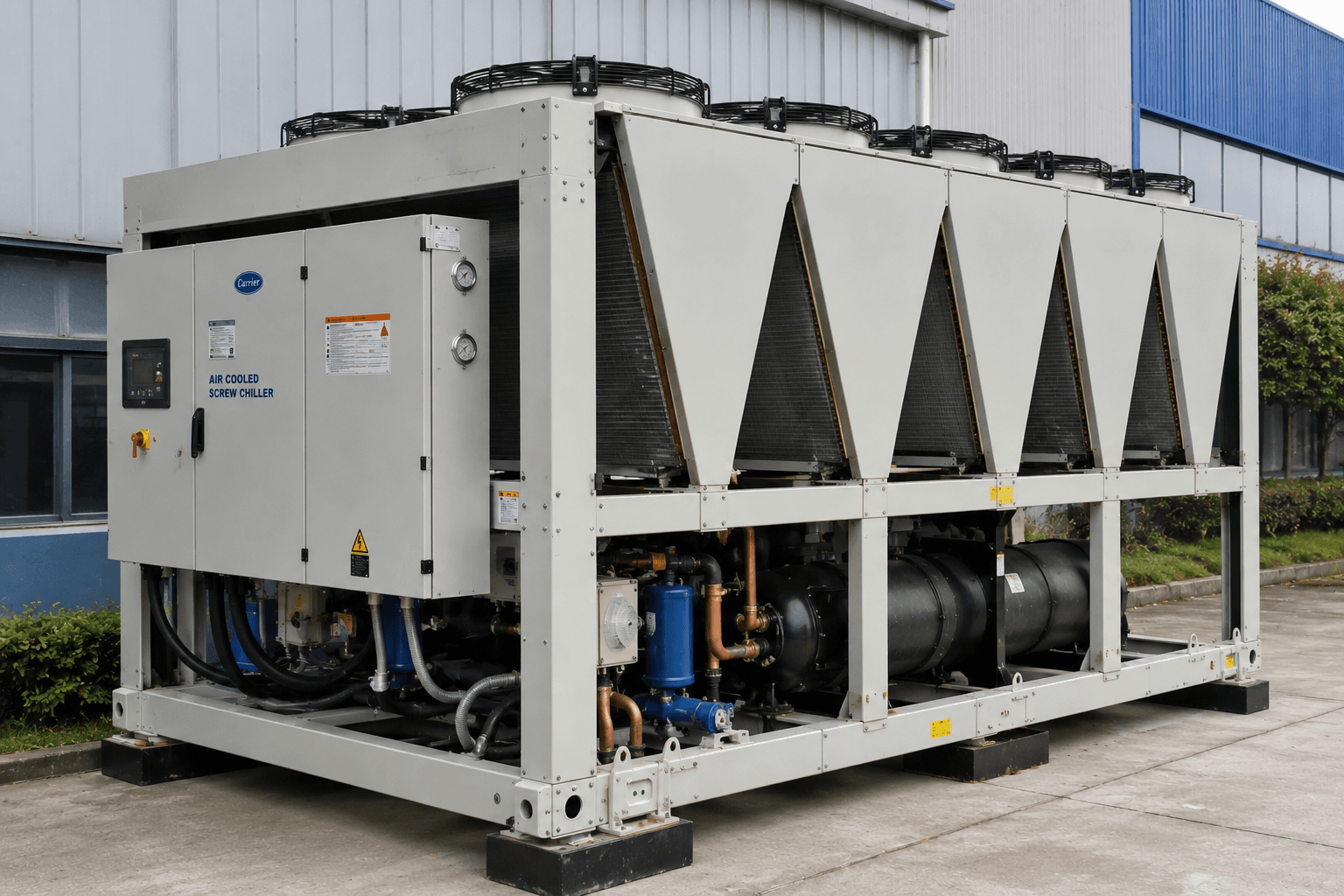
Our air-cooled screw chiller solutions include:
Twin-screw compressor chillers
Variable-speed screw chillers
Inverter screw chillers
Packaged air-cooled chillers
Modular screw chillers
High-efficiency screw chillers
Industrial screw chillers
Glycol screw chillers
Low-temperature process chillers
Central chilled-water plants
BMS-integrated air-cooled screw chillers
Chiller plant automation and sequencing
Chiller piping and pump installation
Screw compressor maintenance
Chiller retrofit and replacement
Testing, balancing and commissioning
What Is an Air-Cooled Screw Chiller?
An air-cooled screw chiller is a refrigeration system that produces chilled water using one or more rotary screw compressors.
The chilled water circulates between the chiller and connected cooling equipment such as:
Air handling units
Fan coil units
Process heat exchangers
Precision cooling units
Industrial machinery
Production equipment
Cooling coils
A typical air-cooled screw chiller contains:
Rotary screw compressor
Chiller evaporator
Air-cooled condenser
Condenser coils
Axial condenser fans
Electronic expansion valve
Refrigerant circuit
Chiller control panel
Safety controls
Chilled-water connections
The compressor raises the refrigerant pressure, while the air-cooled condenser releases heat into the outdoor environment.
Zenvent Engineering supplies packaged and modular air-cooled screw chiller systems according to the required cooling capacity, operating conditions and installation space.
01
Rotary Screw Chiller
A rotary screw chiller uses rotating helical rotors to compress refrigerant vapour.
The screw compression process provides stable refrigerant flow and is suitable for commercial and industrial systems requiring continuous cooling.
Rotary screw chillers are commonly selected for:
Medium and high cooling loads
Long operating hours
Industrial process cooling
Central air-conditioning systems
Variable cooling demand
Low-temperature applications
02
Twin-Screw Compressor Chiller
A twin-screw compressor chiller uses two intermeshing rotors inside the compressor casing.
As the rotors rotate, refrigerant is drawn into the compressor, trapped between the rotor profiles and compressed before discharge.
A twin-screw compressor chiller system can provide:
Stable operation
Continuous refrigerant compression
Good part-load performance
High cooling capacity
Compatibility with variable-speed controls
Reliable industrial cooling
03
Air-Cooled vs Water-Cooled Screw Chiller
An air-cooled screw chiller rejects heat through outdoor condenser coils and fans.
A water-cooled screw chiller rejects heat through condenser water and normally requires:
Cooling towers
Condenser-water pumps
Water-treatment systems
Additional piping
Cooling-tower maintenance
Air-cooled screw chillers may be preferred where:
Water availability is limited
Cooling-tower installation is not practical
Simplified plant infrastructure is required
Outdoor installation space is available
Reduced water consumption is important
Zenvent Engineering evaluates operating hours, ambient temperature, water availability, system capacity and energy requirements before recommending an air-cooled or water-cooled screw chiller.
How Air-Cooled Screw Chillers Work
An air-cooled screw chiller operates through a continuous refrigeration cycle.
01
Evaporator Cooling Process
Warm return water from the building or industrial process enters the chiller evaporator.
The refrigerant inside the evaporator absorbs heat from the water. The cooled water then leaves the chiller and returns to the connected air-conditioning or process equipment.
Depending on the system design, the evaporator may be:
Shell-and-tube evaporator
Brazed-plate heat exchanger
Flooded evaporator
Direct-expansion evaporator
02
Screw Compressor Operation
The refrigerant vapour enters the chiller screw compressor.
The rotating screw elements reduce the available volume and increase the refrigerant pressure and temperature. The compressed refrigerant then moves toward the condenser.
The system may use:
Fixed-speed screw compressor
Variable-speed screw compressor
Inverter screw compressor
Single screw compressor
Multiple compressor arrangement
03
Heat Rejection Through the Condenser
High-pressure refrigerant enters the air-cooled condenser.
Axial condenser fans move outdoor air across the condenser coil. Heat transfers from the refrigerant to the outdoor air, causing the refrigerant to condense.
The condenser system may use:
Copper-tube aluminium-fin coils
Microchannel condenser coils
Standard axial fans
Variable-speed fans
EC condenser fans
Multiple fan stages
04
Refrigerant Expansion
The liquid refrigerant passes through an electronic expansion valve.
The expansion valve reduces refrigerant pressure and regulates the amount of refrigerant entering the evaporator.
The refrigerant then absorbs heat from the chilled-water circuit, and the refrigeration cycle repeats.
Types and Main Components of Air-Cooled Screw Chillers
Zenvent Engineering selects the chiller configuration according to cooling capacity, operating profile, redundancy requirements and available installation space.
01
Fixed-Speed Screw Chiller
A fixed-speed screw chiller operates its compressor at a constant motor speed.
Cooling capacity may be controlled using:
Slide valves
Compressor staging
Unloading mechanisms
Multiple compressor sequencing
Fixed-speed systems can provide dependable cooling where the load remains relatively stable.
02
Variable-Speed Screw Chiller
A variable-speed screw chiller adjusts compressor speed according to actual cooling demand.
Variable-speed operation can provide:
Improved part-load efficiency
Reduced compressor power
Stable chilled-water temperature
Lower starting current
Reduced equipment cycling
Better response to changing loads
Zenvent Engineering provides variable-speed screw chiller installation for commercial and industrial applications with changing cooling demand.
03
Inverter Screw Chiller
An inverter screw chiller uses an electronic drive to regulate compressor motor speed.
The inverter responds to:
Chilled-water temperature
Cooling demand
Refrigerant pressure
Compressor operating limits
Building management system commands
An inverter air-cooled screw chiller can coordinate compressor speed with condenser fans and chilled-water pumps for improved system performance.
04
Packaged Air-Cooled Screw Chiller
A packaged air-cooled screw chiller combines the primary refrigeration components in one factory-assembled unit.
A packaged system usually includes:
Screw compressor
Evaporator
Air-cooled condenser
Condenser fans
Refrigerant circuit
Expansion controls
Electrical panel
Operating controller
Safety devices
Packaged construction simplifies site installation because the refrigerant circuit is assembled and tested before delivery.
Zenvent Engineering provides packaged air-cooled screw chiller installation, including foundation preparation, piping, pumps, controls and commissioning.
05
Modular Air-Cooled Screw Chiller System
A modular air-cooled screw chiller system uses multiple chiller modules connected to common chilled-water headers.
Modular systems can provide:
Flexible cooling capacity
Staged operation
Partial redundancy
Future expansion
Better low-load operation
Simplified maintenance planning
Chiller sequencing determines how each module starts, stops and shares cooling demand.
06
Industrial Screw Chillers
Industrial screw chillers are designed for process applications that require stable water or glycol temperatures.
Typical applications include:
Manufacturing equipment
Plastic-processing machinery
Chemical production
Pharmaceutical facilities
Food-processing systems
Metalworking operations
Process tanks
Hydraulic systems
Machine cooling
Production-line cooling
Zenvent Engineering provides screw chillers for factories and manufacturing plants according to process temperature, flow rate and operating schedule.
07
Air-Cooled Condenser
The air-cooled condenser transfers heat from the refrigerant to outdoor air.
Its performance depends on:
Outdoor ambient temperature
Condenser coil condition
Fan airflow
Equipment clearance
Refrigerant pressure
Hot-air recirculation
Coil surface area
The chiller must be positioned where condenser air can enter and discharge without obstruction.
08
Microchannel Condenser
A microchannel condenser uses compact aluminium passages to provide efficient heat transfer.
Potential benefits include:
Compact coil design
Reduced refrigerant charge
Lower equipment weight
Efficient heat rejection
Reduced unit footprint
Protective coil treatment may be required in coastal, industrial or corrosive environments.
09
Axial and EC Condenser Fans
Axial condenser fans move outdoor air across the condenser coils.
An EC condenser fan can vary its speed according to refrigerant pressure and cooling demand.
Variable fan control can help:
Reduce unnecessary fan energy
Maintain condensing pressure
Lower noise at partial load
Improve seasonal efficiency
Reduce fan cycling
10
Chiller Evaporator
The chiller evaporator transfers heat from the chilled water or glycol solution to the refrigerant.
Evaporator selection depends on:
Cooling capacity
Water flow rate
Entering-water temperature
Leaving-water temperature
Fluid pressure drop
Glycol concentration
Process temperature
11
Electronic Expansion Valve
The electronic expansion valve controls refrigerant flow into the evaporator.
It responds to changing cooling demand and operating conditions to maintain stable refrigerant performance.
12
Refrigerant Circuit
A screw chiller refrigerant circuit may contain:
Compressor
Oil separator
Condenser
Liquid receiver
Filter drier
Sight glass
Expansion valve
Evaporator
Refrigerant sensors
Pressure controls
The circuit design depends on compressor type, chiller capacity and selected refrigerant.
Chilled-Water Pumps and Hydronic Components
The chilled-water circuit distributes cooling between the chiller and connected equipment.
A complete system may include:
Primary chiller pump
Secondary chilled-water pump
Buffer tank
Expansion tank
Air separator
Strainers
Isolation valves
Balancing valves
Control valves
Flexible connectors
Pressure gauges
Temperature gauges
Flow switches
01
Primary Chiller Pump
The primary chiller pump maintains the required water flow through the evaporator.
Correct evaporator flow is important for:
Heat-transfer performance
Stable chilled-water temperature
Freeze protection
Chiller safety
Efficient compressor operation
02
Secondary Chilled-Water Pump
The secondary chilled-water pump distributes chilled water throughout the building or industrial process.
Secondary pumps may use variable-frequency drives to adjust flow according to system demand.
03
Buffer Tank
A buffer tank increases the water volume in the chilled-water circuit.
It can help:
Reduce compressor cycling
Stabilise water temperature
Manage rapid process-load changes
Improve low-load operation
Support modular chiller systems
04
Expansion Tank
An expansion tank accommodates changes in water volume as the fluid temperature changes.
It must be selected according to:
Total system volume
Operating temperature
System pressure
Glycol concentration
Building height
05
Glycol Cooling System
A glycol cooling system uses a water-and-glycol mixture where freeze protection or lower fluid temperatures are required.
A glycol screw chiller for industrial applications may serve:
Food-processing equipment
Cold-storage processes
Outdoor pipelines
Industrial tanks
Low-temperature production
Process heat exchangers
The glycol concentration affects fluid density, heat-transfer performance, pump flow and system pressure loss.
Benefits and Energy Efficiency
Air-cooled screw chillers provide several advantages for commercial and industrial cooling projects.
01
No Cooling Tower Requirement
Because heat is rejected directly to outdoor air, an air-cooled screw chiller does not require a cooling tower.
This reduces the need for:
Condenser-water pumps
Cooling-tower piping
Water treatment
Tower cleaning
Make-up water
Cooling-tower plant space
02
Reduced Water Consumption
Air-cooled chillers do not consume water for condenser heat rejection under normal operation.
This makes them suitable for projects where water conservation or water availability is important.
03
Reliable Cooling Performance
Rotary screw compressors provide continuous refrigerant compression and are suitable for systems operating for extended periods.
They can manage changing cooling loads through compressor unloading, staging or variable-speed operation.
04
Flexible Capacity
Air-cooled screw chillers are available in multiple capacity configurations.
Project requirements may include:
50-ton air-cooled screw chiller
Medium-capacity packaged chillers
Large industrial screw chillers
Modular multi-chiller systems
Multiple-compressor chillers
Central chilled-water plants
A 50-ton air-cooled screw chiller may be suitable for certain commercial or industrial applications, but final capacity must be based on calculated cooling demand.
05
High Part-Load Efficiency
Most chilled-water systems operate below full cooling capacity for a large portion of their operating hours.
Part-load efficiency can be improved through:
Variable-speed compressors
Compressor staging
EC condenser fans
Variable-speed pumps
Chiller sequencing
Chilled-water temperature reset
BMS control
A high-efficiency air-cooled screw chiller should therefore be evaluated across its complete operating range rather than at full load alone.
06
Screw Chiller COP
Chiller COP compares the cooling output with the electrical power used.
COP is affected by:
Outdoor ambient temperature
Chilled-water temperature
Cooling load
Condenser cleanliness
Evaporator water flow
Compressor efficiency
Fan operation
Refrigerant condition
Zenvent Engineering reviews chiller COP during performance testing and energy audits.
07
Chiller IPLV
Chiller IPLV represents integrated part-load efficiency across different operating conditions.
IPLV can help compare expected seasonal performance, but actual energy use also depends on:
Local climate
Building load pattern
Operating schedule
Pump energy
Control settings
Equipment maintenance
Chiller sequencing
08
Low-GWP Refrigerant Screw Chillers
A low-GWP refrigerant chiller uses refrigerant selected to reduce environmental impact.
Refrigerant selection must consider:
Compressor compatibility
Chiller performance
Safety requirements
Operating pressure
Service availability
Project specifications
Zenvent Engineering evaluates low-GWP refrigerant screw chiller options during new equipment selection and chiller replacement projects.
Chiller Controls, BMS Integration and Automation
Modern air-cooled screw chillers use electronic controls to manage cooling operation, safety and energy performance.
01
Chiller Control Panel
The chiller control panel monitors:
Entering chilled-water temperature
Leaving chilled-water temperature
Compressor status
Compressor loading
Refrigerant pressure
Condenser fan operation
Water-flow status
Pump interlocks
Electrical current
Alarm history
Operating hours
The controller can automatically adjust compressor and fan operation according to cooling demand.
02
BMS Chiller Integration
A BMS-integrated air-cooled screw chiller allows central monitoring through the building management system.
The BMS may display:
Chiller operating status
Chilled-water temperatures
Cooling capacity
Compressor loading
Pump status
Condenser fan status
Energy consumption
Fault alarms
Maintenance alerts
Zenvent Engineering provides BMS chiller integration for new and existing systems.
03
Remote Chiller Monitoring
Remote chiller monitoring enables maintenance and facility teams to review operating data without remaining near the equipment.
Remote monitoring may include:
Live temperatures
Compressor status
Alarm notifications
Refrigerant pressure
Energy consumption
Operating trends
Maintenance reminders
Early identification of abnormal operation can reduce the risk of unexpected equipment failure.
04
Chiller Sequencing
Chiller sequencing controls how multiple chillers start, stop and share the cooling load.
Sequencing may consider:
Current building load
Chiller efficiency
Operating hours
Equipment availability
Chiller capacity
Standby requirements
Chilled-water temperature
Correct sequencing can reduce unnecessary compressor operation and improve plant efficiency.
05
Chiller Plant Optimization
Chiller plant optimization coordinates chillers, pumps, valves and control settings.
Optimization measures may include:
Load-based chiller staging
Variable-speed pump control
Differential-pressure reset
Chilled-water temperature reset
Condenser fan optimization
Operating-schedule adjustment
Sensor calibration
BMS logic improvement
Zenvent Engineering provides chiller plant performance optimization services for commercial and industrial systems.
Design, Installation and Commissioning
Zenvent Engineering provides complete industrial and commercial chiller installation services.
01
Cooling-Load Calculation
Correct cooling-load calculation helps prevent equipment oversizing or undersizing.
Our design process considers:
Building heat gain
Occupancy
Lighting
Equipment load
Fresh-air load
Process heat
Operating hours
Outdoor design conditions
Required chilled-water temperature
Future expansion
Standby capacity
An oversized chiller may cycle frequently or operate inefficiently. An undersized system may fail to maintain the required water temperature.
02
Equipment Selection
Equipment selection considers:
Required cooling capacity
Screw compressor configuration
Full-load efficiency
Part-load efficiency
Chilled-water flow
Chilled-water temperature
Electrical supply
Equipment footprint
Noise requirements
Refrigerant type
BMS requirements
Maintenance clearance
Zenvent Engineering selects packaged, modular, fixed-speed or variable-speed screw chillers according to project conditions.
03
Air-Cooled Screw Chiller Piping Installation
The chilled-water piping system may include:
Supply and return headers
Isolation valves
Check valves
Balancing valves
Strainers
Flexible connectors
Pressure gauges
Temperature gauges
Air vents
Drain valves
Flow switches
Pipe sizes are selected according to water flow, permitted velocity and pressure loss.
04
Chilled-Water Pump and Chiller Installation
Zenvent Engineering coordinates the chiller with:
Primary pumps
Secondary pumps
Variable-speed drives
Buffer tanks
Expansion tanks
Control valves
Differential-pressure sensors
Air handling units
Process equipment
Correct pump selection is essential for stable evaporator flow and efficient water distribution.
05
Electrical Installation
Electrical requirements may include:
Main power supply
Local isolators
Protection devices
Earthing
Control wiring
Pump interlocks
Flow-switch connections
Emergency-stop controls
Energy meters
BMS communication
The electrical system must be selected according to chiller current, starting method, inverter configuration and project requirements.
06
Chiller Testing and Commissioning
Air-cooled screw chiller testing and commissioning may include:
Installation inspection
Piping inspection
Water-system flushing verification
Pump rotation checks
Water-flow measurement
Pressure-drop checks
Control-panel inspection
Compressor start-up
Condenser fan testing
Refrigerant-pressure checks
Safety-control testing
Alarm testing
BMS communication checks
Performance recording
Zenvent Engineering documents operating temperatures, pressures and system flow after commissioning.
07
Air and Water Balancing
Hydronic balancing ensures that each cooling coil or process connection receives the required chilled-water flow.
Balancing may involve:
Pump-speed adjustment
Balancing-valve setting
Differential-pressure measurement
Flow measurement
Control-valve checks
Temperature-difference verification
Proper balancing improves cooling distribution and plant efficiency.
Air-Cooled Screw Chiller Capacity and Pricing
Air-cooled screw chiller price depends on the complete technical and installation requirements.
Factors include:
Cooling capacity
Number of compressors
Fixed or variable-speed operation
Condenser type
Refrigerant selection
Full-load efficiency
Part-load efficiency
Evaporator type
Pump configuration
Control requirements
BMS integration
Piping scope
Electrical scope
Installation location
Commissioning requirements
A chiller should not be selected only according to price or nominal tonnage. Cooling capacity, efficiency, reliability and expected operating cost must be evaluated together.
Compatible Screw Chiller Systems and Equipment
Zenvent Engineering can assess new and existing screw chiller systems from multiple manufacturers as part of installation, replacement, maintenance and retrofit projects.
Projects may involve equipment associated with:
Carrier 30XV chillers
Carrier AquaForce chillers
Carrier air-cooled screw chillers
Carrier screw chillers
Carrier 30XW water-cooled chillers
Carrier 23XRV chillers
Daikin air-cooled screw chillers
Daikin AWV chillers
Daikin screw chillers
York YVAA chillers
York YCAV chillers
York YCIV chillers
York YCAS chillers
York air-cooled screw chillers
York water-cooled screw chillers
Trane screw chillers
Trane helical rotary screw compressors
Daikin screw compressors
McQuay screw compressors
Dunham Bush screw chillers
Dunham Bush vertical screw compressors
Blue Star screw chillers
Kirloskar screw chillers
Voltas screw chillers
LG water-cooled screw chillers
Millennium screw chillers
Equipment condition, technical documentation, refrigerant type and spare-part availability are evaluated before repair, overhaul or replacement recommendations are prepared.
Applications and Industries Served
Zenvent Engineering provides Air Cooled Screw Chillers for a wide range of commercial and industrial applications.
01
Commercial Buildings
Air-cooled screw chillers can provide central cooling for:
Office complexes
Shopping malls
Retail centres
Convention facilities
Mixed-use developments
Educational buildings
A screw chiller system for shopping malls and offices can supply chilled water to multiple air handling units and fan coil units.
02
Hotels and Hospitals
An air-cooled chiller for hotels and hospitals can support:
Guest-room cooling
Patient-area cooling
Operating departments
Public areas
Kitchens
Administrative spaces
Air handling units
Fan coil units
System redundancy and maintenance access are important for facilities requiring continuous cooling.
03
Data Centres
An air-cooled chiller for data centre cooling can serve:
Precision cooling units
Data halls
Server rooms
Network facilities
Technology campuses
Data-centre systems may require:
Continuous operation
Standby chiller capacity
Variable-speed operation
Remote monitoring
BMS integration
Free-cooling options
Redundant pumps
04
Factories and Manufacturing Plants
Screw chillers for factories and manufacturing plants can cool:
Production equipment
Hydraulic systems
Moulding machinery
Process tanks
Heat exchangers
Industrial fluids
Manufacturing spaces
Zenvent Engineering provides industrial process cooling screw chiller systems according to process temperature and operating schedule.
05
Pharmaceutical Facilities
Screw chillers can support:
Cleanroom air conditioning
Process cooling
Production areas
Laboratories
Storage facilities
Packaging rooms
Stable chilled-water temperature is important for pharmaceutical HVAC and temperature-sensitive processes.
06
Food and Beverage Facilities
A glycol screw chiller may be used for:
Food processing
Beverage cooling
Process tanks
Cold rooms
Production-line cooling
Temperature-controlled storage
07
Industrial Low-Temperature Cooling
A low-temperature air-cooled process chiller can be designed for applications requiring water or glycol below standard comfort-cooling temperatures.
Compressor capacity, refrigerant type, evaporator design and glycol concentration must be selected for the required operating temperature.
Screw Chiller Maintenance and Repair
Regular maintenance protects cooling capacity, energy efficiency and equipment reliability.
Zenvent Engineering provides air-cooled screw chiller maintenance services for commercial and industrial systems.
Maintenance may include:
Condenser-coil cleaning
Compressor inspection
Oil-level checks
Oil-filter replacement
Refrigerant checks
Leak detection
Evaporator inspection
Fan inspection
Electrical-terminal tightening
Sensor calibration
Control-panel checks
Pump inspection
Water-flow measurement
Alarm-history review
Performance monitoring
01
Screw Compressor Maintenance
Screw compressor maintenance may include:
Compressor sound and vibration checks
Oil inspection
Oil-separator inspection
Bearing-condition assessment
Motor-current measurement
Slide-valve inspection
Refrigerant-pressure analysis
Temperature checks
Electrical inspection
Scheduled maintenance can help identify abnormal operating conditions before compressor damage develops.
02
Screw Compressor Repair and Overhaul
Zenvent Engineering coordinates screw compressor repair and overhaul services according to compressor condition and technical requirements.
The process may involve:
Compressor inspection
Disassembly
Rotor assessment
Bearing replacement
Seal replacement
Oil-system cleaning
Motor checks
Reassembly
Performance testing
Repair feasibility depends on compressor condition, component availability and the cost of replacement alternatives.
03
Annual Maintenance Contract
An annual maintenance contract for screw chillers can include:
Scheduled maintenance visits
Condenser cleaning
Refrigerant monitoring
Electrical inspection
Compressor checks
Pump checks
Control-panel checks
Operating-data recording
Performance reports
Maintenance recommendations
The service schedule is prepared according to equipment quantity, operating hours and site conditions.
Chiller Retrofit and Replacement
Existing chillers may require upgrading when performance, controls or energy efficiency no longer meet project requirements.
01
Air-Cooled Chiller Retrofit
An air-cooled chiller retrofit and control upgrade may include:
New chiller controller
Variable-speed drive
EC condenser fans
Sensor replacement
BMS integration
Pump-speed control
Chiller sequencing
Electrical-panel modification
Refrigerant-system improvements
Water-flow optimization
02
Existing Screw Chiller Replacement
Existing screw chiller replacement services may be required when a unit has:
Repeated breakdowns
Reduced cooling capacity
High energy consumption
Obsolete controls
Refrigerant limitations
Compressor damage
Excessive maintenance costs
Limited spare-part availability
Zenvent Engineering provides removal planning, replacement equipment selection, piping modification, electrical integration and commissioning.
03
Chiller Energy Audit
A chiller energy audit may review:
Cooling output
Electrical consumption
Chiller COP
Part-load performance
Water-flow rates
Chilled-water temperatures
Pump operation
Chiller sequencing
Condenser condition
Operating schedules
BMS trends
The findings can support chiller energy audit and efficiency improvement measures.
Why Choose Zenvent Engineering?
01
Complete System Engineering
Zenvent Engineering designs the complete cooling system, including chillers, pumps, tanks, piping, controls and hydronic accessories.
02
Application-Based Chiller Selection
Every chiller is selected according to cooling load, operating temperature, load profile and project requirements.
03
Commercial and Industrial Capability
Our systems support commercial comfort cooling, industrial process cooling, data centres, hospitals and manufacturing plants.
04
Variable-Speed and High-Efficiency Solutions
We provide fixed-speed, variable-speed and inverter screw chiller solutions according to required energy performance.
05
Turnkey Chiller Installation
Our scope can include equipment supply, foundation coordination, piping, pumps, electrical connections, BMS integration, testing and commissioning.
06
Plant Automation and Remote Monitoring
Air-cooled screw chillers can be integrated with plant sequencing, remote monitoring and building management systems.
07
Maintenance and Compressor Services
Zenvent Engineering provides preventive maintenance, compressor inspection, repair coordination and annual maintenance contracts.
08
Retrofit and Energy Optimization
Existing chiller systems can be upgraded with improved controls, variable-speed equipment, fan upgrades and plant optimization.
Frequently Asked Questions
An air-cooled screw chiller is a chilled-water cooling system that uses a rotary screw compressor and an air-cooled condenser. It rejects heat directly to outdoor air without requiring a cooling tower.