CENTRAL CHILLED-WATER SOLUTIONS

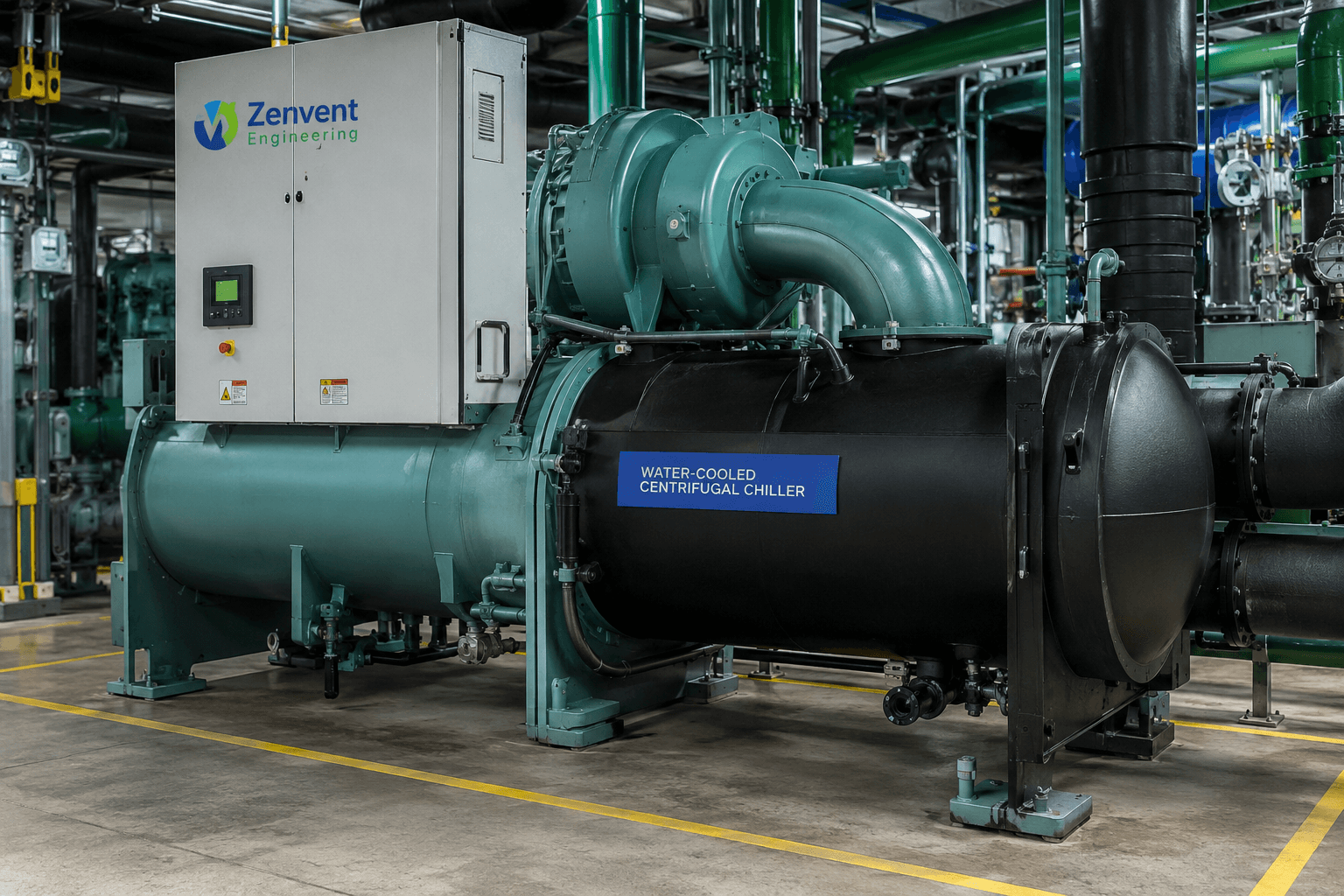
Water-Cooled Centrifugal Chillers

Design, Installation, Commissioning and Maintenance

Water-Cooled Centrifugal Chiller Solutions

Water-Cooled Centrifugal Chillers

Zenvent Engineering provides high-performance Water-Cooled Centrifugal Chillers for large commercial buildings, industrial facilities and central cooling plants. Our engineered solutions deliver high cooling capacity, stable chilled-water temperatures, efficient part-load performance and reliable long-term operation.

As a trusted water-cooled centrifugal chiller supplier in India, Zenvent Engineering supports projects from cooling-load assessment and equipment selection to chilled-water piping, condenser-water piping, cooling tower installation, pump integration, BMS connectivity, testing and commissioning.

Our solutions include conventional centrifugal chillers, variable-speed centrifugal chillers, two-stage centrifugal compressor systems, oil-free centrifugal chillers and magnetic-bearing centrifugal chillers. We design each system around the required cooling capacity, operating schedule, chilled-water temperature, condenser-water conditions, available plant-room space and energy-efficiency objectives.

Whether the requirement involves a new chilled-water plant, replacement of an existing centrifugal chiller or optimization of an operating central cooling plant, Zenvent Engineering delivers a complete, technically coordinated solution.

Contact Zenvent Engineering for a dependable, energy-efficient and turnkey water-cooled centrifugal chiller system.

Water-Cooled Centrifugal Chillers

What Is a Water-Cooled Centrifugal Chiller?

A water cooled centrifugal chiller is a high-capacity refrigeration system that removes heat from circulating chilled water and transfers it to a condenser-water circuit. The condenser water carries this heat to a cooling tower, where it is released into the atmosphere.

The chilled water produced by the chiller circulates through air handling units, fan coil units, process heat exchangers or precision cooling equipment. This forms part of a complete chilled water air conditioning system or industrial process cooling network.

A centrifugal water chiller uses a high-speed centrifugal refrigeration compressor. Instead of compressing refrigerant through pistons, screws or scroll elements, the compressor uses a rotating impeller to increase the refrigerant velocity and pressure.

The centrifugal compressor is particularly suitable for high-capacity installations where efficient operation, central control and continuous chilled-water production are required.

01

Water-Cooled Chiller vs Air-Cooled Chiller

A water-cooled chiller system rejects heat through a water-cooled condenser connected to a cooling tower. An air cooled water chiller rejects heat directly into the outdoor air through condenser coils and fans.

Water-cooled centrifugal chillers are commonly selected for high-capacity buildings and industrial plants because the condenser-water system can support efficient operation under large cooling loads.

An air cooled centrifugal chiller or centrifugal air cooled chiller may be considered for specific applications, but conventional centrifugal chillers are generally integrated into cooling tower chiller systems.

Zenvent Engineering evaluates the total plant requirement before recommending a centrifugal liquid chiller, water cooled screw chiller, air cooled liquid chiller or another suitable technology.

02

Centrifugal Chiller vs Screw Chiller

A centrifugal chiller is generally preferred for high-capacity central plants with stable or predictable cooling requirements. A water cooled screw chiller may be suitable for medium-capacity applications, industrial processes and installations with different load characteristics.

The correct solution depends on:

Required cooling capacity

Minimum and maximum cooling load

Daily operating hours

Part-load efficiency

Chilled-water temperature

Condenser-water temperature

Plant-room space

Redundancy requirements

Initial and long-term operating costs

Zenvent Engineering assesses these conditions to recommend the most appropriate water chiller unit.

Working Principle and Main Components

A centrifugal chiller system operates through a continuous refrigeration cycle. The refrigerant absorbs heat from the chilled-water circuit and releases that heat into the condenser-water circuit.

01

Centrifugal Chiller Working Principle

The refrigeration cycle begins inside the chiller evaporator. Warm return water flows through the evaporator tubes, while low-pressure refrigerant surrounds the tubes inside the shell.

The refrigerant absorbs heat from the water and evaporates. The resulting refrigerant vapour enters the centrifugal chiller compressor.

The compressor impeller rotates at high speed, increasing the refrigerant velocity. The diffuser then converts this velocity into pressure. The high-pressure refrigerant moves into the condenser.

Condenser water absorbs heat from the refrigerant. As heat is removed, the refrigerant condenses into a liquid.

The liquid refrigerant then passes through an expansion device, where its pressure and temperature decrease. The low-pressure refrigerant returns to the evaporator and the refrigeration cycle repeats.

This centrifugal chiller operation continues until the required chilled-water supply temperature is achieved.

02

Centrifugal Refrigeration Compressor

The centrifugal refrigeration compressor is the main component responsible for moving and compressing refrigerant.

Depending on the system design, a centrifugal refrigeration system may include:

Single-stage centrifugal compressor

Two-stage centrifugal compressor

Variable-speed centrifugal compressor

Oil-lubricated centrifugal compressor

Oil-free magnetic-bearing compressor

Gear-driven centrifugal compressor

Direct-drive centrifugal compressor

The centrifugal chiller compressor must be selected according to cooling capacity, refrigerant type, pressure ratio and operating conditions.

03

Chiller Evaporator

The evaporator removes heat from the chilled-water circuit. Large centrifugal chillers commonly use a flooded evaporator with a shell-and-tube heat exchanger arrangement.

In a flooded evaporator, refrigerant surrounds the water tubes and absorbs heat from the circulating water. The cooled water then returns to the building or industrial process.

Proper evaporator design supports:

Efficient heat transfer

Stable leaving-water temperature

Low water-side pressure drop

Correct refrigerant distribution

Reliable part-load operation

04

Water-Cooled Condenser

The water-cooled condenser transfers heat from the refrigerant to the condenser-water circuit.

Warm condenser water leaves the chiller and travels to the cooling tower. The cooling tower rejects the heat and returns cooler water to the condenser.

A correctly designed condenser-water system helps maintain stable refrigerant pressure and efficient chiller operation.

05

Centrifugal Chiller Economizer

A centrifugal chiller economizer can improve refrigeration efficiency by separating flash gas from liquid refrigerant before it enters the evaporator.

In two-stage centrifugal compressor systems, the economizer may direct intermediate-pressure refrigerant vapour to the second compressor stage. This arrangement can improve overall system performance under suitable operating conditions.

06

Chilled-Water Pumps

The chilled-water pump circulates water between the chiller and the cooling terminals.

Depending on the plant design, the system may include:

Primary chiller pump

Secondary chilled-water pump

Variable-flow chilled-water pump

Duty and standby pump arrangement

A primary-secondary chilled-water system uses separate pumps for chiller circulation and building distribution. Variable-primary-flow systems may use one pumping circuit with controlled flow through the chillers.

07

Condenser-Water Pump

The condenser-water pump circulates water between the chiller condenser and the cooling tower.

Correct pump selection is essential because insufficient condenser-water flow can reduce heat transfer, increase condensing pressure and affect system efficiency.

08

Cooling Tower

The cooling tower removes heat from the condenser-water circuit through air and water contact.

A complete cooling tower and chiller system installation may include:

Cooling towers

Condenser-water pumps

Make-up water system

Blowdown arrangement

Water-treatment system

Chemical dosing system

Strainers

Isolation valves

Balancing valves

Temperature sensors

Conductivity controls

09

Water Treatment System

Proper water treatment helps protect the condenser tubes, cooling tower and piping against scale, corrosion and biological growth.

The water-treatment system may include filtration, chemical dosing, conductivity control, blowdown management and periodic water-quality testing.

10

Expansion Tank and Air Separator

The expansion tank manages changes in chilled-water volume caused by temperature variation.

An air separator removes trapped air and microbubbles from the chilled-water circuit. Removing air supports stable pump operation and improves heat transfer.

11

Chiller Control Panel

The chiller control panel monitors and controls the refrigeration system.

A modern control panel can display:

Chilled-water supply temperature

Chilled-water return temperature

Condenser-water temperatures

Refrigerant pressures

Compressor speed

Motor current

Chiller capacity

Active alarms

Operating hours

Energy consumption

Chiller COP

Chiller IPLV data

A BMS-integrated chiller can communicate with the building management system for centralized monitoring, scheduling, alarm reporting and performance analysis.

Types and Available Technologies

Zenvent Engineering provides different centrifugal chiller technologies according to project capacity, operating profile and efficiency requirements.

01

Conventional Water-Cooled Centrifugal Chiller

A conventional centrifugal water chiller uses an oil-lubricated, high-speed compressor to produce chilled water for large commercial and industrial installations.

These systems are commonly used in:

Central cooling plants

Commercial towers

Shopping malls

Hotels

Hospitals

Airports

Data centres

Manufacturing plants

02

Variable-Speed Centrifugal Chiller

A variable-speed centrifugal chiller adjusts compressor speed according to real-time cooling demand and condenser conditions.

Variable-speed operation can reduce energy consumption during part-load conditions, particularly when cooling demand or condenser-water temperature decreases.

Zenvent Engineering provides variable-speed centrifugal chiller installation with coordinated pumps, cooling towers, controls and BMS integration.

03

Oil-Free Centrifugal Chiller

An oil-free centrifugal chiller uses a compressor design that does not require a conventional oil-lubrication circuit.

Removing oil from the refrigerant circuit can reduce oil-management requirements and help maintain clean heat-transfer surfaces.

Oil-free systems are suitable for projects requiring:

High part-load efficiency

Low operating vibration

Compact compressor technology

Reduced oil-system maintenance

Advanced plant controls

04

Magnetic-Bearing Centrifugal Chiller

A magnetic-bearing centrifugal chiller uses magnetic forces to support the compressor rotor without conventional mechanical bearings.

A mag bearing chiller can provide low vibration, variable-speed operation and efficient part-load performance.

Zenvent Engineering offers oil-free magnetic-bearing centrifugal chiller solutions for commercial buildings, data centres, hospitals, hotels and industrial facilities.

05

Magnetic Centrifugal Chiller Retrofit

Magnetic-bearing chiller retrofit services may be considered where an existing central plant requires efficiency improvement, compressor modernization or replacement of ageing equipment.

The retrofit assessment can include:

Existing cooling load

Chiller condition

Electrical capacity

Chilled-water flow

Condenser-water flow

Cooling tower performance

Plant-room dimensions

BMS compatibility

Existing piping connections

06

Two-Stage Centrifugal Chiller

A two-stage centrifugal compressor divides refrigerant compression between two compression stages.

This technology can support efficient operation across specific pressure conditions and may be combined with a centrifugal chiller economizer.

07

High-Efficiency Water-Cooled Chiller

A high-efficiency water-cooled chiller combines efficient compressor technology, optimized heat exchangers, variable-speed controls and intelligent plant operation.

The total system efficiency depends on more than the chiller alone. Cooling tower performance, pump operation, chilled-water balancing and control sequences also influence overall energy consumption.

08

Low-GWP Refrigerant Centrifugal Chiller

A low-GWP refrigerant centrifugal chiller can support modern environmental and efficiency requirements.

Refrigerant selection should consider:

Cooling capacity

Equipment compatibility

Operating pressure

Refrigerant safety classification

Plant-room requirements

Long-term service availability

Project specifications

09

Existing Centrifugal Chiller Systems

Zenvent Engineering can assess existing equipment from different centrifugal chiller families, subject to system condition, technical documentation and component availability.

Existing installations may include equipment commonly associated with:

Carrier 19DV chiller

19XR Carrier centrifugal chiller

Carrier centrifugal chiller

Carrier magnetic bearing chiller

Carrier centrifugal compressor 02XR

Trane CentraVac water chiller

Trane CentraVac water chiller HCFC 123

Trane HDWA chiller

Trane CVHE chiller

Trane centrifugal chiller

York centrifugal chiller

York YZ chiller

YK centrifugal chiller

Daikin centrifugal chiller

Daikin water cooled chiller

Hitachi centrifugal chiller

Our technical assessment may cover compressor condition, refrigerant circuit, evaporator, condenser, starter panel, control system, pumps, cooling towers and replacement feasibility.

10

Legacy Refrigerant Chiller Evaluation

Some existing centrifugal systems use legacy refrigerants. A Trane CentraVac water chiller HCFC 123 or another older centrifugal chiller refrigerant system may require a detailed review of equipment condition, refrigerant availability, leak history and long-term operating plans.

Zenvent Engineering can evaluate whether continued maintenance, control retrofit, major overhaul or complete chiller replacement is the most practical solution.

Benefits and Energy-Efficiency Features

Water-cooled centrifugal chillers offer important advantages for high-capacity commercial and industrial cooling applications.

01

High Cooling Capacity

Centrifugal chillers are designed for large cooling loads. They can serve central chilled-water systems that would otherwise require several smaller water chiller units.

They are suitable for high-capacity applications where 20 ton water chiller, 30 ton water chiller or 50 ton water chiller units may not provide the scale required for the complete plant.

For smaller requirements such as a 1 ton water chiller, water chiller 2 ton, 3 ton water chiller, 5TR chiller or 10 ton water chiller, alternative chiller technologies may be more suitable.

Zenvent Engineering selects the chiller type according to the actual capacity and operating requirements rather than using one technology for every project.

02

Strong Full-Load Efficiency

A properly selected water-cooled centrifugal chiller can provide efficient operation under large and stable cooling loads.

Cooling tower water can reach lower condensing temperatures than outdoor air under many operating conditions, supporting efficient heat rejection.

03

Excellent Part-Load Efficiency

Commercial buildings and industrial plants often operate below peak cooling load for much of the year.

A variable-speed or magnetic-bearing centrifugal chiller can adjust compressor output to match reduced demand. This can improve part-load efficiency and reduce unnecessary energy consumption.

04

Chiller COP and IPLV Performance

Chiller COP measures cooling output compared with electrical power input.

Chiller IPLV represents performance across different part-load conditions. Both values are important when evaluating an energy-efficient water-cooled centrifugal chiller.

Actual performance depends on:

Chilled-water temperature

Condenser-water temperature

Chilled-water flow

Condenser-water flow

Cooling load

Heat exchanger cleanliness

Compressor condition

Control settings

05

Long Equipment Life

With correct installation, water treatment, tube cleaning and preventive maintenance, centrifugal chillers can provide dependable long-term service.

The shell-and-tube heat exchangers, central plant arrangement and serviceable compressor components support planned maintenance and overhaul activities.

06

Centralized Cooling

A chilled-water plant can serve multiple buildings, floors, zones or industrial processes from one central location.

Centralized cooling supports:

Consolidated maintenance

Plant-level monitoring

Cooling-load management

Chiller sequencing

Equipment redundancy

Energy-performance tracking

Future capacity planning

07

Reduced Plant Noise

The chiller equipment is normally installed inside a dedicated plant room. This can help isolate equipment noise from occupied spaces.

Oil-free and magnetic-bearing compressors can further reduce mechanical vibration.

08

Intelligent Chiller Sequencing

Chiller sequencing determines which chillers, pumps and cooling towers should operate at each load condition.

An effective sequence can:

Avoid unnecessary equipment operation

Maintain stable chilled-water temperatures

Balance operating hours

Improve plant efficiency

Maintain standby capacity

Reduce rapid cycling

09

Chiller Plant Optimization

Chiller plant optimization coordinates chillers, pumps, cooling towers and control valves to achieve efficient total-plant operation.

Optimization may include:

Chilled-water temperature reset

Condenser-water temperature reset

Variable pump speed

Cooling tower fan speed control

Chiller staging

Differential pressure control

Real-time efficiency monitoring

Design, Installation and Commissioning

Zenvent Engineering provides turnkey water-cooled centrifugal chiller solutions covering design, supply, installation, testing, commissioning and maintenance.

01

Cooling-Load Assessment

The first stage is to calculate or verify the required cooling load.

The assessment considers:

Building heat gain

Occupancy

Lighting and equipment load

Fresh-air requirements

Industrial process load

Operating hours

Seasonal load variation

Future expansion

Required redundancy

Correct sizing is essential. An oversized chiller may operate inefficiently at low loads, while an undersized unit may fail to maintain the required chilled-water temperature.

02

Chilled-Water Plant Design

A complete chilled-water plant design may include:

Centrifugal chillers

Chilled-water pumps

Condenser-water pumps

Cooling towers

Expansion tanks

Air separators

Chemical dosing systems

Water-treatment equipment

Electrical panels

Control panels

BMS integration

Distribution piping

Isolation and balancing valves

Zenvent Engineering coordinates these systems to provide stable and maintainable plant operation.

03

Central Chilled-Water Plant Installation

As a central chilled-water plant installation contractor, Zenvent Engineering manages equipment positioning, piping installation, pump installation, electrical work, controls and commissioning.

Plant layouts are designed to provide:

Equipment service access

Tube-pulling clearance

Safe operating space

Efficient piping routes

Proper drainage

Ventilation

Noise and vibration control

Future replacement access

04

Chilled-Water and Condenser-Water Piping Installation

Proper chilled-water and condenser-water piping installation is essential for reliable plant operation.

The installation can include:

Chilled-water supply and return piping

Condenser-water supply and return piping

Pump connections

Cooling tower connections

Expansion tank connections

Air separators

Strainers

Isolation valves

Non-return valves

Balancing valves

Flexible connectors

Flow meters

Temperature sensors

Pressure gauges

Pipe supports

Thermal insulation

05

Cooling Tower, Pump and Chiller Installation

A coordinated cooling tower, pump and chiller installation helps ensure correct water flow and efficient heat rejection.

Zenvent Engineering checks:

Chiller flow requirements

Pump head

Cooling tower capacity

Pipe pressure drop

Equipment elevation

Balancing requirements

Water-treatment needs

Control interlocks

06

Chilled-Water Balancing

Chilled-water balancing ensures that each chiller, air handling unit and cooling circuit receives the required water flow.

Incorrect balancing can cause:

Low temperature difference

Insufficient cooling

Excessive pump energy

Unstable chiller operation

Poor building comfort

Process temperature variation

07

BMS-Integrated Centrifugal Chiller System

A BMS-integrated centrifugal chiller system enables centralized supervision of the chilled-water plant.

BMS points can include:

Chiller start and stop

Operating status

Fault status

Chilled-water temperatures

Condenser-water temperatures

Pump status

Cooling tower status

Differential pressure

Energy consumption

Compressor loading

08

Chiller Plant Automation and Sequencing

Chiller plant automation and sequencing coordinates the operating order of chillers, pumps and cooling towers.

The control sequence can be programmed according to:

Cooling demand

Chiller efficiency

Operating hours

Equipment availability

Chilled-water temperature

Differential pressure

Standby requirements

09

Water-Cooled Chiller Testing and Commissioning

Our water-cooled chiller testing and commissioning process can include:

Equipment inspection

Piping pressure testing

System flushing

Water-treatment verification

Chilled-water flow measurement

Condenser-water flow measurement

Pump rotation checks

Electrical connection checks

Control panel inspection

Compressor operation checks

Cooling tower performance checks

Safety and alarm testing

BMS communication testing

Leaving-water temperature verification

Performance observation

10

Chilled-Water System Testing and Balancing

Testing and balancing confirms that the chilled-water system delivers the required flow to each circuit.

The process may include pump performance checks, valve adjustment, flow measurement, differential pressure verification and temperature-difference analysis.

Commercial and Industrial Applications

Zenvent Engineering supplies water-cooled centrifugal chillers for a wide range of high-capacity cooling applications.

01

Commercial Buildings

A high-capacity centrifugal chiller for commercial buildings can provide chilled water for:

Office towers

Business parks

Mixed-use developments

Educational campuses

Convention centres

Airports

Large retail facilities

02

Data Centres

A water-cooled centrifugal chiller for data centres supports precision cooling systems and high-density technology environments.

Data centre installations may require:

Duty and standby chillers

Redundant pumps

Multiple cooling towers

Continuous monitoring

Chiller plant automation

Fast alarm reporting

Stable chilled-water temperature

03

Hospitals and Hotels

A centrifugal chiller for hospitals and hotels provides centralized comfort cooling for guest rooms, wards, operating areas, public spaces and service zones.

These facilities often benefit from multiple chillers with staged operation and standby capacity.

04

Shopping Malls and Offices

A chiller plant for shopping malls and offices can handle changing occupancy and seasonal cooling demand.

Variable-speed centrifugal chillers, optimized pumps and cooling tower controls support efficient part-load operation.

05

Manufacturing Plants

A water-cooled chiller for manufacturing plants can serve production equipment, process heat exchangers, air handling units, electrical rooms and machinery cooling systems.

06

Industrial Process Cooling

An industrial process cooling centrifugal chiller is suitable for large industrial applications requiring continuous chilled water.

Applications can include:

Pharmaceutical production

Chemical processing

Food and beverage production

Plastic manufacturing

Electronics manufacturing

Automotive plants

Printing facilities

Process machinery

District cooling

07

Central Cooling Plants

A central cooling plant can serve several buildings or large zones through a common chilled-water network.

Zenvent Engineering provides coordinated chiller plant design, installation, automation and optimization services.

Maintenance and Why Choose Zenvent Engineering

Regular maintenance is essential for preserving chiller efficiency, reliability and equipment life.

Zenvent Engineering provides centrifugal chiller repair and maintenance for commercial and industrial chilled-water plants.

01

Preventive Chiller Maintenance

Preventive maintenance can include:

Compressor inspection

Motor current measurement

Refrigerant pressure checks

Oil-system inspection

Refrigerant leak testing

Control panel inspection

Sensor verification

Safety-control testing

Chilled-water flow inspection

Condenser-water flow inspection

Pump inspection

Cooling tower inspection

Water-quality review

Alarm-history analysis

An annual maintenance contract for centrifugal chillers helps establish scheduled inspections and planned maintenance activities.

02

Centrifugal Compressor Maintenance

Centrifugal compressor maintenance may include:

Vibration analysis

Bearing inspection

Oil analysis

Seal inspection

Impeller inspection

Motor testing

Alignment checks

Control verification

Operating-pressure analysis

03

Centrifugal Compressor Repair and Overhaul

Centrifugal compressor repair and overhaul may be required when the system develops excessive vibration, bearing wear, motor problems, reduced capacity or repeated shutdowns.

A complete overhaul can involve:

Compressor disassembly

Bearing replacement

Seal replacement

Impeller inspection

Shaft inspection

Motor testing

Oil-system cleaning

Reassembly and alignment

Operational testing

Zenvent Engineering can assess requirements involving Trane centrifugal compressor systems, Carrier centrifugal compressor systems and other centrifugal refrigeration equipment, subject to equipment condition and component availability.

04

Trane Centrifugal Chiller Overhaul

A Trane centrifugal chiller overhaul may include compressor inspection, bearing assessment, oil-system service, motor testing, refrigerant-circuit evaluation, heat-exchanger inspection and control-system checks.

The exact scope depends on the chiller model, operating history and current condition.

05

Chiller Condenser and Evaporator Tube Cleaning

Chiller condenser and evaporator tube cleaning removes scale, sediment and biological deposits from heat-transfer surfaces.

Dirty condenser tubes can increase condensing pressure and energy consumption. Dirty evaporator tubes can reduce cooling capacity and affect chilled-water temperature.

Tube-cleaning frequency depends on water quality, operating hours and plant conditions.

06

Chiller Repair

Chiller repair services can address:

Compressor faults

Refrigerant leaks

Control failures

Sensor faults

Motor problems

Pump faults

Flow alarms

High-pressure alarms

Low-pressure alarms

Heat-exchanger performance issues

Electrical protection trips

07

Chiller Retrofit

A chiller retrofit can improve the reliability or control capability of an existing unit.

Retrofit options may include:

New PLC control panel

BMS communication

Variable-frequency drives

Sensor replacement

Starter-panel upgrade

Refrigerant-management improvements

Remote monitoring

Plant sequencing controls

08

Existing Centrifugal Chiller Replacement

Existing centrifugal chiller replacement may be suitable when the current equipment has repeated failures, obsolete controls, high operating costs, refrigerant limitations or major compressor damage.

Zenvent Engineering evaluates:

Existing cooling capacity

Chiller dimensions

Equipment access

Pipe connection locations

Pump compatibility

Cooling tower capacity

Electrical supply

BMS requirements

Installation shutdown period

09

Chiller Energy Audit and Plant Optimization

A chiller energy audit identifies opportunities to improve total plant performance.

The assessment may include:

Chiller loading

Chiller COP

Part-load efficiency

Chilled-water temperature difference

Condenser-water temperatures

Pump energy

Cooling tower fan energy

Chiller sequencing

Operating schedules

Tube cleanliness

Control settings

Recommendations may include control changes, balancing, tube cleaning, pump-speed adjustment, cooling tower optimization, chiller retrofit or equipment replacement.

10

Factors Affecting Centrifugal Chiller Cost Per Ton

Centrifugal chiller cost per ton depends on:

Total cooling capacity

Compressor technology

Refrigerant selection

Chiller efficiency

Heat exchanger design

Magnetic-bearing or conventional bearings

Pump requirements

Cooling tower requirements

Control system

BMS integration

Piping scope

Electrical installation

Commissioning requirements

Industrial water chiller price or industrial chiller price should be evaluated against the complete system scope, operating efficiency and lifecycle requirements.

11

Why Choose Zenvent Engineering?

Zenvent Engineering provides complete technical support for water-cooled centrifugal chiller projects.

Our services include:

Water-cooled centrifugal chiller selection

Industrial water-cooled chiller contracting

Commercial centrifugal chiller installation services

Central chilled-water plant installation

Cooling tower installation

Chilled-water pump installation

Condenser-water pump installation

Chilled-water and condenser-water piping

BMS integration

Plant automation

Testing and commissioning

Chilled-water balancing

Preventive maintenance

Compressor overhaul

Tube cleaning

Chiller retrofit

Chiller replacement

Plant energy optimization

We focus on correct engineering, coordinated installation, safe commissioning, operational efficiency and long-term serviceability.

Contact Zenvent Engineering for a turnkey water-cooled centrifugal chiller solution designed for your cooling capacity, operating schedule and project requirements.

Frequently Asked Questions

A water-cooled centrifugal chiller is a high-capacity refrigeration system that uses a centrifugal compressor to produce chilled water. Heat is transferred from the chilled water to a condenser-water circuit and rejected through a cooling tower.

0