
Piston compressor chillers
Air-Cooled Reciprocating Chiller Solutions
Air Cooled Reciprocating Chillers
Zenvent Engineering provides complete Air Cooled Reciprocating Chillers and chilled-water cooling solutions for factories, commercial buildings, hospitals, hotels, food-processing plants, pharmaceutical facilities, warehouses and manufacturing units.
An air cooled reciprocating chiller uses one or more piston compressors to circulate refrigerant through an evaporator, air-cooled condenser and expansion device. The system removes heat from water or glycol and rejects that heat directly into the outdoor air through condenser coils and axial fans.
Zenvent Engineering works as an air-cooled reciprocating chiller installation contractor, managing equipment selection, cooling-load calculation, system design, piping, chilled-water pumps, electrical connections, controls, BMS integration, testing and maintenance.
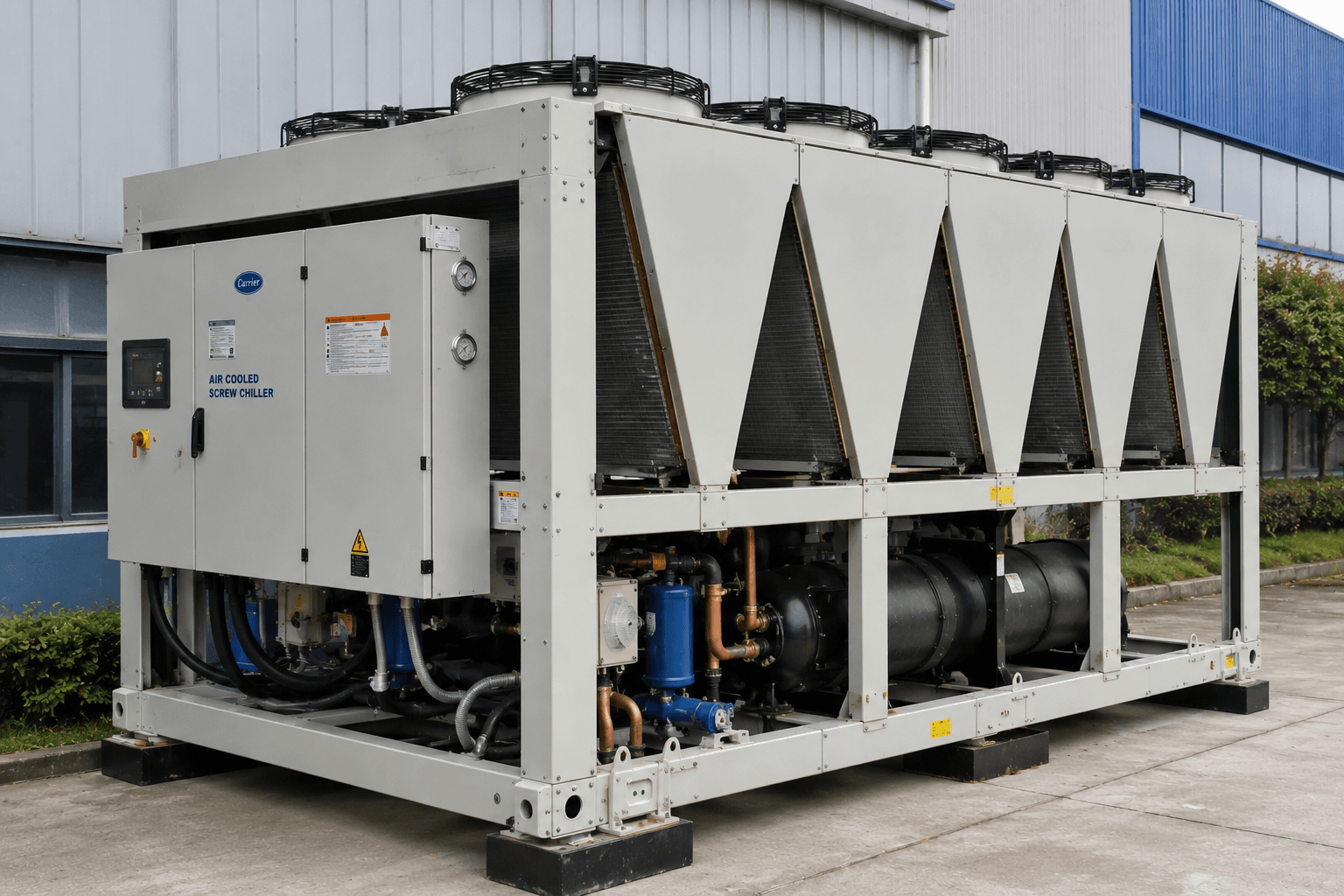
Our reciprocating chiller solutions include:
Semi-hermetic reciprocating chillers
Hermetic reciprocating chillers
Multi-compressor chillers
Packaged reciprocating chillers
Modular air-cooled chillers
Reciprocating liquid chillers
Process water chillers
Glycol chillers
Low-temperature chillers
Comfort cooling systems
Central chilled-water systems
BMS-integrated reciprocating chillers
Chiller retrofit and replacement
Reciprocating compressor repair
Chiller preventive maintenance
Refrigerant leak testing and gas charging
Chiller testing and commissioning
What Is an Air-Cooled Reciprocating Chiller?
An air-cooled reciprocating chiller is a refrigeration machine that produces chilled water by using a reciprocating or piston-type compressor.
The compressor draws low-pressure refrigerant vapour from the evaporator and compresses it using pistons moving inside cylinders. The high-pressure refrigerant then passes through an air-cooled condenser, where heat is released into the outdoor environment.
The cooled refrigerant flows through an expansion valve and returns to the evaporator. Inside the evaporator, it absorbs heat from the circulating water or glycol solution.
The chilled fluid can then be supplied to:
Air handling units
Fan coil units
Process heat exchangers
Injection-moulding machines
Industrial equipment
Production lines
Storage tanks
Cooling coils
Food-processing machinery
Pharmaceutical equipment
A reciprocating compressor water chiller system is suitable for commercial and industrial applications that require reliable cooling, staged capacity control and serviceable compressor technology.
01
Reciprocating Liquid Chiller
A reciprocating liquid chiller cools water, glycol or another compatible process fluid.
The chilled liquid circulates between the chiller and the connected equipment through a closed piping network.
Applications can include:
Comfort air conditioning
Industrial process cooling
Machine cooling
Product cooling
Temperature-controlled manufacturing
Low-temperature fluid cooling
02
Recip Chiller
The term recip chiller is commonly used for a chiller equipped with a reciprocating refrigeration compressor.
These chillers can use a single compressor or multiple compressors to provide staged cooling capacity and operational redundancy.
03
Air-Cooled vs Water-Cooled Reciprocating Chiller
An air-cooled reciprocating chiller rejects heat through condenser coils and outdoor fans.
A water-cooled reciprocating chiller rejects heat through a condenser-water circuit and normally requires:
Cooling tower
Condenser-water pump
Additional piping
Water-treatment equipment
Cooling-tower maintenance
Make-up water supply
An air-cooled system may be suitable where:
Cooling-tower installation is not practical
Water availability is limited
Outdoor equipment space is available
Simplified installation is required
Reduced water consumption is important
Zenvent Engineering evaluates operating hours, cooling capacity, ambient temperature, installation space and water availability before recommending an air-cooled or water-cooled reciprocating chiller.
Working Principle and Main Components
An air-cooled reciprocating chiller operates through a continuous refrigeration cycle involving evaporation, compression, condensation and expansion.
01
Evaporation
Warm return water or glycol enters the chiller evaporator.
The refrigerant absorbs heat from the fluid, causing the refrigerant to evaporate. The chilled fluid then returns to the air-conditioning equipment or industrial process.
02
Compression
The refrigerant vapour enters the reciprocating compressor.
The piston moves inside the compressor cylinder and reduces the refrigerant volume. This increases refrigerant pressure and temperature before it moves to the condenser.
03
Condensation
The hot refrigerant enters the air-cooled condenser unit.
Axial condenser fans move outdoor air across the condenser coil. Heat transfers from the refrigerant to the air, causing the refrigerant to condense into a liquid.
04
Expansion
The liquid refrigerant passes through an electronic expansion valve or thermostatic expansion valve.
The valve reduces refrigerant pressure and controls the flow entering the evaporator. The refrigerant then absorbs more heat, and the cycle repeats.
Reciprocating Refrigeration Compressor
The reciprocating refrigeration compressor is the main refrigerant-moving component inside the chiller.
Its principal components can include:
Compressor cylinders
Pistons
Connecting rods
Crankshaft
Suction valves
Discharge valves
Motor
Oil system
Cylinder heads
Compressor casing
Reciprocating compressors are available in hermetic and semi-hermetic configurations.
01
Semi-Hermetic Reciprocating Compressor
A semi-hermetic reciprocating compressor has a sealed motor and compressor assembly inside a bolted casing.
The casing can be opened for inspection and repair, depending on compressor design and condition.
A semi-hermetic reciprocating chiller can provide:
Serviceable compressor construction
Replaceable internal components
Multiple-cylinder capacity
Staged compressor operation
Suitability for industrial cooling
Compatibility with several refrigerant applications
Zenvent Engineering provides semi-hermetic reciprocating chiller selection, installation, maintenance and compressor overhaul services.
02
Hermetic Reciprocating Compressor
A hermetic reciprocating compressor contains the motor and compressor inside a permanently sealed housing.
This configuration is commonly used in smaller cooling systems where compact construction is important.
Hermetic compressors are generally replaced as complete assemblies when significant internal damage occurs.
03
Piston Compressor Chiller
A piston compressor chiller uses one or more pistons to compress refrigerant vapour.
A piston compressor chiller for industrial cooling can be designed for:
Process water cooling
Equipment cooling
Glycol cooling
Production-line cooling
Mould cooling
Temperature-controlled storage
Comfort air conditioning
04
Multi-Compressor Chiller
A multi-compressor reciprocating chiller system uses two or more compressors connected to a common refrigerant or chilled-water circuit.
Multiple compressors can provide:
Staged cooling capacity
Improved low-load operation
Partial redundancy
Reduced compressor cycling
Flexible maintenance
Better load matching
The chiller control panel starts and stops compressors according to the chilled-water temperature and cooling demand.
Main Components of an Air-Cooled Reciprocating Chiller
A complete packaged reciprocating chiller contains mechanical, electrical and control components working as one system.
01
Air-Cooled Condenser
The air-cooled condenser transfers heat from the refrigerant to outdoor air.
The condenser normally includes:
Condenser coils
Axial condenser fans
Fan motors
Refrigerant headers
Protective grilles
Pressure sensors
Fan-speed controls
The air-cooled condenser must have sufficient clearance for air intake and discharge.
Obstructed airflow or hot-air recirculation can increase refrigerant pressure and reduce cooling performance.
02
Condenser Coil
The condenser coil provides the heat-transfer surface between the refrigerant and outdoor air.
Coil performance can be affected by:
Dust accumulation
Bent fins
Corrosion
Restricted airflow
High outdoor temperature
Fan problems
Incorrect refrigerant charge
Regular condenser cleaning is an important part of chiller preventive maintenance.
03
Axial Condenser Fan
The axial condenser fan moves large volumes of outdoor air across the condenser coil.
Fan operation may be controlled using:
Pressure switches
Fan staging
Variable-speed drives
Electronic controllers
Refrigerant-pressure sensors
Correct fan operation helps maintain suitable condensing pressure and chiller efficiency.
04
Chiller Evaporator
The chiller evaporator transfers heat from the water or glycol solution to the refrigerant.
The evaporator can use:
Shell-and-tube construction
Brazed-plate heat exchanger
Direct-expansion design
Flooded design, depending on equipment configuration
Evaporator selection depends on:
Cooling capacity
Water-flow rate
Fluid type
Leaving-water temperature
Pressure drop
Glycol concentration
Freeze-protection requirements
05
Shell-and-Tube Evaporator
A shell-and-tube evaporator contains tubes arranged inside a cylindrical shell.
Water or refrigerant flows through the tube-and-shell arrangement according to the equipment design.
This type of evaporator can be suitable for medium and large chilled-water systems requiring durable heat-exchanger construction.
06
Brazed-Plate Heat Exchanger
A brazed-plate heat exchanger uses multiple metal plates to provide compact and efficient heat transfer.
It is commonly used in smaller packaged chillers and modular air-cooled chiller systems.
The water circuit must remain clean because narrow internal passages can be affected by debris or scale.
07
Electronic Expansion Valve
An electronic expansion valve regulates refrigerant flow using signals from the chiller controller.
It can respond to changing load conditions and help maintain suitable refrigerant superheat.
08
Thermostatic Expansion Valve
A thermostatic expansion valve controls refrigerant flow according to evaporator outlet conditions.
It is commonly used in traditional reciprocating refrigeration systems and packaged chillers.
09
Refrigerant Circuit
The refrigerant circuit may contain:
Reciprocating compressor
Oil separator
Air-cooled condenser
Liquid receiver
Filter drier
Sight glass
Solenoid valve
Expansion valve
Chiller evaporator
Suction accumulator
Pressure controls
Refrigerant sensors
Zenvent Engineering inspects the complete refrigerant circuit during installation, commissioning and chiller repair.
Chilled-Water System Components
A complete chiller installation requires suitable pumps, piping and hydronic accessories.
01
Chilled-Water Pump
The chilled-water pump circulates cooled water between the chiller and connected cooling equipment.
Pump selection depends on:
Required water flow
Total piping pressure loss
Evaporator pressure drop
Cooling-coil pressure drop
System height
Operating schedule
Fluid type
02
Primary Chiller Pump
A primary chiller pump maintains the required flow through the evaporator.
Insufficient evaporator flow can result in:
Poor heat transfer
Low-temperature alarms
Evaporator freezing
Compressor cycling
Reduced cooling capacity
03
Buffer Tank
A buffer tank increases the volume of water in the chilled-water system.
It can help:
Reduce compressor cycling
Stabilise chilled-water temperature
Support low-load operation
Manage rapid process-load changes
Improve multi-compressor staging
04
Expansion Tank
An expansion tank accommodates changes in water volume caused by temperature variation.
The expansion tank must be selected according to:
Total system water volume
Operating pressure
Water temperature
Building height
Glycol concentration
05
Chilled-Water Piping
The chilled-water piping system may include:
Supply and return headers
Isolation valves
Check valves
Balancing valves
Control valves
Y-strainers
Flexible connectors
Air vents
Drain valves
Pressure gauges
Temperature gauges
Flow switches
Zenvent Engineering provides air-cooled chiller piping and pump installation for new and existing cooling systems.
Types and Available Configurations
Reciprocating chillers are available in several configurations to suit different cooling capacities and process requirements.
01
Packaged Air-Cooled Reciprocating Chiller
A packaged air-cooled reciprocating chiller combines the refrigeration components, controls and condenser assembly in one factory-built unit.
A packaged unit may include:
One or more reciprocating compressors
Air-cooled condenser
Chiller evaporator
Expansion controls
Electrical control panel
Safety devices
Chilled-water connections
Packaged construction can simplify site installation and reduce refrigerant piping work.
02
Modular Air-Cooled Chiller
A modular air-cooled chiller uses multiple cooling modules connected to common chilled-water piping.
Modular systems can provide:
Flexible capacity
Staged operation
Partial redundancy
Future expansion
Improved low-load control
Easier equipment replacement
A modular reciprocating system can start or stop individual compressors or modules according to cooling demand.
03
Single-Compressor Chiller
A single-compressor chiller uses one reciprocating compressor to meet the complete cooling load.
It may be suitable for smaller applications with stable operating conditions.
04
Multiple-Compressor Chiller
A multiple-compressor chiller uses several compressors to divide the total cooling load.
This arrangement can provide more capacity-control stages and allow partial cooling operation when one compressor is stopped for maintenance.
05
Glycol Chiller
A glycol chiller uses a mixture of water and glycol as the circulating cooling fluid.
Glycol can provide:
Freeze protection
Lower operating temperatures
Protection for outdoor piping
Suitability for food and process cooling
Improved low-temperature operation
A glycol reciprocating chiller for industrial applications must be selected according to glycol concentration, flow rate and required leaving-fluid temperature.
06
Low-Temperature Chiller
A low-temperature air-cooled process chiller is designed to supply water or glycol below standard comfort-cooling temperatures.
Low-temperature operation can affect:
Compressor capacity
Refrigerant selection
Evaporator design
Expansion-valve selection
Insulation thickness
Glycol concentration
Defrost or freeze protection
07
Process Water Chiller
A process water chiller maintains the fluid temperature required by industrial equipment or production processes.
Applications can include:
Plastic moulding
Food processing
Chemical production
Pharmaceutical manufacturing
Machine tools
Printing equipment
Hydraulic systems
Process tanks
08
Comfort Cooling System
A comfort cooling system supplies chilled water to air handling units and fan coil units for indoor air conditioning.
Typical applications include:
Offices
Hotels
Hospitals
Retail buildings
Educational facilities
Commercial complexes
09
Central Chilled-Water System
A central chilled-water system uses one or more chillers to supply cooling to several building zones or process areas.
The central plant may include:
Reciprocating chillers
Chilled-water pumps
Buffer tanks
Expansion tanks
Supply and return headers
Control valves
BMS controls
Chiller sequencing
Reciprocating Chillers Compared with Other Chiller Types
Different compressor technologies suit different cooling capacities and operating profiles.
01
Reciprocating Chiller vs Scroll Chiller
A reciprocating chiller uses piston compressors, while an air-cooled scroll chiller uses scroll compressors.
Reciprocating chillers may offer serviceable semi-hermetic compressor options and multiple capacity stages.
Scroll chillers commonly provide compact construction and are often used for small to medium packaged systems.
02
Reciprocating Chiller vs Screw Chiller
A screw compressor chiller uses rotary screw compressors instead of pistons.
Air-cooled screw chillers are commonly selected for larger and continuously operating cooling loads.
Reciprocating chillers may be suitable for smaller or medium loads where staged compressors, repairable compressor construction and flexible capacity control are important.
03
Air-Cooled vs Water-Cooled Chillers
Air-cooled chillers reject heat directly to outdoor air.
Water-cooled systems use cooling towers and condenser-water pumps. The final selection depends on:
Cooling capacity
Water availability
Energy requirements
Plant space
Operating hours
Maintenance resources
Installation cost
Local climate
Benefits and Performance Features
Air-cooled reciprocating chillers provide practical benefits for commercial and industrial cooling projects.
01
No Cooling Tower Requirement
The air-cooled condenser removes the requirement for a cooling tower and condenser-water circuit.
This can reduce:
Water consumption
Cooling-tower maintenance
Water-treatment requirements
Condenser-water piping
Pumping equipment
Plant-room coordination
02
Staged Capacity Control
Multi-compressor chillers can start and stop individual compressors according to cooling demand.
This helps the system match changing loads more closely than a single fixed-capacity machine.
03
Serviceable Compressor Options
Semi-hermetic reciprocating compressors can be inspected and repaired depending on their condition and construction.
Potential service activities include:
Valve replacement
Bearing replacement
Piston inspection
Connecting-rod inspection
Gasket replacement
Oil-system cleaning
Motor testing
04
Flexible Process Cooling
Reciprocating chillers can be configured for water or glycol cooling and can support a wide range of process temperatures.
05
Packaged Construction
A packaged air-cooled reciprocating chiller combines the primary refrigeration components into one unit, simplifying site coordination.
06
Multiple Refrigeration Circuits
Some chillers use multiple independent refrigerant circuits.
This can provide partial cooling if one circuit is unavailable, depending on the equipment configuration.
Chiller Capacity Control
Chiller capacity control adjusts cooling output according to actual demand.
A reciprocating chiller may use:
Compressor staging
Cylinder unloading
Multiple refrigerant circuits
Hot-gas bypass
Electronic expansion control
Water-temperature control
Chiller sequencing
Correct capacity control helps maintain stable chilled-water temperature while reducing unnecessary compressor operation.
Chiller COP and Part-Load Efficiency
Chiller COP compares cooling output with electrical power input.
Chiller COP can be affected by:
Outdoor ambient temperature
Chilled-water temperature
Cooling load
Condenser condition
Refrigerant charge
Water-flow rate
Compressor condition
Fan operation
Part-load efficiency describes chiller performance when the cooling demand is below full capacity.
A multi-compressor reciprocating chiller can improve part-load operation by switching compressors on or off according to load.
Zenvent Engineering evaluates operating data, compressor staging, water temperatures and electrical consumption during performance assessments.
Low-GWP Refrigerant Options
A low-GWP refrigerant can reduce the environmental impact associated with the chiller refrigerant circuit.
Refrigerant selection must consider:
Compressor compatibility
System pressure
Cooling capacity
Safety requirements
Operating temperature
Service availability
Equipment design
Existing reciprocating chillers should not be converted to a different refrigerant without evaluating compressor, seals, oil, expansion devices and system controls.
Chiller Control Panels
The chiller control panel manages compressor operation, condenser fans, safety devices and water-temperature control.
The panel may monitor:
Entering-water temperature
Leaving-water temperature
Compressor status
Refrigerant pressure
Oil pressure
Condenser fan status
Pump interlock
Water-flow status
Electrical current
Alarm history
Operating hours
Control panels can use fixed logic, programmable controllers or BMS-compatible interfaces.
BMS Chiller Integration
A BMS-integrated reciprocating chiller allows facility teams to monitor equipment from a central building management system.
The BMS may display:
Chiller running status
Compressor operating status
Chilled-water temperatures
Pump status
Refrigerant alarms
Fan status
Energy consumption
Maintenance alarms
General fault conditions
Zenvent Engineering provides BMS chiller integration for new installations and control upgrades.
Chiller Sequencing
Chiller sequencing controls how multiple chillers or compressors operate together.
A sequencing system may consider:
Current cooling load
Chilled-water temperature
Compressor operating hours
Equipment availability
Energy performance
Standby requirements
Maintenance status
Correct sequencing can reduce excessive compressor cycling and distribute operating hours across available equipment.
Design, Installation and Commissioning
Zenvent Engineering provides complete industrial reciprocating chiller installation services for new projects, replacement projects and HVAC upgrades.
01
Cooling-Load Calculation
Correct cooling-load calculation is essential for reliable chiller selection.
Our design process considers:
Building heat gain
Occupancy
Equipment heat
Lighting
Fresh-air load
Process heat
Operating hours
Outdoor conditions
Required chilled-water temperature
Glycol concentration
Future expansion
Redundancy
An oversized chiller may cycle frequently and operate inefficiently. An undersized chiller may fail to maintain the required process or room temperature.
02
Equipment Selection
Chiller selection considers:
Cooling capacity
Compressor configuration
Evaporator type
Refrigerant
Leaving-water temperature
Full-load performance
Part-load efficiency
Electrical supply
Equipment footprint
Noise level
BMS requirements
Maintenance access
Zenvent Engineering provides customised process cooling chiller systems based on project-specific operating requirements.
03
Equipment Positioning
Air-cooled chillers must be installed where sufficient outdoor airflow is available.
Installation planning includes:
Foundation size
Vibration isolation
Service clearance
Condenser airflow
Hot-air discharge
Crane access
Pipe routing
Electrical access
Future maintenance
04
Piping and Pump Installation
Our air-cooled chiller piping and pump installation scope may include:
Chilled-water piping
Glycol piping
Primary pump installation
Buffer tank connections
Expansion tank installation
Isolation valves
Strainers
Balancing valves
Flexible connections
Pipe insulation
Drain and vent points
05
Electrical Installation
Electrical work may include:
Main power connection
Local isolation
Circuit protection
Earthing
Compressor control wiring
Fan connections
Pump interlocks
Flow-switch wiring
Emergency controls
BMS communication
06
Refrigerant Leak Testing
Refrigerant leak testing helps identify leaks in:
Compressor connections
Condenser coils
Evaporator connections
Service valves
Brazed joints
Flared connections
Expansion devices
Refrigerant piping
The system must be repaired and properly tested before refrigerant gas charging.
07
Refrigerant Gas Charging
Refrigerant gas charging must follow the chiller design and operating requirements.
Incorrect refrigerant charge can result in:
Reduced cooling capacity
High discharge pressure
Low suction pressure
Compressor overheating
Poor evaporator performance
Increased power consumption
Zenvent Engineering provides refrigerant leak testing and gas charging services for compatible reciprocating chiller systems.
08
Chiller Commissioning
Air-cooled chiller testing and commissioning may include:
Installation inspection
Water-system flushing checks
Pump rotation checks
Water-flow measurement
Compressor start-up
Oil-pressure checks
Refrigerant-pressure checks
Condenser fan testing
Expansion-valve checks
Safety-control testing
Alarm verification
Temperature recording
BMS communication checks
Operating data is recorded to establish the system’s initial performance condition.
Industrial and Commercial Applications
Zenvent Engineering provides Air Cooled Reciprocating Chillers for a wide range of industrial and commercial applications.
01
Factories and Manufacturing Plants
An air-cooled reciprocating chiller for factories can support:
Production machinery
Hydraulic systems
Process tanks
Machine tools
Manufacturing lines
Cooling jackets
Heat exchangers
02
Plastics and Injection-Moulding Machines
A chiller for plastics and injection-moulding machines can remove heat from:
Moulds
Hydraulic oil
Extrusion equipment
Blow-moulding equipment
Process cooling loops
Stable chilled-water temperature can support consistent production conditions and equipment protection.
03
Food-Processing Plants
A reciprocating chiller for food-processing plants can provide cooling for:
Process water
Mixing tanks
Product cooling
Packaging areas
Glycol loops
Storage rooms
Production equipment
04
Pharmaceutical Facilities
Reciprocating chillers can support:
Process equipment
Air handling units
Laboratories
Production rooms
Storage areas
Packaging sections
05
Commercial Buildings
A reciprocating chiller for commercial buildings can supply chilled water to:
Air handling units
Fan coil units
Office spaces
Retail areas
Hotels
Hospitals
Educational buildings
06
Industrial Process Cooling
An industrial process water cooling chiller can serve:
Chemical processes
Metalworking
Printing equipment
Welding equipment
Laser machinery
Industrial ovens
Production tanks
Compressor systems
07
Glycol Refrigeration
A glycol refrigeration system can support applications requiring freeze protection or low fluid temperatures.
Typical applications include:
Food production
Beverage processing
Cold-storage equipment
Outdoor process piping
Industrial tanks
Low-temperature cooling circuits
Compatible Reciprocating Chiller Systems
Zenvent Engineering can assess existing reciprocating chillers from various manufacturers for repair, maintenance, retrofit or replacement planning.
Projects may involve equipment associated with:
Carrier reciprocating chillers
Trane reciprocating chillers
York reciprocating chillers
Voltas water-cooled reciprocating chillers
Packaged reciprocating liquid chillers
Air-cooled industrial chillers
Water-cooled reciprocating chillers
Multi-compressor reciprocating chillers
Equipment condition, refrigerant type, compressor availability, controls and replacement-part availability are evaluated before service recommendations are prepared.
Chiller Preventive Maintenance
Regular preventive maintenance helps protect cooling capacity, compressor reliability and energy performance.
Zenvent Engineering provides reciprocating chiller repair and maintenance services that may include:
Condenser-coil cleaning
Compressor inspection
Oil-level checks
Oil-pressure checks
Refrigerant-pressure checks
Leak inspection
Electrical-terminal tightening
Contactor inspection
Fan inspection
Water-flow checks
Evaporator inspection
Sensor calibration
Control-panel inspection
Alarm-history review
Performance monitoring
Reciprocating Compressor Repair
Reciprocating compressor repair may be required when the compressor develops:
Abnormal noise
Low oil pressure
Reduced pumping capacity
Valve damage
Motor problems
Excessive vibration
Refrigerant leakage
Overheating
Mechanical wear
Repair activities may include:
Compressor removal
Cylinder-head inspection
Suction-valve replacement
Discharge-valve replacement
Piston inspection
Connecting-rod inspection
Bearing replacement
Gasket replacement
Oil-system cleaning
Motor testing
The repair method depends on compressor construction, condition and replacement-part availability.
Reciprocating Compressor Repair and Overhaul
A complete reciprocating compressor repair and overhaul service may involve:
Operating-condition assessment
Refrigerant recovery
Compressor removal
Compressor disassembly
Internal component inspection
Valve and bearing assessment
Piston and cylinder inspection
Cleaning and component replacement
Compressor reassembly
Pressure testing
Reinstallation
System evacuation
Refrigerant charging
Performance testing
Zenvent Engineering determines whether repair, overhaul or complete compressor replacement is the most practical solution.
Chiller Overhaul
A chiller overhaul may include work beyond the compressor.
The scope can involve:
Compressor overhaul
Condenser-coil repair
Evaporator cleaning
Expansion-valve replacement
Refrigerant piping repair
Control-panel replacement
Sensor replacement
Fan replacement
Pump servicing
Pipe insulation replacement
Refrigerant gas charging
Complete commissioning
Annual Maintenance Contracts
An annual maintenance contract for reciprocating chillers can provide planned inspection and service throughout the year.
An AMC may include:
Scheduled preventive maintenance
Condenser cleaning
Compressor checks
Oil inspection
Refrigerant monitoring
Electrical inspection
Pump checks
Control-panel checks
Operating-data recording
Performance reporting
Maintenance recommendations
The maintenance schedule depends on chiller quantity, operating hours, site conditions and process requirements.
Industrial Chiller Emergency Repair
Unexpected chiller failure can interrupt manufacturing, process cooling or building air conditioning.
Zenvent Engineering provides industrial chiller emergency repair services for problems such as:
Compressor trips
High-pressure alarms
Low-pressure alarms
Refrigerant leaks
Pump failure
Condenser fan failure
Control-panel faults
Flow-switch alarms
Electrical problems
Low cooling capacity
The complete system is inspected to identify the cause rather than resetting alarms without correcting the underlying fault.
Chiller Retrofit and Control Upgrade
An air-cooled chiller retrofit and control upgrade can improve the performance of an existing reciprocating chiller.
Possible upgrades include:
New chiller controller
Digital temperature sensors
Pressure transmitters
Electronic expansion valves
Compressor sequencing
Condenser fan controls
BMS integration
Remote alarm monitoring
Electrical-panel replacement
Pump interlocks
Energy meters
Existing Reciprocating Chiller Replacement
Existing reciprocating chiller replacement may be considered when equipment has:
Repeated compressor failures
Obsolete controls
High energy consumption
Refrigerant limitations
Reduced cooling capacity
Severe condenser damage
Limited spare-part availability
Excessive repair costs
Zenvent Engineering provides replacement planning, cooling-load verification, new chiller selection, piping modifications, electrical coordination and commissioning.
Chiller Energy Audit and Performance Improvement
A chiller energy audit evaluates the performance of the complete cooling system.
The assessment may include:
Chiller COP
Compressor staging
Electrical consumption
Chilled-water flow
Entering-water temperature
Leaving-water temperature
Condenser condition
Refrigerant charge
Pump performance
Operating schedule
Control settings
BMS data
Performance improvement measures may include:
Condenser cleaning
Refrigerant correction
Compressor staging adjustment
Pump optimization
Sensor calibration
Control upgrades
Chiller sequencing
Equipment replacement
Turnkey Air-Cooled Reciprocating Chiller Solutions
Zenvent Engineering provides turnkey air-cooled reciprocating chiller solutions for new installations, system extensions and replacement projects.
Our turnkey scope may include:
Site inspection
Cooling-load calculation
Chiller capacity selection
Equipment selection
Chilled-water system design
Pump selection
Piping installation
Buffer and expansion tank installation
Electrical coordination
Control-panel installation
BMS integration
Refrigerant testing
Commissioning
Maintenance planning
Why Choose Zenvent Engineering?
01
Complete Chilled-Water System Design
Zenvent Engineering designs the complete cooling system, including the chiller, pumps, piping, buffer tanks, expansion tanks and controls.
02
Application-Based Equipment Selection
Each reciprocating chiller is selected according to cooling capacity, process temperature, operating hours and site conditions.
03
Industrial and Commercial Experience
Our systems are suitable for factories, commercial buildings, hospitals, food-processing plants and manufacturing facilities.
04
Compressor Service Capability
We provide inspection, repair and overhaul support for semi-hermetic reciprocating compressors.
05
Turnkey Installation
Our scope can include equipment positioning, piping, pumps, electrical connections, controls, testing and commissioning.
06
Refrigerant Services
Zenvent Engineering provides leak testing, evacuation and refrigerant gas charging for compatible chiller systems.
07
Retrofit and Replacement Support
Existing chillers can be upgraded with new controls, sensors, compressor sequencing and BMS integration or replaced with a suitable new system.
08
Preventive Maintenance
We provide planned chiller maintenance, performance monitoring and annual maintenance contracts.
Frequently Asked Questions
An air-cooled reciprocating chiller is a chilled-water cooling system that uses piston compressors and an air-cooled condenser. It removes heat from water or glycol and rejects the heat directly to outdoor air.