
Reliable cooling performance
Water-Cooled Reciprocating Chiller Solutions
Water-Cooled Reciprocating Chillers
Zenvent Engineering provides dependable Water-Cooled Reciprocating Chillers for industrial process cooling, commercial air conditioning and specialised chilled-water applications. Our systems are engineered to deliver stable water temperatures, reliable compressor performance and efficient operation under demanding site conditions.
As a water-cooled reciprocating chiller manufacturer in India, Zenvent Engineering supports projects from cooling-load assessment and equipment selection to chilled-water piping, condenser-water integration, control installation, testing, commissioning and preventive maintenance.
Our reciprocating water chiller solutions can be configured for manufacturing plants, commercial buildings, laboratories, process equipment, laser machines, production facilities and low-temperature applications. Each system is designed according to the required cooling capacity, chilled-water temperature, operating hours, ambient conditions, available space and process requirements.
Zenvent Engineering offers complete support for new installations, custom water-cooled reciprocating chiller systems, existing equipment replacement and chiller plant upgrades.
Contact Zenvent Engineering for a reliable industrial or commercial reciprocating chiller solution designed around your operating requirements.
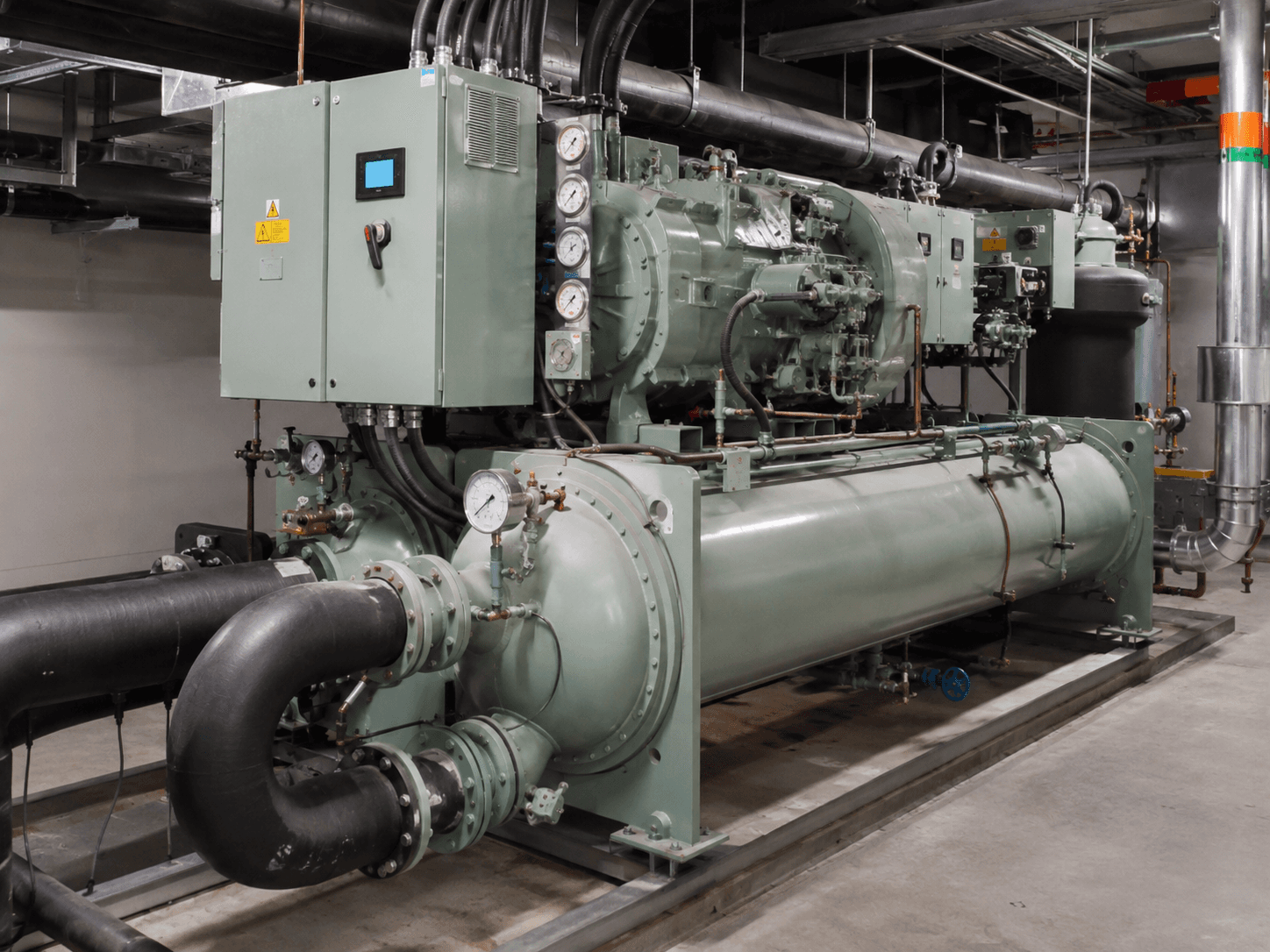
Introduction to Water-Cooled Reciprocating Chillers
A water cooled reciprocating chiller is a refrigeration system that produces chilled water using a reciprocating compressor. Heat absorbed from the chilled-water circuit is transferred to a condenser-water circuit and rejected through a cooling tower or another suitable heat-rejection system.
The chilled water can be circulated through air handling units, fan coil units, production equipment, process heat exchangers, laser systems, moulding machines or other temperature-sensitive equipment.
A reciprocating compressor chiller is commonly selected for small- to medium-capacity applications requiring:
Stable chilled-water temperatures
Flexible compressor staging
Straightforward maintenance
Process-specific configurations
Low-temperature water or glycol cooling
Multiple cooling capacity options
Zenvent Engineering supplies both standard and customised water-cooled chiller systems for commercial and industrial requirements.
01
Reciprocating Chiller vs Other Chiller Technologies
A reciprocating chiller uses pistons moving inside compressor cylinders to compress refrigerant. This differs from scroll, screw and centrifugal chiller technologies.
A water cooled screw chiller uses rotating screw rotors and is generally selected for larger continuous cooling loads. A scroll chiller commonly serves smaller comfort-cooling or modular applications. Centrifugal chillers are normally used in high-capacity central cooling plants.
A recip chiller is suitable where moderate cooling capacity, staged compressor operation, process flexibility and serviceable compressor construction are important.
The correct chiller technology depends on:
Required cooling capacity
Minimum and maximum cooling load
Chilled-water temperature
Process operating schedule
Available electrical supply
Condenser-water arrangement
Installation space
Maintenance requirements
Future expansion plans
Zenvent Engineering evaluates these conditions before recommending a suitable industrial water chiller.
02
Water-Cooled vs Air-Cooled Reciprocating Chiller
A water-cooled reciprocating chiller transfers heat to condenser water, which is normally connected to a cooling tower. An air cooled reciprocating chiller rejects heat directly into outdoor air through condenser coils and fans.
Water-cooled chillers are suitable for facilities requiring:
Efficient condenser heat rejection
Indoor chiller installation
Long operating hours
Stable performance in high ambient conditions
Centralised cooling-tower operation
Air-cooled systems may be preferred where water availability, cooling-tower space or condenser-water infrastructure is limited.
Zenvent Engineering can evaluate whether a water-cooled water chiller, air cooled water chiller or another chiller configuration best suits the project.
Working Principle and Refrigeration Cycle
A water-cooled reciprocating chiller operates through a closed refrigeration cycle. The refrigerant continuously absorbs heat from the chilled water and releases that heat into the condenser-water circuit.
01
Evaporation Process
Warm return water enters the chiller evaporator. Low-pressure refrigerant absorbs heat from the water and changes into vapour.
As heat is removed, the water temperature decreases. The cooled water then returns to the building, process equipment or chilled-water storage system.
02
Compression Process
The refrigerant vapour enters the reciprocating compressor.
Inside the compressor:
The piston moves downward and draws refrigerant vapour into the cylinder.
The suction valve closes.
The piston moves upward and compresses the refrigerant.
The discharge valve opens.
High-pressure refrigerant leaves the cylinder.
A multi-cylinder water chiller compressor can use several pistons to provide the required cooling capacity.
03
Condensation Process
The high-pressure refrigerant enters the water-cooled condenser.
Condenser water absorbs heat from the refrigerant. As the refrigerant loses heat, it changes from vapour into liquid.
The heated condenser water then flows to the cooling tower, where the absorbed heat is released into the atmosphere.
04
Refrigerant Expansion
The liquid refrigerant passes through an expansion device. Its pressure and temperature decrease before it returns to the evaporator.
The refrigeration cycle continues until the chilled-water supply reaches the required set point.
05
Recirculating Water Chiller Operation
A recirculating water chiller continuously circulates chilled water between the chiller and the cooling application.
This arrangement provides:
Stable process temperature
Continuous water circulation
Controlled supply temperature
Reduced temperature variation
Improved equipment protection
Consistent production conditions
A recirculating system may include a water chiller tank, circulating pump, buffer tank, expansion tank and temperature controller.
Main Components of the Chiller System
The performance of a water-cooled reciprocating chiller depends on the correct selection and coordination of its mechanical, refrigeration, electrical and water-side components.
01
Reciprocating Compressor
The reciprocating compressor is the main refrigeration component.
It may include:
Semi-hermetic reciprocating compressor
Open-type reciprocating compressor
Multiple-cylinder compressor
Single- or multi-compressor arrangement
Staged capacity control
Unloader-based capacity control
A multi-compressor arrangement allows the system to match cooling output with changing demand.
02
Chiller Evaporator
The evaporator transfers heat from the chilled-water circuit to the refrigerant.
Common evaporator configurations include:
Shell-and-tube evaporator
Brazed-plate heat exchanger
Tank-type evaporator
Direct-expansion evaporator
Flooded evaporator
The evaporator is selected according to chilled-water flow, leaving-water temperature, pressure drop and process requirements.
03
Water-Cooled Condenser
The condenser transfers refrigerant heat to the condenser-water circuit.
A shell-and-tube condenser is commonly used in industrial water-cooled chiller systems because it provides effective heat transfer and allows planned tube cleaning.
Correct condenser-water flow is essential for reliable compressor operation.
04
Chilled-Water Pump
The chilled-water pump circulates cooled water between the chiller and the cooling application.
Depending on the system design, the installation may include:
Primary chiller pump
Secondary chilled-water pump
Process circulation pump
Duty and standby pumps
Variable-speed pump
05
Condenser-Water Pump
The condenser-water pump circulates water between the condenser and the cooling tower.
The pump must be selected according to:
Required condenser-water flow
Pipe pressure loss
Condenser pressure drop
Cooling tower elevation
Valve and fitting losses
06
Cooling Tower System
A water-cooled chiller system normally rejects heat through a cooling tower.
A complete cooling tower and chiller arrangement may include:
Cooling tower
Condenser-water pump
Make-up water connection
Blowdown system
Water-treatment system
Chemical dosing system
Strainers
Isolation valves
Balancing valves
Temperature sensors
07
Water Chiller Tank
A water chiller tank stores chilled water and increases the total water volume in the system.
It can help:
Stabilise chilled-water temperature
Reduce rapid compressor cycling
Manage changing process loads
Maintain continuous water circulation
Improve temperature control
08
Expansion Tank
The expansion tank accommodates changes in water volume caused by temperature variation.
Correct sizing protects piping, pumps and heat exchangers from excessive system pressure.
09
Glycol Cooling System
A glycol cooling system uses a mixture of water and glycol to reduce freezing risk and support lower operating temperatures.
Glycol for chiller systems may be required for:
Low-temperature process cooling
Outdoor piping
Cold storage
Industrial production
Laser equipment
Seasonal shutdown protection
The correct glycol concentration must be calculated according to the required fluid temperature and environmental conditions.
10
Chiller Control Panel
The control panel manages compressor operation, pump control, temperature regulation and system protection.
A modern control system may monitor:
Chilled-water supply temperature
Chilled-water return temperature
Condenser-water temperature
Refrigerant pressure
Compressor current
Water flow
Pump status
Operating hours
Active alarms
Safety shutdowns
Key Features and Technical Specifications
Zenvent Engineering configures each reciprocating liquid chiller according to the project’s cooling load, water temperature and operating conditions.
01
Custom Cooling Capacity
Cooling capacity can be selected for small, medium or larger process requirements.
Depending on technical feasibility and application, project requirements may include:
1 ton water chiller
3 ton water chiller
3 ton water cooled chiller
Water chiller 5 ton
5 ton water cooled chiller
10 ton water chiller
Water chiller 10 ton
10 ton water cooled chiller
20 ton water chiller
20 ton water cooled chiller
30 ton water chiller
50 ton water chiller
The final selection is based on actual heat load rather than nominal tonnage alone.
02
Single- and Multi-Compressor Configurations
A reciprocating chiller can use one or more compressors.
Multi-compressor arrangements provide:
Staged capacity control
Improved low-load operation
Reduced compressor cycling
Operational flexibility
Partial cooling availability during service
03
Custom Leaving-Water Temperature
Zenvent Engineering can configure systems for:
Standard comfort-cooling temperatures
Industrial process cooling
Cold water chiller applications
Low-temperature water chiller operation
Glycol-based cooling
Specialised production requirements
04
Compact and Packaged Construction
A compact water chiller can combine the compressor, evaporator, condenser, pump, tank and controls within a coordinated package.
Packaged construction can simplify:
Equipment installation
Pipe connections
Electrical integration
Service access
Site commissioning
05
Heavy-Duty Construction
A heavy-duty water-cooled chiller for tropical conditions can be designed with suitable compressor capacity, condenser selection, electrical protection and water-side components.
This is important for industrial facilities operating under high cooling demand and challenging environmental conditions.
06
Refrigerant Options
Refrigerant selection depends on equipment design, cooling temperature, operating pressure and project requirements.
Zenvent Engineering considers:
Compressor compatibility
Environmental requirements
Refrigerant availability
Safety classification
Operating temperature
Service requirements
07
Electrical and Control Options
Available control and electrical features may include:
PLC control
Digital temperature display
Compressor sequencing
Pump interlocks
Cooling tower interlocks
Phase protection
Overload protection
High- and low-pressure safety
Water-flow protection
Remote start and stop
Alarm output
BMS communication
Cooling Capacity and Performance Options
Correct cooling-load calculation is essential for reliable chiller performance.
Zenvent Engineering evaluates both peak and normal operating conditions before selecting the chiller.
01
Process Heat-Load Assessment
Industrial cooling-load calculations may consider:
Machine heat output
Product cooling requirements
Water flow rate
Required temperature reduction
Batch production cycle
Continuous production load
Ambient heat gain
Tank volume
Piping heat gain
Future process expansion
02
Commercial Cooling-Load Assessment
Commercial chilled water air conditioning calculations may consider:
Building area
Occupancy
Lighting load
Equipment heat load
Fresh-air requirements
Solar heat gain
Operating schedule
Required redundancy
03
Small and Compact Chiller Applications
A mini water chiller, small water chiller or portable water chiller may be used for:
Individual machines
Laboratory equipment
Small tanks
Test equipment
Laser systems
Medical equipment
Limited process loads
Portable water chillers for industrial applications should still be selected according to actual water temperature, pump pressure and heat load.
04
Medium-Capacity Process Applications
Applications requiring a 5 ton, 10 ton or 20 ton water chiller may include:
Manufacturing machinery
Plastic processing
Printing equipment
Food processing
Production lines
Commercial air conditioning
Process tanks
05
Larger Industrial Cooling Systems
Requirements involving a 30 ton or 50 ton water chiller may require:
Multiple compressors
Larger shell-and-tube heat exchangers
Dedicated cooling towers
Primary and secondary pumps
Advanced control panels
Equipment sequencing
Standby capacity
Zenvent Engineering evaluates whether reciprocating, screw or another chiller technology is most suitable for larger capacities.
Energy Efficiency and Operational Benefits
A correctly selected and maintained water-cooled reciprocating chiller can provide dependable and efficient cooling for commercial and industrial applications.
01
Efficient Heat Rejection
Water-cooled condensers can maintain efficient refrigerant condensation when paired with a correctly selected cooling tower and condenser-water system.
This can support reliable operation during high ambient temperatures.
02
Compressor Staging
Multiple compressors or cylinder unloaders allow the chiller to reduce capacity during lower cooling demand.
Staged operation can help:
Reduce unnecessary compressor power
Maintain stable water temperature
Reduce rapid cycling
Match changing process loads
Balance compressor operating hours
03
Stable Process Temperature
An energy-efficient reciprocating chiller for process cooling helps maintain controlled water temperature for production equipment.
Stable water temperature can improve:
Production consistency
Equipment reliability
Product quality
Machine operating conditions
Process repeatability
04
Flexible System Design
A custom water-cooled reciprocating chiller system can be configured with different:
Compressor quantities
Water pumps
Tank capacities
Evaporator types
Condenser sizes
Control options
Glycol concentrations
Piping materials
05
Maintainable Compressor Technology
Reciprocating compressors provide accessible mechanical construction for planned inspection and service.
Depending on compressor design, maintenance may include valve replacement, gasket replacement, motor inspection and internal component servicing.
06
Reliable Operation in Industrial Conditions
A heavy-duty industrial water cooled chiller can be designed for:
Extended operating hours
Variable production loads
High ambient temperatures
Low-temperature processes
Dusty industrial environments
Frequent start and stop cycles
07
Centralised Cooling Supply
A chilled water system can serve multiple machines, process lines or building zones from one central chiller plant.
Centralised cooling supports:
Consolidated maintenance
Common temperature control
Reduced equipment duplication
Central alarm monitoring
Future capacity expansion
Industrial and Commercial Applications
Zenvent Engineering provides water-cooled reciprocating chiller solutions for a broad range of applications.
01
Manufacturing Plants
The best reciprocating water chiller for manufacturing plants should be selected according to process heat load, required water temperature and operating hours.
Applications can include:
Plastic moulding machines
Hydraulic systems
CNC machinery
Production lines
Welding equipment
Packaging equipment
Printing machines
Industrial tanks
02
Industrial Process Cooling
An industrial process cooling chiller removes heat from production equipment and process fluids.
A water-cooled reciprocating chiller for industrial applications can support:
Pharmaceutical production
Food and beverage processing
Chemical production
Electronics manufacturing
Metal processing
Laboratory processes
Industrial machinery
03
Commercial Air Conditioning
A commercial water-cooled chiller with reciprocating compressor can provide chilled water for air handling units and fan coil units.
Applications include:
Office buildings
Hotels
Hospitals
Educational buildings
Commercial complexes
Retail facilities
Community buildings
04
Laser Cooling
A laser water chiller maintains the operating temperature of laser equipment and related optical components.
Laser chiller applications require:
Stable chilled-water temperature
Correct pump pressure
Clean water circuit
Continuous circulation
Reliable alarms
Protection against overheating
Zenvent Engineering can configure a chiller laser cooling system according to the machine’s heat load and water-quality requirements.
05
Low-Temperature Cooling
Low temp chillers are used where water or glycol must operate below standard comfort-cooling temperatures.
Applications include:
Cold storage processes
Chemical production
Laboratory testing
Food processing
Product cooling
Specialised industrial machinery
06
Tank Cooling
A chiller for water tank applications can circulate cooled water through the tank directly or through a separate heat exchanger.
Tank cooling is used in:
Process storage
Food production
Chemical mixing
Aquatic systems
Industrial washing
Temperature-controlled testing
07
Recirculating Equipment Cooling
A recirculating water chiller can cool equipment that requires continuous water flow.
Applications include:
Lasers
Welding systems
Medical devices
Analytical equipment
Printing machines
Laboratory instruments
Production equipment
08
Specialised Chiller Replacement
Zenvent Engineering can evaluate requirements involving existing carrier water cooled chiller, Trane water cooled chiller, Daikin water chiller, Carrier reciprocating chiller, Trane reciprocating chiller, York reciprocating chiller or Voltas water cooled reciprocating chiller systems.
The assessment can cover:
Existing capacity
Compressor condition
Refrigerant circuit
Heat exchanger condition
Control system
Water flow
Equipment dimensions
Replacement feasibility
Installation and System Integration Requirements
Correct installation is essential for stable cooling performance and long equipment life.
Zenvent Engineering provides reciprocating chiller installation and maintenance services for new and existing facilities.
01
Equipment Location
The chiller should be installed on a level and structurally suitable base.
The plant-room layout should provide:
Compressor service access
Condenser tube-cleaning clearance
Control-panel access
Pump maintenance space
Safe electrical access
Proper drainage
Ventilation
Equipment replacement access
02
Chilled-Water Piping
The chilled-water piping system may include:
Supply and return pipes
Chilled-water pump
Isolation valves
Balancing valves
Flexible connections
Strainers
Temperature gauges
Pressure gauges
Flow switches
Air vents
Drain points
Pipe insulation
03
Condenser-Water Piping
The condenser-water circuit connects the chiller condenser to the cooling tower.
The installation may include:
Condenser-water pump
Cooling tower
Isolation valves
Strainers
Balancing valves
Non-return valves
Temperature sensors
Chemical dosing connections
Blowdown arrangement
04
Cooling Tower Integration
The cooling tower must be selected according to the total heat-rejection load and design conditions.
Correct integration requires:
Adequate condenser-water flow
Correct pump selection
Effective water distribution
Proper tower ventilation
Water-treatment provision
Chiller and tower interlocks
05
Water Treatment
Condenser-water treatment helps control:
Scale
Corrosion
Biological growth
Sediment
Heat-exchanger fouling
Poor water treatment can reduce chiller efficiency and damage condenser tubes.
06
Glycol System Integration
For low-temperature applications, the system may require glycol for chilled water systems.
The design must consider:
Glycol percentage
Pump performance
Reduced heat-transfer efficiency
Material compatibility
Expansion tank sizing
Freeze protection
Pipe insulation
07
Electrical Installation
Electrical integration may include:
Incoming power supply
Isolator
Compressor starter
Overload protection
Phase protection
Control transformer
Pump starters
Cooling tower controls
Earthing
Emergency stop
08
Testing and Commissioning
Commissioning can include:
Equipment inspection
Piping pressure testing
System flushing
Water-flow verification
Pump rotation checking
Cooling tower inspection
Electrical connection verification
Refrigerant pressure checks
Compressor operation checks
Temperature-control testing
Alarm testing
Safety-control testing
Performance observation
Maintenance, Controls and Safety Features
Regular maintenance helps preserve chiller capacity, energy efficiency and operating reliability.
01
Preventive Maintenance
Preventive chiller maintenance may include:
Compressor inspection
Refrigerant pressure checks
Refrigerant leak inspection
Oil-level inspection
Motor current measurement
Condenser inspection
Evaporator inspection
Water-flow verification
Pump inspection
Cooling tower inspection
Electrical terminal tightening
Control-panel inspection
Sensor verification
Alarm-history review
02
Reciprocating Compressor Maintenance
Reciprocating compressor maintenance may include:
Compressor oil inspection
Suction and discharge valve assessment
Cylinder-head inspection
Gasket inspection
Motor winding testing
Crankcase heater checking
Vibration monitoring
Operating-pressure analysis
03
Condenser Tube Cleaning
Scale and deposits inside condenser tubes reduce heat transfer and increase compressor operating pressure.
Planned condenser tube cleaning helps:
Improve heat rejection
Reduce compressor load
Maintain cooling capacity
Control energy consumption
Protect compressor components
04
Evaporator Cleaning
Evaporator fouling can reduce chilled-water cooling performance.
Cleaning frequency depends on water quality, system design and operating conditions.
05
Refrigerant Leak Detection
Refrigerant leaks can cause:
Reduced cooling capacity
Low-pressure shutdown
Compressor overheating
Increased operating time
Equipment damage
Leaks should be identified and repaired before refrigerant is added.
06
Chiller Control Features
Available controls may include:
Digital temperature control
Automatic compressor staging
Pump interlocks
Cooling tower interlocks
Remote start and stop
Operating-hour display
Alarm history
BMS connection
Temperature data logging
07
Safety Protection
Safety features can include:
High-pressure protection
Low-pressure protection
Compressor overload protection
Phase-failure protection
Reverse-phase protection
Low-water-flow protection
Freeze protection
High-discharge-temperature protection
Emergency shutdown
08
Chiller Repair
Chiller repair services may address:
Compressor faults
Refrigerant leaks
Control problems
Sensor failures
Water-flow alarms
High-pressure trips
Low-pressure trips
Pump problems
Cooling tower faults
Electrical failures
09
Existing Chiller Replacement
Used water cooled chillers or ageing reciprocating chillers may develop repeated failures, refrigerant limitations or high operating costs.
Existing chiller replacement can include:
Cooling-load reassessment
Replacement chiller selection
Pipe modification
Electrical modification
Control integration
Equipment removal
New installation
Testing and commissioning
Why Choose Zenvent Engineering?
Zenvent Engineering provides complete technical support for industrial and commercial reciprocating chiller projects.
Our services include:
Water-cooled reciprocating chiller manufacturing
Industrial water-cooled reciprocating chiller supply
Cooling-load assessment
Custom system design
Chiller equipment selection
Chilled-water piping
Condenser-water piping
Pump installation
Cooling tower integration
Glycol cooling systems
Electrical installation
Control-panel integration
Testing and commissioning
Preventive maintenance
Compressor servicing
Chiller repair
Existing chiller replacement
01
Custom-Engineered Solutions
Every cooling project has different temperature, flow, capacity and operating requirements.
Zenvent Engineering designs each custom water-cooled reciprocating chiller system according to the actual application rather than relying on a standard configuration for every project.
02
Commercial and Industrial Capability
We provide solutions for both commercial water chiller and industrial water chiller requirements.
Our engineering approach considers:
Process reliability
Energy performance
Maintainability
Safety
Future expansion
Local operating conditions
03
Complete Project Execution
Zenvent Engineering can manage the complete project from technical selection to final commissioning.
This coordinated approach helps reduce interface problems between the chiller, pumps, piping, cooling tower, electrical system and controls.
04
Maintenance and Service Support
Our reciprocating chiller installation and maintenance services help maintain system reliability after commissioning.
Scheduled maintenance supports:
Stable cooling capacity
Reduced breakdown risk
Improved compressor life
Better heat-transfer performance
Safer system operation
05
Water-Cooled Reciprocating Chiller Price in India
Water-cooled reciprocating chiller price in India depends on the complete technical configuration.
Important cost factors include:
Cooling capacity
Compressor quantity
Refrigerant selection
Evaporator type
Condenser size
Pump capacity
Water tank volume
Cooling tower scope
Glycol requirements
Control system
Electrical installation
Piping work
Commissioning requirements
Zenvent Engineering prepares a project-specific solution based on the required cooling performance and installation scope.
Contact Zenvent Engineering for an industrial water-cooled reciprocating chiller engineered for dependable process cooling, commercial air conditioning and long-term operation.
Frequently Asked Questions
A water-cooled reciprocating chiller is a refrigeration system that uses a piston-type compressor to produce chilled water. Heat is transferred to condenser water and normally rejected through a cooling tower.